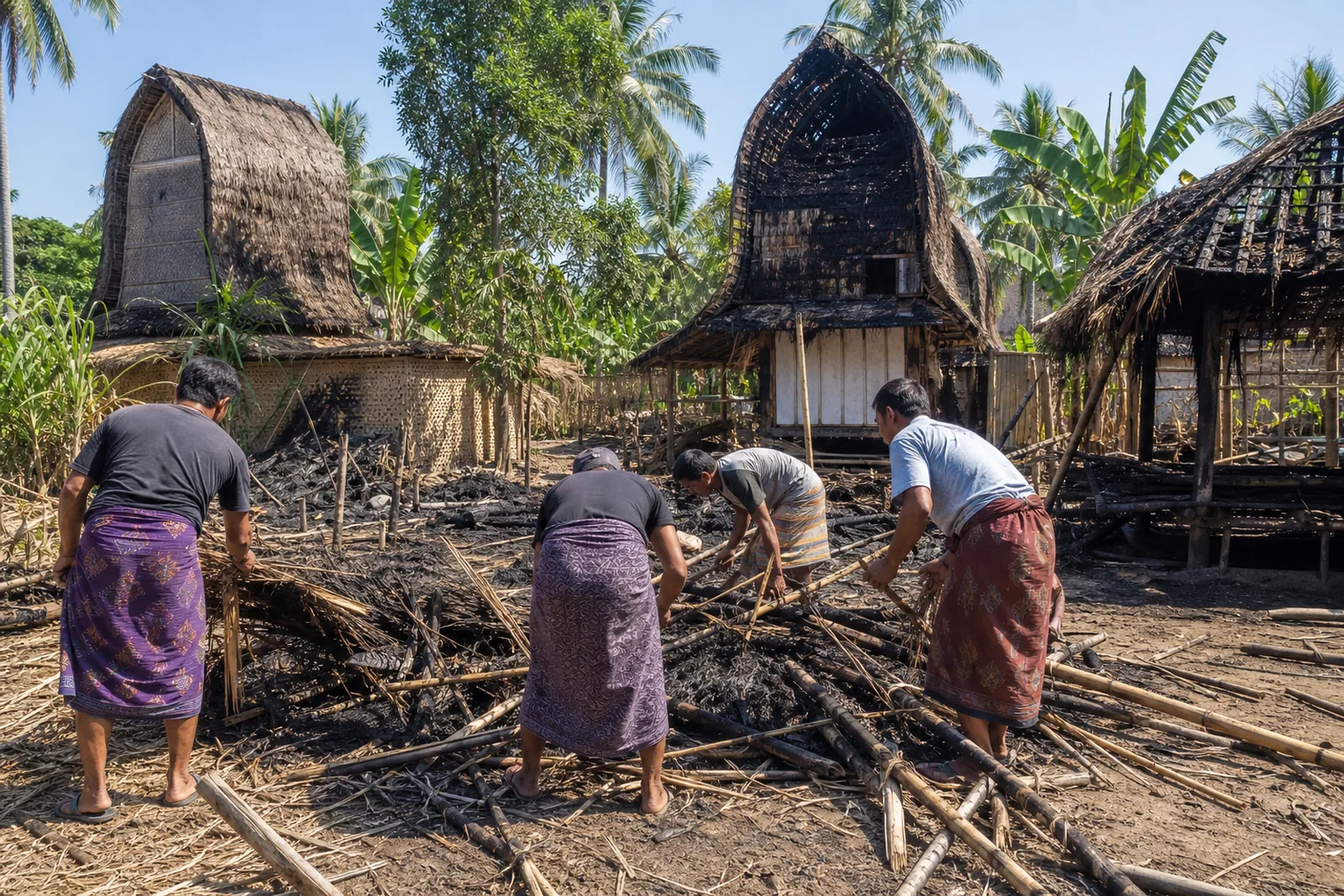
Daily Dispatch: Task Force Mobilised After Sade Village Fire
A task force is coordinating recovery after fire devastated Sade Traditional Village, putting heritage restoration and local livelihoods at the centre of Lombok’s response.
Quick answer: A provincial task force has been formed to coordinate recovery after a fire devastated Sade Traditional Village on Lombok, destroying homes, a mosque, granaries, craft shops and tourism infrastructure. For investors, the immediate significance is operational: watch how relief, rehabilitation and heritage restoration are coordinated before drawing wider conclusions about local tourism or property demand.
This is a live local emergency with consequences that reach beyond physical damage. Sade is a historic traditional village and a cultural landmark; the official response now combines urgent resident support with the longer work of restoring housing, livelihoods and visitor-facing infrastructure.
The Context
Officials in Indonesia’s West Nusa Tenggara province have established a dedicated task force after a major fire struck Sade Traditional Village on Lombok Island. The blaze broke out on Saturday evening and, according to the regional Disaster Mitigation Agency, or BPBD, caused extensive destruction across the village.
The reported losses are stark. The fire destroyed 75 traditional homes, a mosque, eight thatched-roof granaries and nearly 70 local craft shops. It also destroyed traditional wooden gathering pavilions, known as berugak, and public tourism infrastructure.
Approximately 320 residents across 120 families were displaced, according to BPBD.
Central Lombok Regency authorities estimate total damage at 35 billion rupiah ($2.1 million), although provincial agencies are still conducting a formal assessment. That distinction matters: the local estimate offers an early indication of the scale of loss, but it is not yet the final provincial assessment.
For a place whose built fabric, craft activity and visitor infrastructure are intertwined, the damage cannot be reduced to a single balance-sheet line. Homes, shops, communal spaces and tourism facilities have all been affected. The immediate question is therefore not simply reconstruction, but how recovery is sequenced so that residents can regain safety, shelter and a route back to normal economic activity.
Emergency teams have set up tents, tarpaulins and relief supplies on site. Governor Lalu Muhamad Iqbal said the provincial government would cover basic necessities and fund the education of affected children during the recovery phase.
Recovery Coordination Takes Shape
The task force was formed following direct orders from Governor Iqbal. Its purpose is to coordinate relief efforts and accelerate restoration of the cultural landmark, rather than leave rehabilitation dispersed across individual agencies.
BPBD chief Sadimin described the mandate plainly:
“The team's primary responsibility is to accelerate recovery, coordinate rehabilitation plans, and delegate tasks across relevant government agencies.”
That is the central development in this dispatch. A task force creates a formal mechanism for moving from emergency response to rehabilitation planning. Its effectiveness will depend on execution, including how responsibilities are allocated across the relevant agencies and how quickly the needs of displaced residents are translated into housing restoration and support for affected livelihoods.
Governor Iqbal has also set out the immediate priorities: resident safety first, followed by assistance extending beyond emergency shelter. His stated commitments include food security, clothing and housing restoration for affected families, alongside support for children’s education.
The source does not provide a reconstruction timetable, a final damage assessment, or a detailed funding plan. Investors and observers should resist filling those gaps with assumptions. At this stage, the verified facts are that emergency support is in place, a dedicated coordination structure has been created, and authorities have publicly committed to a recovery process that addresses both immediate welfare and longer-term restoration.
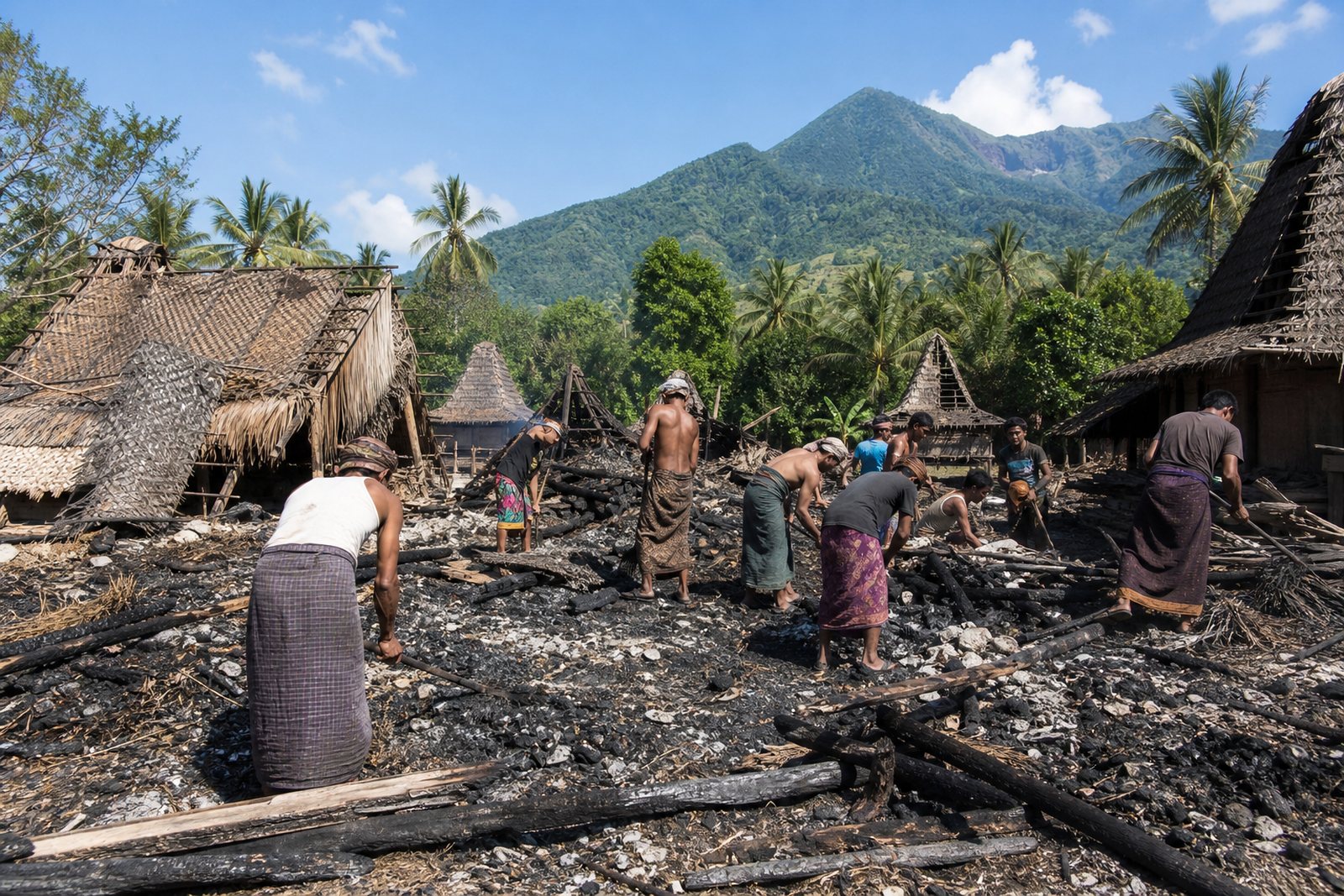 Daily Dispatch · Illustration: HubLombok (AI-generated)
A Heritage and Livelihoods Test
Sade’s recovery presents a dual challenge. It is a historic traditional village, but it is also a working local economy. Nearly 70 local craft shops were destroyed, while public tourism infrastructure and communal structures were also lost. The recovery process must therefore contend with both household displacement and the interruption of commercial activity connected to the village.
For investors who follow Lombok’s visitor economy, this is the relevant lens. The event is not evidence of a broad market shift; the source provides no basis for such a claim. It is, however, a material local disruption in a cultural destination, with the resilience of the response likely to shape the pace at which normal activity can resume.
Three points merit close attention as official assessments progress:
- Safety and shelter: approximately 320 residents have been displaced, making the adequacy and continuity of emergency support the first test.
- Restoration of livelihoods: the loss of craft shops means recovery concerns household income as well as buildings and infrastructure.
- Quality of coordination: the task force has been asked to coordinate rehabilitation and assign responsibilities across agencies; its delivery will be more informative than early announcements alone.
There is also a reputational dimension, though it should be treated carefully. Sade is described by officials as a cultural landmark. Its restoration is therefore likely to be judged not only by the replacement of structures, but by whether the recovery respects the village’s traditional character and supports the residents whose homes and businesses were affected.
The source reports that provincial agencies are still conducting their formal assessment. Until that work is complete, the early 35 billion rupiah ($2.1 million) damage estimate should be read as provisional. Nor does the report state whether restoration will occur in phases, what specific tourism infrastructure will be rebuilt first, or how craft businesses will be supported beyond the immediate relief response.
What This Means for Investors
The disciplined investor response is to separate humanitarian urgency from market inference. The first concern is the safety and recovery of affected residents. The second is the practical question of how quickly the authorities can restore the physical, cultural and commercial functions damaged by the fire.
For those with exposure to Lombok’s tourism-linked economy, the news creates a short monitoring list rather than an investable conclusion. Track the formal damage assessment, the task force’s rehabilitation plan, the restoration of public tourism infrastructure, and the reopening or replacement of affected craft businesses. Each will provide better evidence about the recovery trajectory than early sentiment.
A useful distinction is between what has been confirmed and what remains unresolved:
| Confirmed in the official report | Still to be established | | --- | --- | | A task force has been established. | The final formal damage assessment. | | Emergency tents, tarpaulins and relief supplies are on site. | A reconstruction timetable. | | Basic necessities and education support have been pledged. | Detailed rehabilitation and funding arrangements. | | Homes, shops and tourism infrastructure were destroyed. | The pace at which normal village activity can resume. |
For prospective investors considering assets connected to local tourism flows, this is also a reminder that destination analysis must include operational resilience. Cultural assets can support the appeal of a wider area, but they are also vulnerable to disruptions that cannot be captured by a headline yield or a development brochure. Due diligence should account for the condition and continuity of the visitor ecosystem around an asset, not merely the asset itself.
The report offers no grounds to quantify the fire’s wider effect on Lombok tourism, investor returns or property values. Any such assertion would go beyond the available evidence. What can be said is narrower and more useful: a significant local cultural and economic site has suffered serious damage; public authorities have moved to coordinate a response; and the credibility of the recovery will now rest on tangible progress for displaced families, homes, businesses and heritage infrastructure.
Sade Village’s next chapter will be written in the transition from relief to restoration. For the market, the appropriate stance is sober attention: follow the verified updates, avoid extrapolation, and recognise that the quality of local recovery matters most first to the people whose lives and livelihoods were disrupted.
Stay informed, subscribe to the free Lombok Briefing for market intelligence like this, published twice a month.
What was destroyed in the Sade Traditional Village fire?
The fire destroyed 75 traditional homes, a mosque, eight thatched-roof granaries, nearly 70 local craft shops, traditional berugak gathering pavilions and public tourism infrastructure, according to the regional Disaster Mitigation Agency.
How many people were displaced by the Sade Village fire?
According to the regional Disaster Mitigation Agency, approximately 320 residents across 120 families were displaced by the fire at Sade Traditional Village on Lombok Island.
What should Lombok investors monitor after the Sade Village fire?
Investors should monitor the formal damage assessment, the task force’s rehabilitation plan, restoration of tourism infrastructure and support for affected craft businesses. The source does not establish a wider effect on Lombok tourism, property values or investment returns.

The Lombok Buyer's Field Guide
Legal structures ranked by risk, the honest ROI math line by line, all six zones ranked, and the 24-point due-diligence checklist. The whole book, free in your inbox.
See what's inside