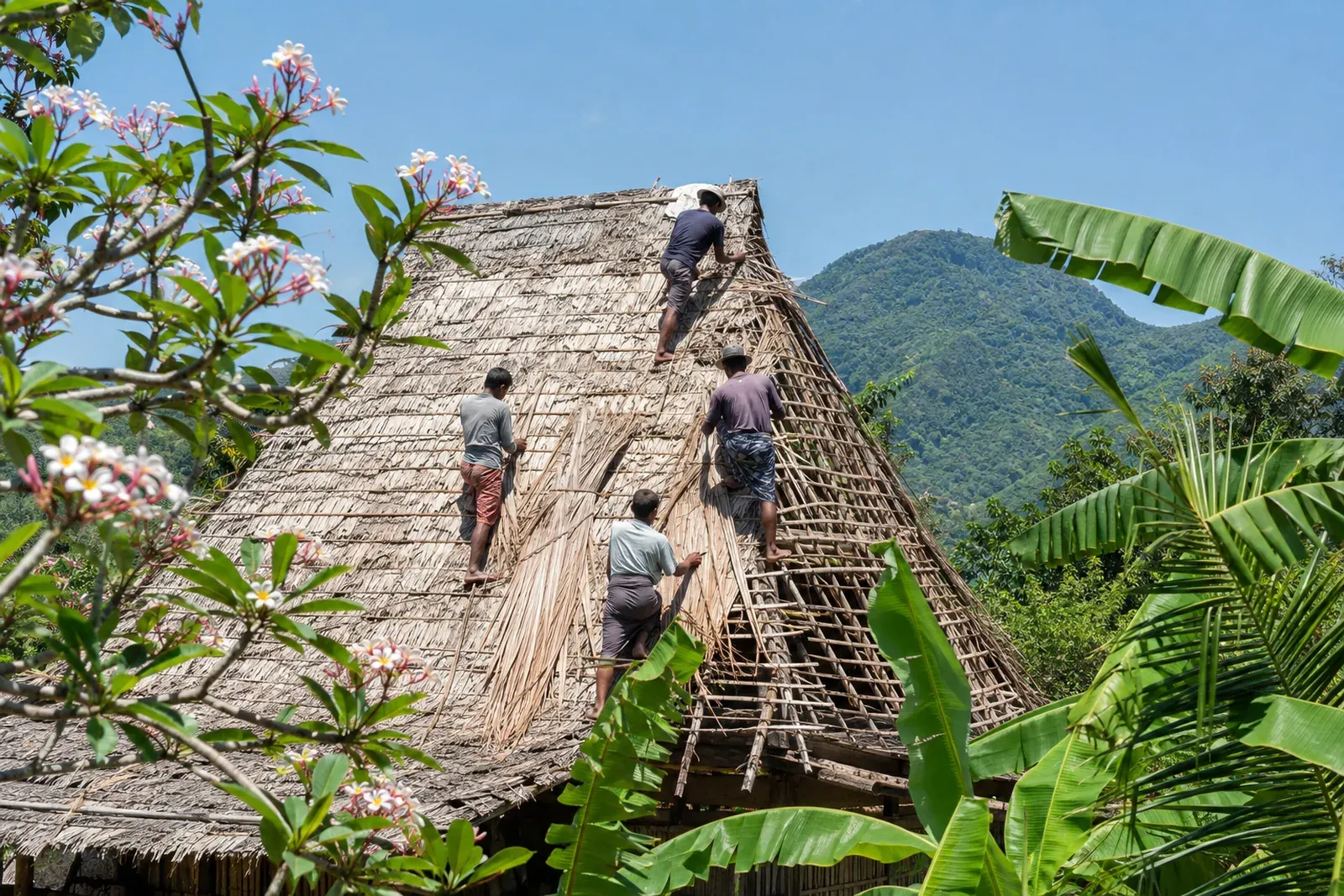
Sade Village Begins Careful Reconstruction After Devastating Fire
Sade Traditional Village has begun rebuilding Sasak homes and its mosque, with officials stressing patience, transparency and cultural preservation.
Sade Traditional Village in Central Lombok has begun rebuilding traditional Sasak homes and a mosque destroyed by fire, marked by the Nyemulak ritual. For investors following Lombok’s tourism economy, the project is a reminder that the island’s cultural assets require both careful stewardship and credible recovery planning.
A ceremonial start to a long rebuilding process
Residents performed Nyemulak, a first post-setting ceremony, to mark the start of construction. Central Lombok District Head Lalu Pathul Bahri said the timing was considered auspicious because it fell in the month commemorating the birth of the Prophet Muhammad.
The ceremony was more than a construction milestone. It represented a collective decision by residents of Sade Hamlet to begin restoring homes and community infrastructure after the fire. Lalu M. Faozal, coordinator of the Sade Traditional House Reconstruction, said residents had agreed on the day to start installing foundation posts for both the mosque and traditional homes.
The reconstruction has begun, but officials have made clear that completion will not happen all at once.
West Nusa Tenggara Governor Lalu M. Iqbal described Nyemulak as the beginning of a long-term rebuilding effort. His emphasis on patience matters: a village whose appeal rests on living architecture, ritual and local identity cannot simply be reconstructed at speed without risking the qualities visitors come to experience.
The scale of the damage
The fire’s impact extended beyond residences. According to the reconstruction coordinator, it affected:
- 75 traditional homes
- Eight berugak, or gazebos
- Six sekenam structures
- One mosque
- Two toilets
- 69 shops
That combination illustrates why the recovery is both a cultural and an economic undertaking. Traditional homes are central to Sade’s character, while shops and visitor-facing activity support the daily livelihoods connected with the village’s tourism role.
Faozal said all construction had formally begun, though it would proceed through a safer reconstruction plan rather than through simultaneous rebuilding across every affected structure. The governor likewise said that the work should not be rushed.
For a destination such as Lombok, where cultural heritage is part of the visitor proposition, this distinction is important. Replacing physical buildings alone would not fully restore Sade’s value. The stated objective is to restore the village’s original character, including the Sasak architecture and rituals that distinguish it within West Nusa Tenggara.
Transparency is central to the recovery
Both provincial and district leaders focused on the governance of reconstruction as well as its physical delivery. Bahri praised donors for helping residents recover and resume normal activities, while saying reconstruction should remain transparent and comply with applicable regulations.
Governor Iqbal called for a task force and a joint bank account to manage donations transparently. He noted that many people wished to contribute and said incoming assistance should be collected through that structure.
Officials are framing transparent donation management as part of rebuilding public confidence alongside the village itself.
This is a practical point for anyone assessing the wider Lombok tourism ecosystem. Heritage recovery can bring together public authorities, residents, donors and businesses, but it also requires clear administration. The announced approach seeks to ensure that assistance supports community welfare and the preservation of a culturally significant place.
The governor also asked authorities to accelerate construction of a semi-permanent museum. The purpose, he said, is to enable residents to resume activities while allowing visitors to understand what Sade looked like during the period in which the area is closed for reconstruction.
Culture remains the asset being protected
Sade’s reconstruction is being presented as a cultural preservation project rather than a conventional building programme. Governor Iqbal said tourists visit to see structures that reflect Sasak culture and rituals practised in West Nusa Tenggara, and that the rebuilt village should retain that original character.
He described the initiative as West Nusa Tenggara’s first cultural preservation project. That framing places authenticity at the centre of the work. It also sets a standard by which the eventual reconstruction will be judged: not merely whether structures are rebuilt, but whether they continue to express the identity that made the village meaningful to residents and visitors alike.
For Lombok’s tourism narrative, Sade represents a form of destination value that is different from hotel inventory, transport links or resort development. It is a cultural experience rooted in a community. The temporary closure cited by the governor may limit access while rebuilding is under way, but the planned museum is intended to preserve a connection between visitors, residents and the village’s history during that period.
What this means for investors
The immediate story is one of recovery, not a new commercial development. Yet investors in Lombok’s visitor economy should watch how the reconstruction balances several priorities:
- Cultural integrity: The stated intention is to restore Sasak architectural character and ritual context, rather than pursue a hurried replacement programme.
- Community continuity: Homes, a mosque, sanitation facilities and shops were all affected, making recovery relevant to both daily life and visitor-facing activity.
- Operational transparency: The proposed task force and joint bank account are intended to provide a structured route for donations and oversight.
- Visitor access: Sade is closed while reconstruction proceeds, while a semi-permanent museum has been urged to help residents resume activities and maintain visitor understanding.
Lombok’s investment case includes tourism, but tourism depends on more than accommodation and scenery. Cultural places need resilient local stewardship, especially when they face disruption. The reconstruction of Sade will therefore be relevant not because it offers a short-term market metric, but because it tests how effectively one of the island’s recognised cultural assets can be restored in partnership with its residents.
The coming work will demand patience, as provincial leaders have acknowledged, but a faithful and transparent reconstruction could help safeguard Sade’s role in Lombok’s cultural landscape for the long term.
Stay informed, subscribe to the free Lombok Briefing for analysis like this, published twice a month.
What structures were affected by the fire in Sade Traditional Village?
The fire affected 75 traditional homes, eight berugak gazebos, six sekenam structures, one mosque, two toilets and 69 shops, according to Sade Traditional House Reconstruction Coordinator Lalu M. Faozal.
Why is Sade Village’s reconstruction significant for Lombok tourism?
Officials say visitors come to Sade to experience buildings, Sasak culture and rituals reflecting West Nusa Tenggara’s heritage. The reconstruction is intended to restore the village’s original character, making cultural preservation central to the recovery.
How will donations for Sade Village reconstruction be managed?
West Nusa Tenggara Governor Lalu M. Iqbal called for a task force and a joint bank account to collect and manage incoming assistance transparently. District officials also said reconstruction should comply with regulations and benefit the community.
The Lombok Buyer's Field Guide
Legal structures ranked by risk, the honest ROI math line by line, all six zones ranked, and the 24-point due-diligence checklist. The whole book, free in your inbox.
See what's inside