When the Rupiah Holds: Foreign Confidence Signals Firmer Ground for Lombok Investors
Rising foreign inflows into Indonesian rupiah securities signal strengthening macroeconomic confidence in Indonesia. For Lombok villa investors, that means reduced currency volatility and sustained to
Quick answer: Rising foreign investment in Indonesian rupiah securities (SRBI) signals strengthening macroeconomic confidence in Indonesia, reducing currency volatility risk for Lombok property investors and supporting the tourism demand thesis that underpins 7–12% net rental yields in the islands.
Indonesia rarely commands the front page of The Financial Times. Yet when Bank Indonesia's Governor reports rising foreign inflows into rupiah-denominated securities, it deserves your attention, particularly if you own, or are considering acquiring, a Lombok villa. Currency stability is the unglamorous foundation upon which every real estate return ultimately rests.
The Foundation: What SRBI Tells Us
Bank Indonesia Rupiah Securities (SRBI) are short-term debt instruments issued by the central bank, denominated in rupiah and typically held by foreign institutions seeking rupiah exposure without direct property or equity risk. When foreign central banks, sovereign wealth funds, and international investors increase their SRBI holdings, it signals confidence in Indonesia's macroeconomic trajectory and the rupiah's trajectory.
Bank Indonesia Governor Perry Warjiyo's recent remarks confirmed that foreign inflows into SRBI have been instrumental in stabilizing the rupiah against external shocks, a material point. The rupiah has historically been volatile during periods of global uncertainty, currency-carry unwinds, or when commodity prices (critical to Indonesia's export revenue) weaken. The fact that foreign investors are actively buying Indonesian government-backed rupiah instruments suggests they believe the currency will hold its value.
For context: the rupiah's strength or weakness directly affects the euro or Australian-dollar cost of owning South Lombok property. A weak rupiah makes your villa investment cheaper on purchase (good for entry). A strengthening rupiah boosts your unhedged return on exit. But unstable rupiah swings, especially sharp depreciations, erode buyer confidence and tourist arrivals, both of which compress Lombok villa valuations and yields.
Foreign Confidence as a Demand Signal
Rising foreign investment in rupiah securities is not merely a currency play; it is a bet on Indonesia's broader stability and growth. When international money managers allocate to SRBI, they are implicitly affirming that:
- Indonesia's macroeconomic policy framework is credible.
- The central bank has adequate foreign reserves and tools to manage volatility.
- Political and regulatory risk remains containable.
All three of these factors underpin tourism demand to Indonesia, and, by extension, to Lombok. The island's foreign-tourist arrivals have been climbing at 40–50% year-on-year, driven significantly by a "Bali-overflow" phenomenon: as Bali becomes more congested and expensive (Bali villa comparable specs command USD 400,000–800,000 versus South Lombok's EUR 95,000–350,000 entry range), international holidaymakers and digital nomads shift east to Lombok's cleaner beaches and earlier-cycle pricing.
Foreign investor confidence in Indonesia's currency and macroeconomic stability directly enables that tourism growth. When rupiah swings are wild or when Indonesia is perceived as politically unstable, booking patterns soften. Occupancy rates, already realistic at 55–70% in stabilised Lombok villas, would deteriorate further, compressing the gross rental yields that management companies quote to you (12–22%) and crushing the net yields (7–12% after fees) upon which investment decisions rest.
Conversely, when foreign money is flowing into SRBI and the rupiah is steady, tourists book with greater confidence, corporate travel to Indonesia (for meetings, conferences, incentive trips) increases, and villa occupancy rates trend toward the healthier end of the range.
What Rupiah Stability Means for Your Lombok Entry
Lombok's six investment zones, Kuta Mandalika, Selong Belanak, Tanjung Aan, Are Guling, Senggigi, and Gili Trawangan, each offer distinct yield and appreciation profiles. But all of them share a common vulnerability: currency risk. That risk is not theoretical.
In 2022–2023, when global interest rates rose sharply and the rupiah faced depreciation pressure, Lombok villa bookings did not collapse overnight, but inquiry rates from European and Australian buyers did soften noticeably. Developers reported slower lead conversion. Second-hand villa sales volumes dipped. The reason was simple: when the rupiah is unstable, foreign buyers either wait for better entry prices or redirect capital to perceived safer jurisdictions.
Conversely, periods of rupiah strength and foreign central-bank confidence (now signalled by rising SRBI inflows) tend to coincide with robust Lombok villa sales momentum. The MotoGP effect, the 2021 launch of the Mandalika Grand Prix circuit, accelerated Kuta Mandalika villa prices by approximately 38% year-on-year, partly because the event was coupled with a period of relative rupiah stability and rising foreign tourism.
Are Guling, the frontier zone where Samudra Villas operates, has posted the strongest momentum of any Lombok investment district, approximately 47% year-on-year, precisely because it combines early-cycle land pricing (around Rp 120–180 million per are, against Kuta Mandalika's Rp 300–400 million per are) with visible infrastructure investments and growing tourism connectivity. But that growth trajectory depends on sustained rupiah confidence and foreign tourist arrivals.
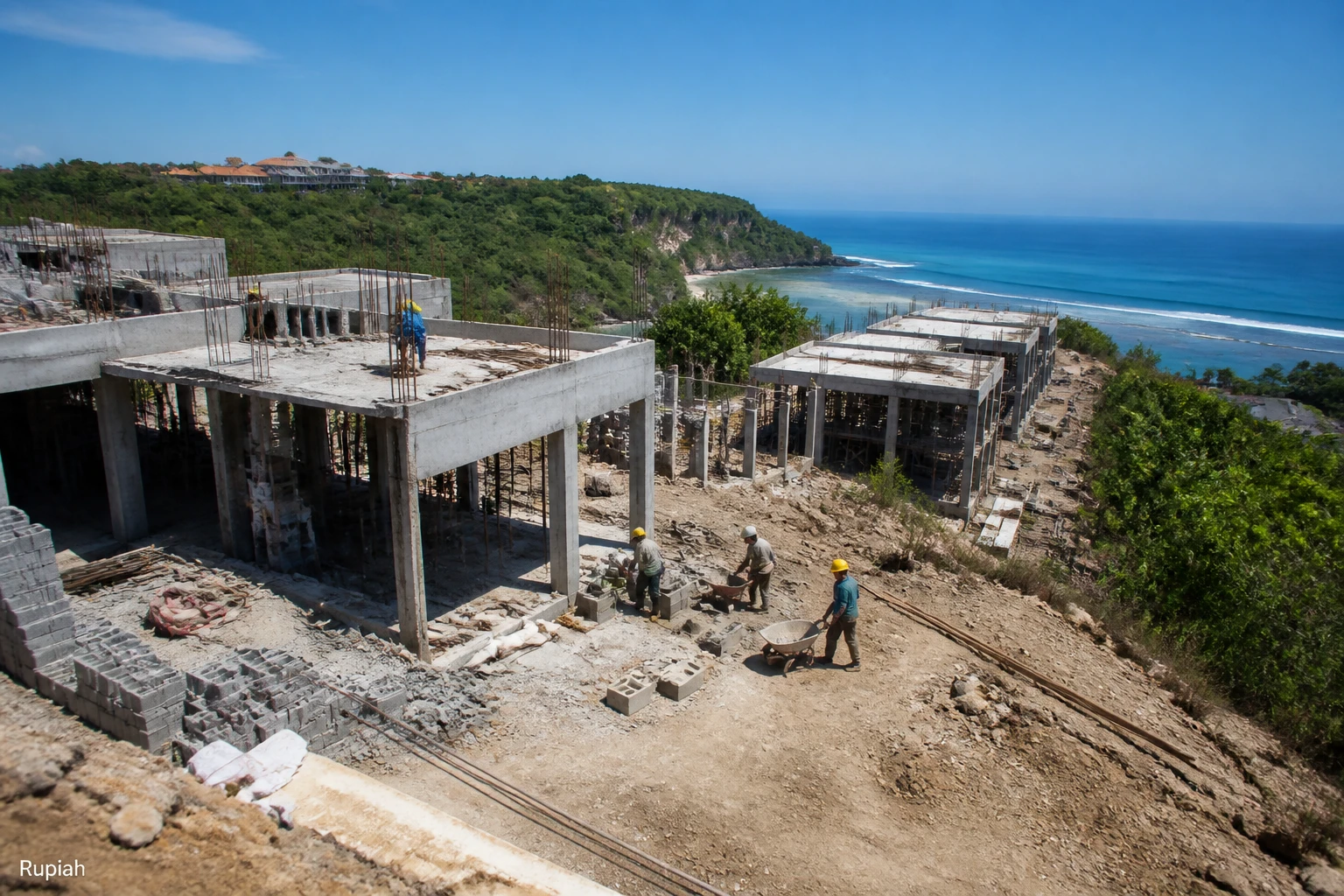
 When the Rupiah Holds · Illustration: HubLombok (AI-generated)
The Investor Implication: Risk Layers Aligning
When macroeconomic stability improves, risk premiums compress. Foreign investors demand lower yields to deploy capital into emerging-market currencies and assets. In practical terms, that means:
- Villa entry prices may appreciate more steadily (lower volatility encourages buy-and-hold mentality).
- Management companies can command higher occupancy rates and per-night rates, expanding the numerator in your yield calculation.
- Exit liquidity improves: when foreign confidence in Indonesia is high, onshore and offshore buyers alike are actively shopping for Lombok property.
The reverse is true during rupiah stress: pricing hesitation, occupancy pressure, and illiquidity.
Bank Indonesia's ability to stabilise the rupiah through SRBI inflows, and foreign central banks' willingness to hold those securities, removes a major tail risk from the Lombok investment thesis. It does not guarantee returns (occupancy still depends on marketing, villa condition, and location within each zone). But it de-risks the currency and macroeconomic foundation upon which tourism demand and property values rest.
What This Means for Investors
If you are evaluating Lombok villa entry or assessing your existing position, Perry Warjiyo's reported success in stabilising the rupiah through foreign SRBI inflows should register as a green flag, not a neutral data point. It signals:
- Currency risk is receding. A stable rupiah reduces the risk that your EUR or AUD-denominated investment is eroded by depreciating local currency.
- Tourism demand has structural support. Foreign investor confidence in Indonesia tends to correlate with sustained tourist arrivals and corporate travel, both drivers of occupancy and daily rates.
- Liquidity is likely to improve. When macroeconomic confidence is high, villa transaction volumes tend to increase, making exit easier should you need to rebalance.
- Competitive positioning vs. Bali strengthens. As Bali becomes saturated and expensive, Lombok's earlier-cycle profile, supported by improving macroeconomic stability, becomes more attractive to the European and Australian buyer base.
None of this negates the importance of doing granular due diligence: verifying villa titles (ensuring freehold is held through a credible PT PMA structure, never a nominee arrangement), understanding management fees (typically 18–22% of gross rental revenue), and selecting zones and properties with realistic 55–70% occupancy benchmarks in your first years.
But it does mean that the broader Indonesia macro story, the foundation upon which all Lombok asset values rest, is solidifying, not fraying.
Stay informed, subscribe to the free Lombok Briefing for market intelligence like this, published twice a month.
How do SRBI inflows affect my Lombok villa yield?
Rising foreign confidence in Indonesian rupiah (signalled by SRBI inflows) reduces currency volatility and supports tourism demand, which stabilises occupancy rates and daily rates, both critical to achieving 7–12% net rental yields.
Why is rupiah stability important for Lombok property?
A stable rupiah attracts foreign tourists and investors, driving occupancy and villa valuations. Rupiah depreciation risks soften buyer interest and compress yields; stability enables confident entry and stronger exit liquidity.
Does this improve Lombok's position against Bali?
Yes. Macroeconomic stability, coupled with Lombok's lower entry prices (EUR 95–350K vs. Bali's USD 400–800K), makes Lombok more attractive as Bali-overflow continues. Stable macro reduces the risk differential investors demand.

The Lombok Buyer's Field Guide
Legal structures ranked by risk, the honest ROI math line by line, all six zones ranked, and the 24-point due-diligence checklist. The whole book, free in your inbox.
See what's inside