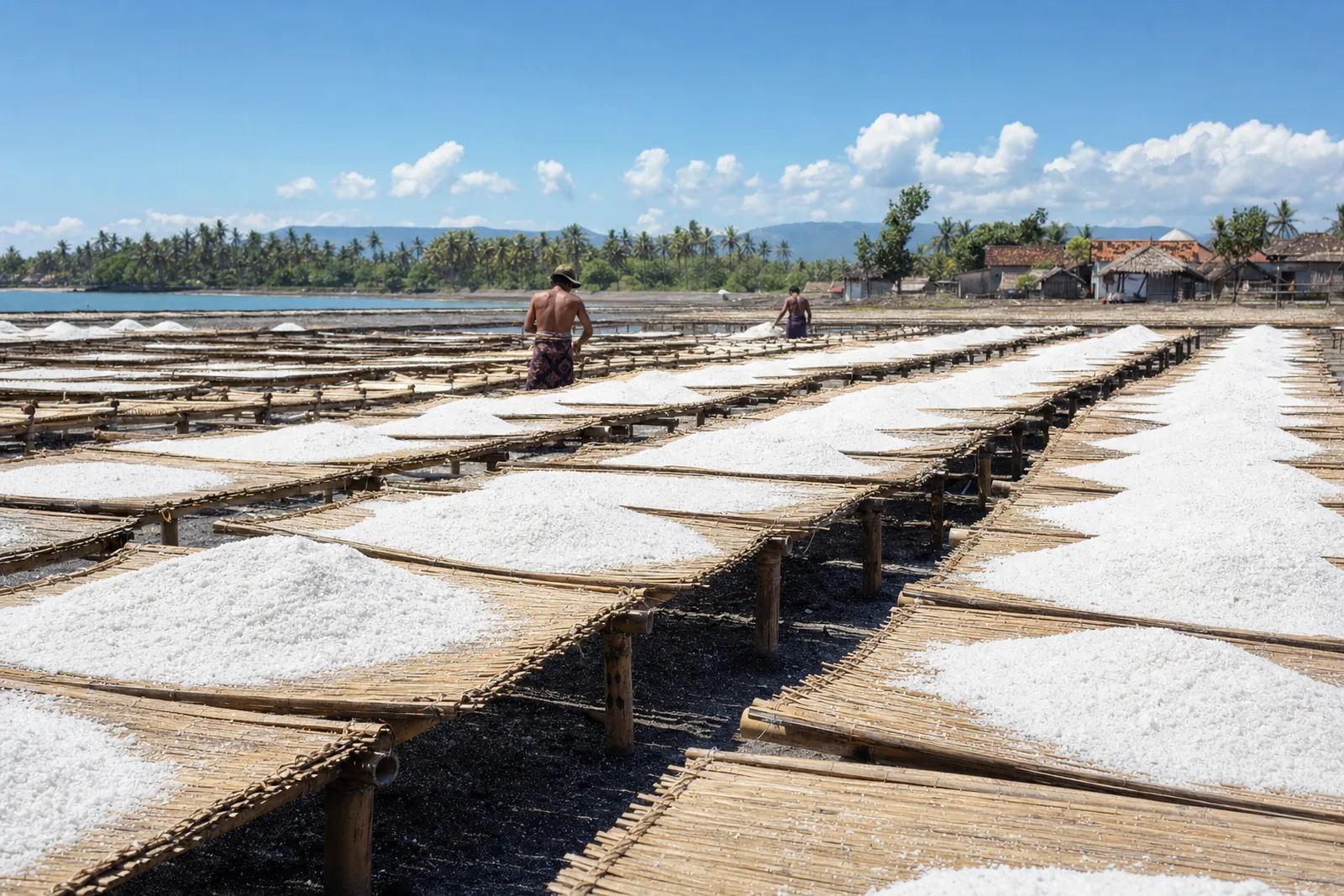
Daily Dispatch: Rote Ndao Salt Centre Targets September Production
Antara Business reports that the Rote Ndao National Salt Industry Center is advancing towards production in September, with key investor details still awaited.
Quick answer: Antara Business reports that construction of the National Salt Industry Center (K-SIGN) in Rote Ndao District, East Nusa Tenggara, is progressing and that production is due to begin in September 2026. For Lombok investors, it is a regional industrial-development signal, but the dispatch does not yet establish a direct property, tourism or investment impact.
A new production timetable is the kind of announcement that deserves attention precisely because it is incomplete. It points to movement in the wider eastern Indonesian economy, yet offers none of the operational detail required to convert a headline into an investment conclusion. The disciplined response is to note the milestone, separate confirmation from implication, and wait for the facts that would make the project investable rather than merely interesting.
The Context
The report from Antara Business is concise: construction of the National Salt Industry Center, known as K-SIGN, in Rote Ndao District, East Nusa Tenggara, is progressing. Its headline adds the material near-term marker: the centre is expected to begin production in September 2026.
That is the full confirmed frame available in this dispatch. It is enough to identify a live development in a named Indonesian district and to establish a stated production target. It is not enough to establish the scale, commercial model or likely returns associated with the project.
For investors following Lombok and the broader Indonesian opportunity set, this distinction matters. Regional headlines can arrive with a persuasive sense of momentum; a production date sounds especially tangible. But a target date is not, by itself, evidence of completed operations, customer demand, revenues, margins, financing terms, logistics arrangements or any spillover into another market.
“Rote Ndao national salt center to begin production in September 2026.”
That is the investable fact-pattern at this stage: a project in construction, a named location, and a stated timetable. Everything beyond it requires either subsequent reporting or primary documentation.
What the Dispatch Confirms
First, the report identifies a national salt-industry project in Rote Ndao District, East Nusa Tenggara. The use of a national-centre designation makes the announcement relevant to investors monitoring public-facing industrial development in the region.
Second, it confirms that construction is still progressing. That wording is important. It does not say that the centre has completed construction, commenced operations or reached stable production. Readers should therefore treat September as a stated next milestone, rather than as proof that the operating phase has already begun.
Third, the report gives a defined horizon: September 2026. In a breaking-news context, specificity of timing is useful. It creates a clear point for investors, operators and advisers to revisit the story and assess whether the planned transition from construction to production has occurred.
A short reading guide helps keep the announcement in proportion:
| What Antara Business reports | What remains unconfirmed in the supplied dispatch | | --- | --- | | K-SIGN is in Rote Ndao District | The centre’s capacity | | Construction is progressing | Its funding and ownership structure | | Production is expected in September 2026 | Customers, pricing and commercial terms | | The project concerns the salt industry | Any direct effect on Lombok assets |
The table is not a criticism of the report. Breaking dispatches often surface a milestone before the fuller investment record is public. Rather, it is a reminder that investors should not allow the vocabulary of national development to stand in for a completed underwriting case.
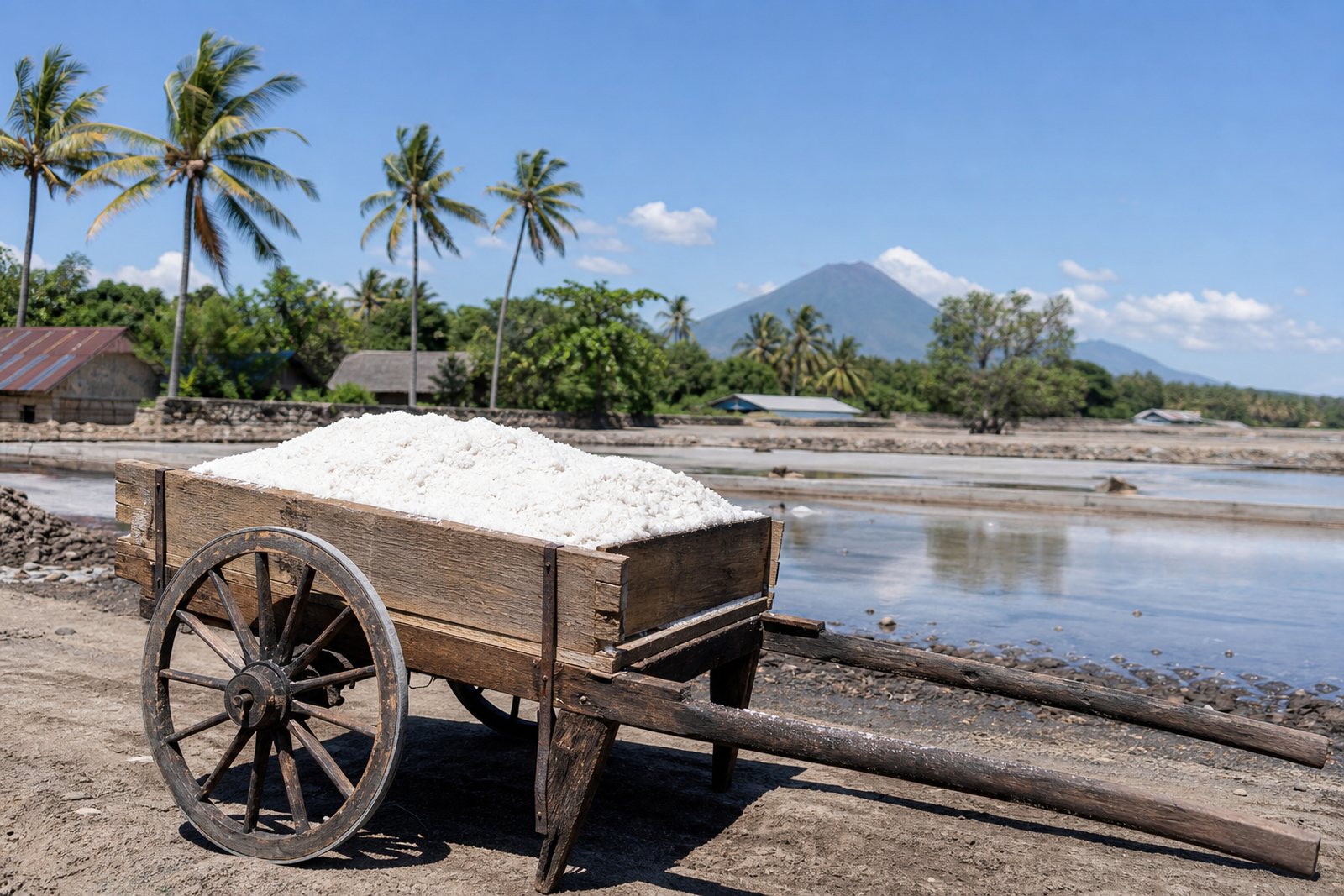 Daily Dispatch · Illustration: HubLombok (AI-generated)
What the Dispatch Does Not Yet Establish
The most immediate limitation is that the supplied report contains no production-volume figure. Without one, it is not possible to assess the project’s scale within the salt industry or to compare its potential output with any other facility, market or investment proposition.
There is also no stated capital cost, source of finance, operating partner, buyer base or route to market. Those omissions preclude any serious estimate of revenue, profitability, payback or execution risk. They also make it impossible to judge whether the September production target is a commissioning event, an initial output milestone or the beginning of a fully commercial operation.
Nor does the dispatch provide a description of the construction stage beyond saying that progress is under way. Investors should resist reading more into that phrase than it contains. Construction progress can be meaningful, but the report does not specify completion status, outstanding work, approvals, equipment readiness or the conditions needed before production begins.
Most importantly for HubLombok readers, Antara’s item does not draw a direct link between K-SIGN and South Lombok. It does not state an effect on local tourism, villa demand, land values, employment, infrastructure or rental performance. It would be unsound to create such a connection merely because both places sit within the wider Indonesian investment conversation.
That restraint is particularly valuable in real-estate decision-making. A regional story can inform an investor’s background view of policy direction and economic activity. It cannot, without further evidence, alter the underwriting of a specific Lombok acquisition. A property decision still turns on the asset, legal structure, location, operator, title and the assumptions that can actually be verified for that asset.
What This Means for Investors
The immediate conclusion is measured: place the announcement on a regional watchlist, not in a return model.
For investors whose mandate includes Indonesia’s developing markets, the September target is a useful future checkpoint. A follow-up report could clarify whether production begins as planned and, if so, provide the facts absent from the first dispatch. Until then, the announcement is best understood as evidence of an active industrial project rather than evidence of an investable outcome.
For Lombok-focused buyers, the practical implication is even narrower. The report does not change the local investment case on its own. It should not be used to justify a revised price view, a higher occupancy assumption, a rental forecast or a claim about capital growth. None of those matters is addressed by Antara’s report.
A sensible review framework is straightforward:
- Confirm whether production begins in September 2026, as reported.
- Look for disclosed information on the centre’s operating model and commercial arrangements.
- Distinguish a verified update from promotional interpretation of that update.
- Keep any Lombok property assessment anchored to property-specific evidence.
- Ask advisers to document the evidence behind every claimed link between regional development and an individual asset.
The last point is worth stressing. Investors often encounter narratives before data. Narratives are not inherently unhelpful: they can direct attention to changing conditions, new projects and emerging policy priorities. Their value lies in prompting questions. Their danger lies in becoming answers before the supporting facts arrive.
In this case, the questions are clear. Has the centre entered production on the stated timetable? What does production mean in operational terms? How is the project structured? Which claims can be independently verified? And does any later development have a demonstrable connection to the specific market or asset under consideration?
Until those questions are answered, the correct posture is neither dismissal nor extrapolation. It is watchful precision. The Antara Business dispatch has delivered a credible near-term marker: construction is progressing and production is expected in September. Investors can use that marker to organise their monitoring, while declining to assign an economic effect that the source does not support.
That is the useful discipline in a live dispatch. The first report tells us where attention should go. It does not relieve us of the work of deciding what, if anything, should follow.
Stay informed, subscribe to the free Lombok Briefing for market intelligence like this, published twice a month.
When is the Rote Ndao salt centre expected to begin production?
Antara Business reports that the National Salt Industry Center, or K-SIGN, in Rote Ndao District is expected to begin production in September 2026. The supplied dispatch says construction is progressing, but it does not provide operational details beyond that stated timetable.
Does the Rote Ndao salt-centre announcement affect Lombok property values?
The supplied Antara Business dispatch does not state any effect on Lombok property values, tourism, rental performance or land demand. Investors should treat it as a regional industrial-development update, not as evidence for changing an individual Lombok property valuation or forecast.
What should investors verify after the September production target?
Investors should verify whether production begins in September 2026 and seek later disclosures on the centre’s operating model, commercial arrangements and scale. Those details are not included in the supplied dispatch, so no return, revenue or market-impact assessment can yet be supported.

The Lombok Buyer's Field Guide
Legal structures ranked by risk, the honest ROI math line by line, all six zones ranked, and the 24-point due-diligence checklist. The whole book, free in your inbox.
See what's inside