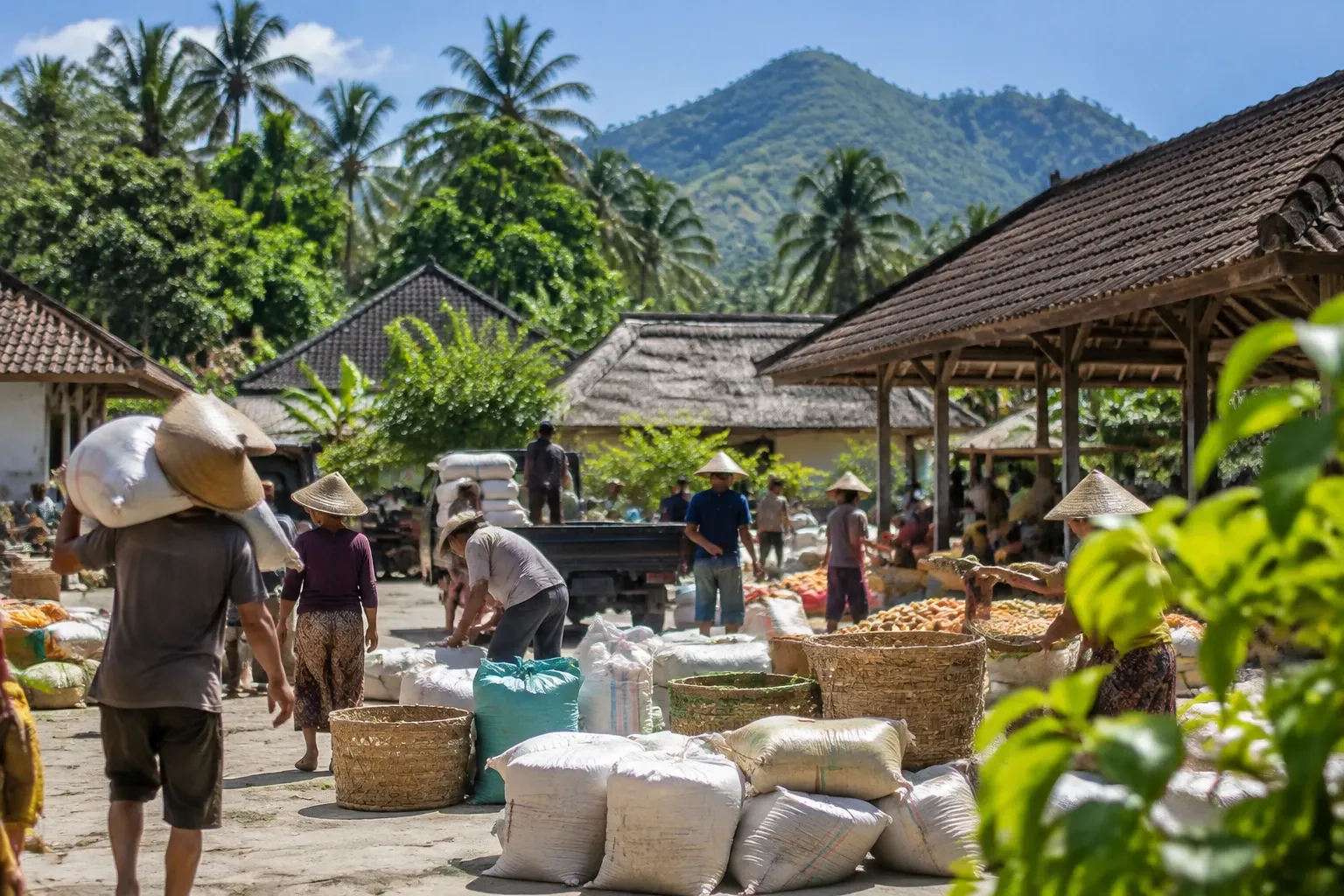
A Praya Loom Weaves Cloth While a Generator Runs Alongside
In Praya, Central Lombok, a traditional foot-operated loom produces patterned sarong while a generator runs in the same space. What the report shows, and what it does not.
In Praya, the capital of Central Lombok, a weaver works a traditional loom while a generator runs nearby. The scene, reported by Suara NTB, is small, but it puts two parts of rural life side by side: handmade cloth and local power.
A loom worked by foot
The report describes an ATBM, or Alat Tenun Bukan Mesin, a weaving frame that does not run on machinery. The weaver's feet alternate on two treadles, the levers that drive the loom. Three threads do the structural work. The lungsi is the warp, the base thread. The gun separates threads to form motifs, and the golong sets the spacing between them. The threads are bound together and pressed tight, and the patterned cloth, a kain londong or woven sarong, builds up centimetres at a time.
Cloth and current in the same frame
At the same moment, a generator runs alongside the loom. The excerpt confirms that both operate in the same workspace, but it does not state the fuel the generator uses, how much electricity it produces, or where that power goes.
What the report confirms: a traditional loom producing a patterned sarong, and a generator running at the same time.
What it does not say: the fuel, the output, or whether the power serves the weaving, the household or anything else.
Those details decide how much the scene means, so this article does not supply them.
Why a workshop belongs in an investment briefing
Stories like this sit at the edge of property investment, yet they describe conditions that shape it. Investors read local economies to understand how income is earned and how power is obtained, because both affect what a neighbourhood can support over time. A workshop that pairs craft production with its own generator is less dependent on a single outside input, provided the generator actually supports production. That condition matters, and the source does not confirm it.
One report cannot show whether such arrangements are widespread across Central or South Lombok. Before treating a local story as a signal, three questions help separate observation from trend:
- Does the story come from one report, or from several independent sources?
- Does it give figures that can be checked, or only a scene?
- Does it touch land titles, access, zoning or infrastructure, the factors that move property values?
By that test, this story fails all three for property purposes. It is worth noting as context, not as a market indicator.
What this means for investors
For anyone considering South Lombok land, the craft story should stay separate from the transaction. The legal position is fixed and worth restating. Foreigners cannot hold freehold (Hak Milik), which is reserved for Indonesian citizens. The routes open to foreign buyers are leasehold (Hak Sewa), Hak Pakai, which requires KITAS or KITAP residency, and a PT PMA company holding Hak Guna Bangunan (HGB), which runs for 30 years and can be extended. Buyer transfer duty, BPHTB, is about 5% of assessed value, and the deed is executed by a licensed PPAT notary.
Independent due diligence on certificates, ownership history, zoning and encumbrances is the step that protects a buyer, whatever the local economy is doing. TerraNusa Advisory, an independent licensed-notary and legal desk for foreign buyers in Lombok, covers that chain from due diligence to the land-office transfer.
The useful question is not whether one loom in Praya signals a trend, but whether small local stories like this one begin to repeat across the island, and what they change for land, housing and the people who live there.
Stay informed: subscribe to our free Lombok Briefing, published twice a month (the 1st and 15th), for analysis like this.
What is an ATBM loom used for in this story?
ATBM stands for Alat Tenun Bukan Mesin, a non-machine weaving frame. In the scene reported by Suara NTB, the weaver works two treadles with the feet to produce a patterned kain londong, a woven sarong, thread by thread.
What is not known about the generator in this story?
The excerpt confirms a generator running alongside the loom. It does not state the fuel used, the electricity produced, or whether that power serves the loom, the household or another purpose. The full report would be needed for those details.
Can foreigners buy land in Lombok on the same basis as Indonesians?
No. Foreigners cannot hold freehold (Hak Milik), which is reserved for Indonesian citizens. Foreign buyers use leasehold (Hak Sewa), Hak Pakai with residency status, or a PT PMA holding Hak Guna Bangunan for 30 years, extendable. Independent due diligence should come before any purchase.

The Lombok Buyer's Field Guide
Legal structures ranked by risk, the honest ROI math line by line, all six zones ranked, and the 24-point due-diligence checklist. The whole book, free in your inbox.
See what's inside