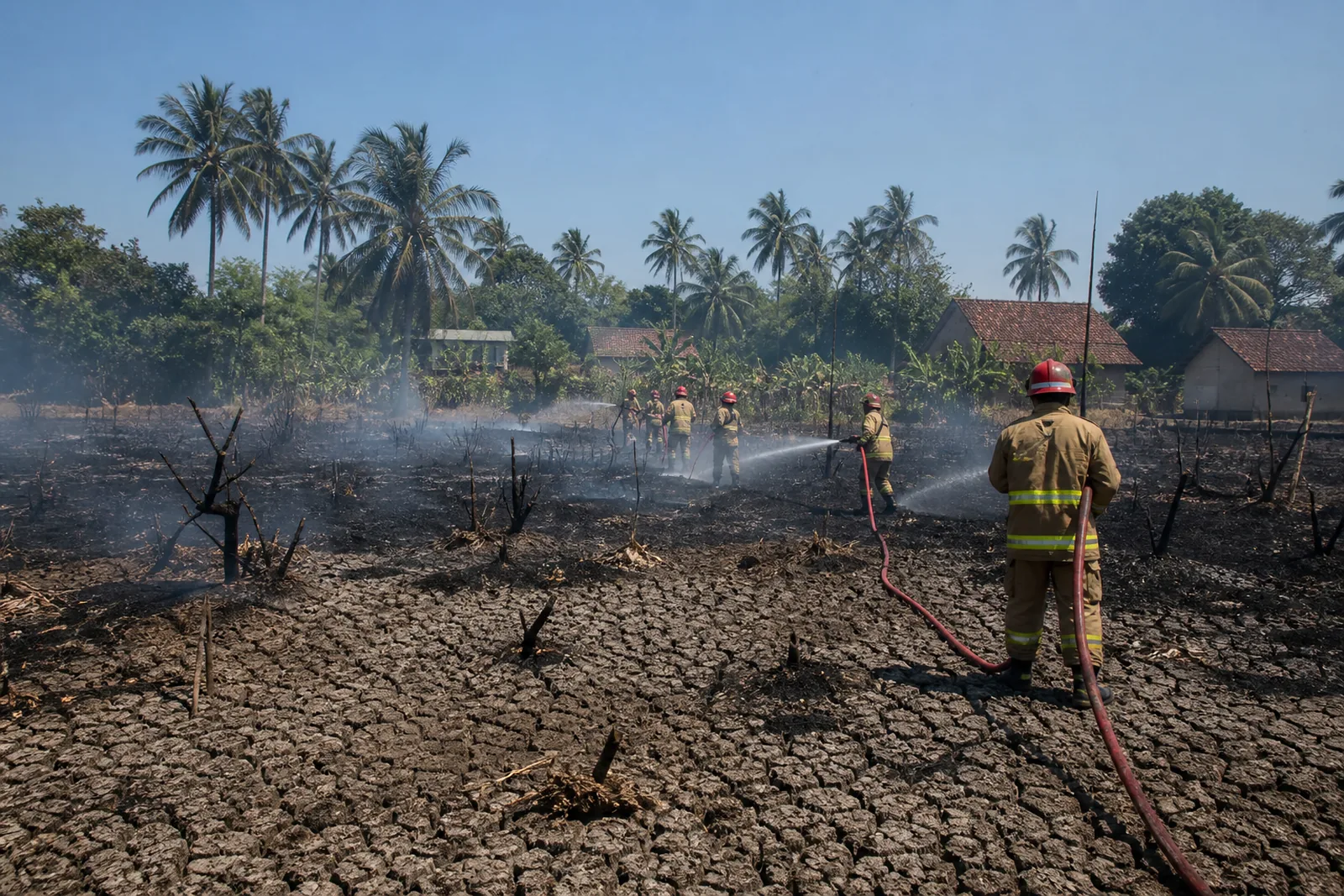
Prabowo Vows Legal Action as Indonesian Wildfires Spread
Indonesia’s president has pledged action against companies found responsible for land and forest fires as firefighting intensifies.
Indonesia’s President Prabowo Subianto has pledged stern action against corporations if investigations prove their involvement in land clearing by fire. The intervention comes as wildfires spread across parts of Kalimantan, Sumatra and Java, placing environmental enforcement alongside the immediate task of containment.
A presidential warning on corporate accountability
Speaking in Palangka Raya after chairing a coordination meeting on wildfires in Central Kalimantan Province, President Prabowo said companies found to be involved would face action under the law.
“If their involvement is proven, we will take action in accordance with the law,” Prabowo said, according to Antara.
The message is significant because it makes the distinction that matters in any enforcement process: corporate responsibility must be established through investigation. The president’s statement was not a finding against a particular company; it was a commitment to act where evidence supports it.
Prabowo also warned companies of severe legal consequences for environmental offences. His comments placed the government’s response on two tracks: suppressing active fires while pursuing legal accountability for any responsible parties.
For investors watching Indonesia, that combination matters. Wildfires are first an environmental and public-safety emergency, but they are also a test of institutional coordination, regulatory credibility and the practical consequences of corporate operating standards.
Four corporations under investigation
State Secretary Prasetyo Hadi said that four corporations in West Kalimantan were under investigation for suspected involvement in forest and land fires.
Hadi said the government would determine its legal response after investigations are completed, with potential measures including the revocation of operating permits.
That is an important qualification. The four corporations are under investigation, not yet publicly identified in the supplied report as having been found responsible. Any eventual action, Hadi said, will depend on the findings.
The possibility of permit revocation nonetheless signals the potential seriousness of the response. For businesses operating in sectors exposed to land-use, environmental or licensing risks, the episode reinforces the value of understanding not only headline regulation but also enforcement capacity and documentary compliance.
The broader investment lesson is straightforward: environmental exposure can become a legal, operational and reputational issue at the same time. A company’s licences, land records, contractual responsibilities and on-the-ground practices may all become relevant when authorities investigate a fire event.
The scale of the firefighting response
The government’s operational response has been substantial. At a meeting in Kubu Raya District, Prabowo received updates indicating more than 3,500 hotspots in West Kalimantan. Of those, 198 were classified as high-confidence hotspots through satellite imagery.
He ordered the deployment of 1,500 additional soldiers and six helicopters to strengthen firefighting operations in the province. After travelling on to Palangka Raya, the president ordered four additional helicopters for water-bombing operations across Central Kalimantan.
West Kalimantan: more than 3,500 hotspots, including 198 high-confidence hotspots.
These figures show why coordination between central and regional authorities has been placed at the centre of the response. Prabowo expressed optimism that the fires could be contained, while stressing that cooperation must be sustained.
He referred to Indonesia’s past experience of dealing with severe wildfires, but did not offer a forecast for the present emergency. The immediate policy objective, as described in the report, is containment: reducing the fires through coordinated deployment and aerial water-bombing operations.
What the story says about risk discipline
For international investors, Indonesia should not be assessed through a single event or a single official statement. Yet the present episode is a useful reminder that environmental due diligence is not a peripheral exercise.
It is especially relevant where an investment involves land, operating permits or corporate partners. A careful review should distinguish among several questions:
- Whether the relevant entity holds the required rights and permits.
- Whether those permissions can be affected by regulatory findings.
- Whether environmental responsibilities are clearly allocated in contracts and operating arrangements.
- Whether an investor has access to reliable local legal and compliance advice.
The report does not identify the corporations under investigation, nor does it establish liability. That restraint should guide investor interpretation. The correct conclusion is not to assume wrongdoing by a particular business, but to recognise that the government has made environmental enforcement a stated priority in this case.
This is also a reminder that official statements and initial reports should be read with precision. A hotspot is not, by itself, a legal conclusion about causation or responsibility. Likewise, an investigation is not a final finding. The eventual legal response, Hadi said, will be based on the results of the investigations.
What this means for investors
The immediate issue is the government’s effort to contain wildfires across affected parts of Indonesia. The longer-term investor relevance lies in the president’s public commitment to enforce the law against corporate involvement in land and forest fires where it is proven.
Investors with exposure to Indonesian companies, land-linked projects or supply chains should treat the event as a prompt for disciplined review rather than speculation. The key questions are practical: what permissions are in place, how are environmental obligations managed, and what would a regulatory investigation mean for operations?
In the current case, the known facts are clear:
- Wildfires have spread across parts of Kalimantan, Sumatra and Java.
- Four corporations in West Kalimantan are under investigation for suspected involvement.
- Potential action could include revoking operating permits if responsibility is established.
- The government has added 1,500 soldiers and a total of 10 helicopters across the described operations in West and Central Kalimantan.
The next developments worth watching are the progress of firefighting efforts, the findings of the investigations, and any legal measures subsequently announced by the government. For investors, the most useful posture is neither alarm nor complacency, but close attention to verified findings and formal regulatory action.
Stay informed, subscribe to the free Lombok Briefing for analysis like this, published twice a month.
Which companies are under investigation over the West Kalimantan fires?
Antara reported that four corporations in West Kalimantan are under investigation for suspected involvement in forest and land fires. The supplied report does not name the companies, and it does not state that any of them has been found responsible.
What action could Indonesia take against companies found responsible?
President Prabowo said companies whose involvement is proven will face action under the law. State Secretary Prasetyo Hadi said the government could take appropriate action based on investigation results, including potentially revoking operating permits.
How large is the firefighting operation described in the report?
The report says President Prabowo ordered 1,500 additional soldiers and six helicopters for West Kalimantan. He later ordered four additional helicopters for water-bombing operations in Central Kalimantan, while more than 3,500 hotspots were reported in West Kalimantan.

The Lombok Buyer's Field Guide
Legal structures ranked by risk, the honest ROI math line by line, all six zones ranked, and the 24-point due-diligence checklist. The whole book, free in your inbox.
See what's inside