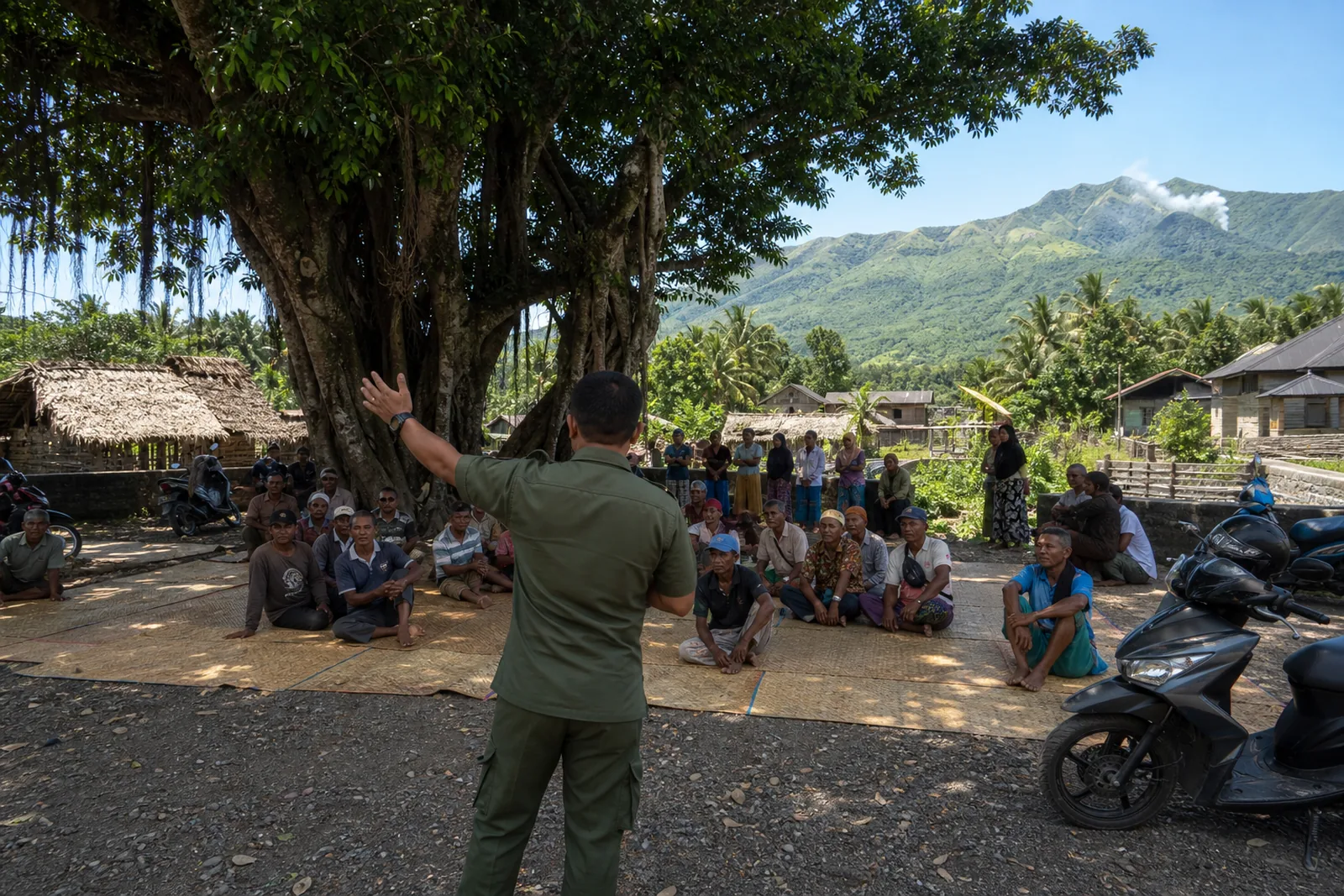
Prabowo Calls for Village-Level Education on Wildfire Risks
President Prabowo has asked Babinsa officers to bring forest- and land-fire education directly to Indonesian villages.
President Prabowo Subianto has asked Indonesia’s village development non-commissioned officers, known as Babinsa, to educate residents about the risks posed by forest and land fires. The instruction places community-level prevention at the centre of the government’s response to a recurring national environmental threat.
A village-first prevention message
According to Cabinet Secretary Teddy Indra Wijaya, President Prabowo raised the issue during a meeting in Hambalang, West Java, attended by the military commander, service chiefs, the defence and higher education ministers, and the state secretary.
The President’s direction was clear: Babinsa officers should bring education about wildfire dangers directly to villages and encourage residents to work collectively to protect forests and land. Babinsa officers operate at the village level, making them a practical channel for a message that depends on local understanding and participation.
The stated aim is to ensure that education on forest-fire risks reaches communities directly at village level.
The emphasis matters because forest and land fires are not simply an emergency-response issue. Prevention depends on whether risks are recognised before a fire spreads, whether communities understand the consequences of unsafe practices, and whether local actors are prepared to protect the land around them.
The role assigned to Babinsa officers
The instruction does not announce a new market programme or a detailed operational timetable. Instead, it assigns an educational role to an existing village-level military presence.
Teddy said the President wants Babinsa officers to explain the dangers of forest fires to residents and to encourage cooperation in safeguarding forests and land. That framing places public awareness alongside the state’s wider capacity to respond when disasters occur.
For investors following Indonesia, the significance lies in the direction of travel rather than in an immediate policy change. National leaders are signalling that environmental risk management should extend beyond central institutions and emergency agencies into local communities. The effectiveness of that approach will ultimately depend on how consistently the message is communicated and acted upon at village level.
Disaster response was also on the agenda
The Hambalang meeting covered more than wildfire prevention. It also addressed responses to several disasters, including the aftermath of the earthquake in Flores and the eruption of Mount Merapi.
This broader agenda underscores the range of natural-risk issues that Indonesian authorities must manage. For property owners, hospitality operators and long-term investors, such developments are a reminder that resilience is not an abstract consideration. It sits alongside legal diligence, site selection, insurance assessment and the practical readiness of local operators.
The source did not set out any new measures connected specifically to Lombok, nor did it provide details of a national wildfire-prevention programme. It did, however, show that the President is asking for risk education to be delivered through local institutions rather than confined to national-level statements.
A wider discussion of access and inclusion
The meeting also included an update on efforts to adjust recruitment requirements for members of remote Dayak communities seeking to join the Indonesian military.
That topic is distinct from wildfire prevention, but it points to the meeting’s wider concern with how national institutions engage with geographically remote communities. In the case of forest and land-fire education, the same principle is apparent: national priorities must be communicated in forms that reach people where they live.
For international observers, Indonesia’s scale and geographic diversity make this local delivery especially relevant. A policy announcement from Jakarta may establish direction, but implementation depends on networks that can operate in villages and regions with different environmental conditions, livelihoods and levels of access to public information.
What this means for investors
This is principally a governance and risk-management story, rather than a direct property-market announcement. Still, it is relevant to investors assessing Indonesia’s long-term operating environment.
- Environmental risk is receiving senior-level attention. The President’s request indicates that forest and land-fire prevention remains a live national concern.
- Local implementation is the focus. Babinsa officers are being asked to take education directly to village communities.
- Due diligence remains essential. Investors should distinguish between national policy direction and the practical conditions of any individual location, asset or operating partner.
- No Lombok-specific measure was announced. The source does not identify a new rule, project or intervention for Lombok.
For those considering Lombok, the prudent interpretation is measured. The announcement should not be treated as evidence of a changed investment return, a new land rule or a specific tourism policy. Rather, it is a reminder that environmental stewardship and disaster preparedness are part of the wider institutional setting in which Indonesian real estate and tourism businesses operate.
The most useful next signal will be whether the village-level education directive is followed by clearly communicated local implementation and practical prevention activity.
Stay informed, subscribe to the free Lombok Briefing for analysis like this, published twice a month.
What did President Prabowo ask Babinsa officers to do?
President Prabowo asked Babinsa village development non-commissioned officers to educate residents about the dangers of forest and land fires and encourage communities to work together to protect forests and land.
Was a Lombok-specific wildfire policy announced?
No. The source reports a national instruction for Babinsa officers to deliver wildfire-risk education at village level. It does not announce a Lombok-specific policy, project, land rule or tourism measure.
Why is this relevant to property investors in Indonesia?
The announcement is relevant as an environmental-governance signal. It shows senior attention to prevention and local risk education, but it does not by itself change property returns, legal structures, land prices or investment requirements.

The Lombok Buyer's Field Guide
Legal structures ranked by risk, the honest ROI math line by line, all six zones ranked, and the 24-point due-diligence checklist. The whole book, free in your inbox.
See what's inside