Daily Dispatch: Prabowo Puts Tourism at Indonesia’s Economic Centre
President Prabowo has highlighted tourism as a strategic driver of Indonesia’s economy, sharpening the case for disciplined Lombok investment.
Quick answer: President Prabowo Subianto’s renewed emphasis on tourism as a strategic driver of Indonesia’s economic growth strengthens Lombok’s investment case, but it is not a substitute for asset-level due diligence. For investors, the signal matters most where rising visitor demand can be converted into resilient occupancy, realistic net income and legally sound ownership.
Antara Business reported on 30 July that President Prabowo had underlined tourism’s strategic role in driving Indonesia’s national economy. The message is brief, but it arrives at a consequential moment for Lombok: the island is no longer assessed only as Bali’s quieter neighbour, but as a market where tourism policy, infrastructure attention and private capital increasingly meet.
The Context
A presidential statement does not, by itself, change a title certificate, fill a villa calendar or guarantee a return. Yet it can matter greatly in a country where tourism is an important economic priority and where destination development depends on alignment between national ambition, local execution and private investment.
Antara Business’s report is significant for its framing. President Prabowo did not present tourism as a peripheral leisure industry; he described it as strategic to economic growth. That framing is relevant to investors because tourism-led property markets are ultimately operating businesses. Their value rests not merely on an attractive view or a well-finished pool, but on the depth and durability of visitor demand.
For South Lombok, the backdrop is already constructive. The verified market picture indicates foreign arrivals are running 40-50% year on year higher, linked to tourism recovery and the MotoGP effect. Villa rates in Kuta and Mandalika are about 38% year on year higher. These are market indicators, not assurances of future performance; they nevertheless help explain why a national focus on tourism attracts investor attention.
The distinction between Lombok’s zones remains essential. Kuta is the demand and liquidity leader, with land priced at about Rp 300-400 million per are. Are Guling, at about Rp 120-180 million per are, is an earlier-cycle frontier, while Mandalika, the separate special economic zone around the circuit, sits at about Rp 100-150 million per are. A policy signal that lifts the visibility of Indonesian tourism may support interest across the island, but it will not erase these differences in maturity, access, buyer profile or execution risk.
Tourism’s strategic importance is an economic signal. It is not an investment underwriting model.
A National Signal, Not a Blank Cheque
The prudent reading of the President’s intervention is neither scepticism for its own sake nor a licence for exuberance. It is a reminder that the national direction of travel favours destinations able to serve visitors well, create durable local economic activity and attract credible investment.
That matters because Lombok’s appeal is closely tied to the so-called Bali-overflow thesis: higher prices and congestion in Bali can push travellers and buyers towards a less mature, lower-entry market. Verified comparisons show turnkey investment-grade villas in South Lombok from EUR 95,000-350,000, against comparable Bali specifications of USD 400,000-800,000. Such comparisons help explain interest; they do not make every Lombok project comparable with every Bali asset.
The key question for investors is therefore not whether tourism is strategically important. It is how an individual property captures that importance. A strong investment proposition should answer four practical questions:
- Is the location aligned with a recognisable visitor market rather than a vague promise of future demand?
- Is the operating model based on realistic occupancy and transparent costs?
- Does the legal structure match the buyer’s residency status and investment objectives?
- Can the sponsor demonstrate control of land, permits, construction and post-completion management?
The answer will differ from Kuta to Selong Belanak, Are Guling, Mandalika, Mawun and Bumbang. Lower land entry may offer more upside if demand develops, but it can also mean a thinner market and more execution dependency. Higher-priced Kuta land may provide stronger liquidity, but its price already reflects its leading position.
A national tourism message should therefore encourage better questions, not fewer of them. Investors should look for the connection between policy-level confidence and a specific asset’s ability to earn revenue after management fees, booking commissions, maintenance and the ordinary friction of operating hospitality property.
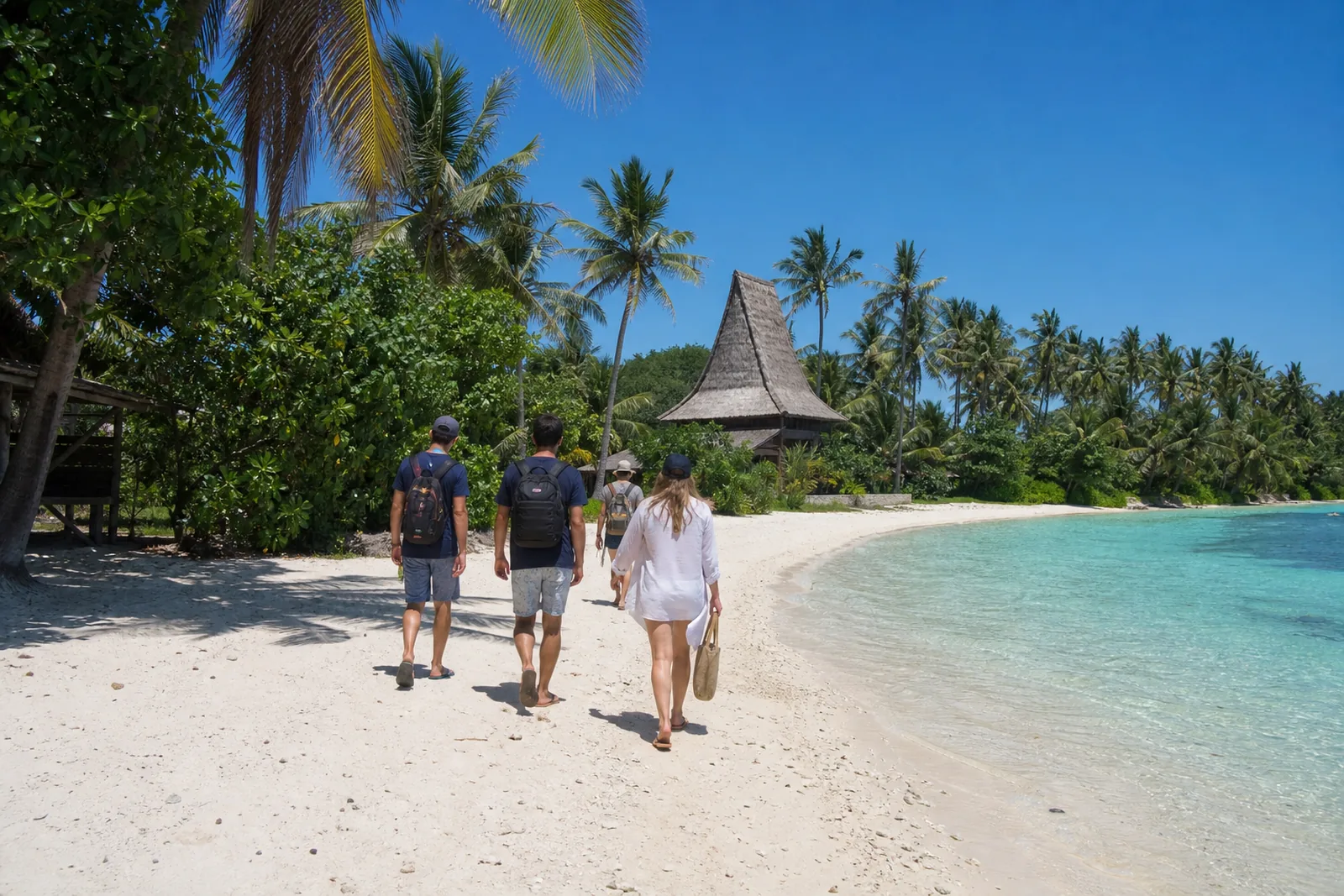
 Daily Dispatch · Illustration: HubLombok (AI-generated)
The Revenue Test Is Still the Decisive One
Tourism enthusiasm is often expressed through gross-yield language. That is understandable: the headline is attractive and easy to communicate. It is also incomplete. In South Lombok, developer-quoted gross yields of 12-22% exclude costs that owners must still bear. Honest net rental yields of 7-12% are the more useful working range after management fees and realistic occupancy, while top-performing assets can reach about 15% net.
This distinction becomes more important when political attention increases market interest. New buyers may see rising arrivals or higher room rates and assume income follows automatically. It does not. A credible model must account for stabilised occupancy of 55-70% in the first three years, management fees of 18-22% of gross rental revenue, and OTA or booking commissions of 15-20%.
| Investor lens | What to examine | |---|---| | Visitor demand | Whether the property has a clear guest proposition and location | | Revenue | Occupancy assumptions, nightly-rate logic and seasonality | | Costs | Management, booking commissions and operating expenses | | Ownership | The legal route, title checks and transfer process |
The market’s opportunity is real precisely because it is not frictionless. South Lombok remains earlier in its development cycle than Bali. That can allow for a more attractive entry point, but it also requires patient underwriting. Investors should be especially wary of models that treat political endorsement, a tourism headline or a circuit-adjacent location as if each were a guaranteed stream of bookings.
Mandalika illustrates the need for precision. It is a special economic zone around the MotoGP circuit, separate from Kuta town. Its land range of Rp 100-150 million per are may be relevant to a buyer’s strategy, but a buyer still needs to establish what a particular parcel can legally support, how the property will be operated and whether the surrounding demand profile fits the intended product.
The same discipline applies to frontier areas. Are Guling’s market momentum is about 47% year on year, the highest among the six tracked zones, and its land range is about Rp 120-180 million per are. Those figures describe momentum and market positioning, not a promise that every site will perform equally. Access, build quality, brand, operations and timing remain material.
What This Means for Investors
For European, Australian and American buyers, the immediate implication is to take Indonesia’s tourism direction seriously while retaining a property investor’s discipline. The President’s emphasis, as reported by Antara Business, gives more weight to the broad economic narrative around tourism. It does not remove the need to verify the individual transaction.
First, separate national tailwinds from asset economics. Rising tourism can improve the pool of potential guests, but only a competitive villa, hotel or land-led project converts that potential into income. Underwrite net rather than gross yield, and test whether the forecast works at realistic occupancy.
Second, treat legal structure as part of the investment thesis, not a legal afterthought. Foreigners cannot hold freehold, or Hak Milik/SHM; that route is reserved for Indonesian citizens. Available lawful routes include leasehold, typically 25-30 years with extensions; Hak Pakai for qualifying residents; and a foreign-owned PT PMA holding Hak Guna Bangunan, with 30 years extendable. Nominee arrangements, where an Indonesian holds freehold on behalf of a foreigner, are illegal and void in court.
Third, budget for the whole transaction. Buyer transfer duty, BPHTB, is about 5% of assessed value. The deed should be executed by a licensed PPAT notary, while land matters are handled through BPN. For foreign buyers, due diligence should cover the relevant certificate, ownership history, zoning and encumbrances before money changes hands.
Finally, distinguish between a national investment narrative and a purchase decision. Tourism’s elevated position in Indonesia’s economic agenda is constructive for Lombok’s long-term visibility. The superior response is not haste; it is careful selection of the right zone, lawful holding structure and operating partner.
President Prabowo’s tourism emphasis is a live reminder that Lombok’s market is connected to a larger national growth story. Investors who benefit most will be those who treat that story as a starting point for rigorous analysis, rather than its conclusion.
Stay informed, subscribe to the free Lombok Briefing for market intelligence like this, published twice a month.
Does Prabowo’s tourism emphasis guarantee Lombok property returns?
No. The President’s emphasis on tourism is a supportive national economic signal, not a guarantee of property performance. Investors should assess each asset’s location, realistic occupancy, operating costs and lawful ownership structure before relying on any projected income.
What net rental yield is realistic for a South Lombok villa?
A realistic honest net rental yield in South Lombok is typically **7-12%** after management fees and realistic occupancy. Top-performing assets can reach about **15% net**, while developer-quoted gross yields of **12-22%** exclude important operating costs.
Can a foreign investor buy freehold land in Lombok?
No. Foreigners cannot hold Indonesian freehold title, known as Hak Milik or SHM. Lawful routes include leasehold, Hak Pakai for qualifying residents, or a foreign-owned PT PMA holding Hak Guna Bangunan, subject to proper due diligence.

The Lombok Buyer's Field Guide
Legal structures ranked by risk, the honest ROI math line by line, all six zones ranked, and the 24-point due-diligence checklist. The whole book, free in your inbox.
See what's inside