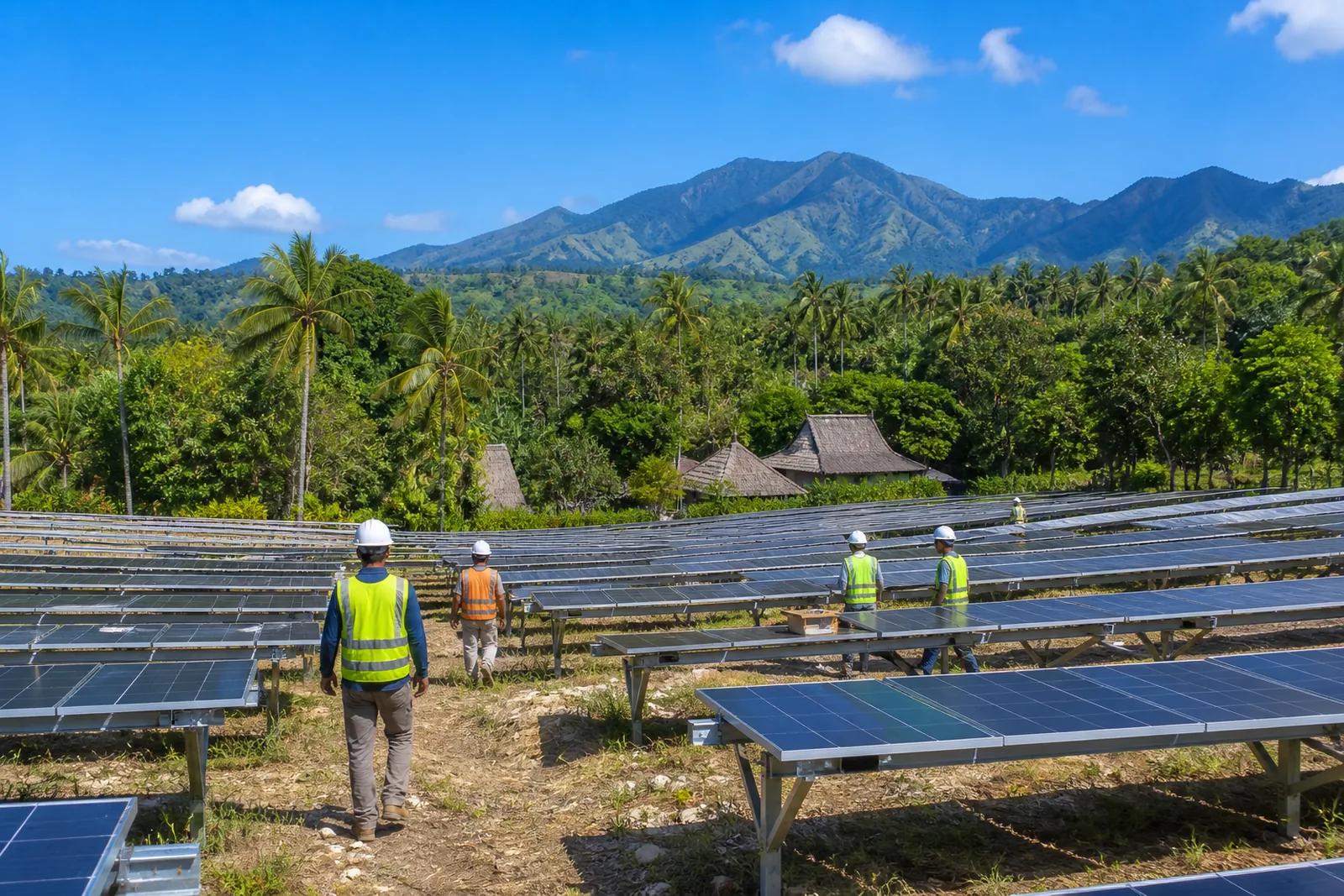
Prabowo Sets Three-Year Goal to End Indonesia’s Oil and LPG Imports
Indonesia’s president has linked a proposed 100 GWp solar build-out to a three-year ambition to end oil and LPG imports.
President Prabowo Subianto has set an ambitious national energy-independence objective: Indonesia should cease importing oil and LPG within three years. Speaking at the launch of a 100 GWp solar power programme in Jembrana, Bali, he presented renewable generation, geothermal development, gas fields and higher domestic oil lifting as linked parts of the plan.
For investors watching Indonesia from Europe, Australia and America, the announcement matters less as an immediate operating forecast than as a clear statement of policy direction. It places energy security, domestic supply and large-scale capacity building at the centre of the government’s economic agenda.
A target framed around energy sovereignty
The president described ending oil and LPG imports as essential to building a more self-reliant Indonesia, less exposed to developments and conditions in other countries. In remarks carried through the Presidential Secretariat’s official online broadcast, he said the country should no longer import a single barrel of oil or a canister of LPG.
The timetable is notably compressed. The government aims to complete the proposed new construction within three years, while Prabowo indicated that the goal could potentially be achieved in less than that period. Such language should be read as a political objective rather than as evidence that delivery is assured; the source reports the target, not a completed financing plan or construction schedule.
Key policy signal: Indonesia is seeking to combine renewable-energy expansion with stronger domestic oil and gas capability, rather than presenting these as competing priorities.
That framing is important. The proposed programme is not described solely as an environmental initiative. It is explicitly connected to reducing dependence on imported fuels and strengthening national sovereignty through the management of domestic resources.
The scale of the proposed solar build-out
At the centre of the announcement is a proposed 100 GWp solar power programme. Prabowo said Indonesia would build 100 gigawatts within three years, alongside geothermal power plants and work to develop gas fields and raise national oil lifting.
The source places this figure in context by noting that Indonesia’s existing total electricity capacity is 88 GW across coal, oil, gas and geothermal sources. The proposed solar addition is therefore nearly equivalent to the country’s current electricity capacity from all those sources combined.
- Current total electricity capacity cited by the president: 88 GW
- Proposed solar capacity: 100 GWp
- Government construction target: three years
- Complementary areas named in the announcement: geothermal, gas fields and oil lifting
For capital markets, the most consequential feature is the scale of the policy ambition. A programme of this size would require execution across generation development and the wider domestic energy system. However, the source does not set out project locations beyond the launch in Jembrana, financing arrangements, procurement terms, grid plans, developer roles or interim milestones. Investors should therefore distinguish the announced national target from investable project detail.
Renewables and hydrocarbons in the same strategy
Prabowo’s remarks did not suggest that solar capacity alone would eliminate fuel imports. Instead, he linked the 100 GWp programme to Indonesia’s geothermal resources, gas-field development and an increase in oil lifting.
This is a pragmatic policy message. Electricity generation and imported oil or LPG sit within a broader energy system, so a large solar build-out does not by itself answer every fuel-supply question. The government’s stated approach is to develop several domestic sources of energy at once.
The president also called on the Red and White Cabinet to work hard, act courageously and focus on tangible results in managing national wealth for public welfare. That political emphasis underlines the importance of implementation. Announcements of capacity targets can change market expectations, but investors will ultimately need to assess individual opportunities against permits, contractual terms, counterparties, delivery capability and the legal structure available to foreign capital.
What this means for investors
The immediate implication is one of direction, not certainty. Indonesia’s leadership is signalling that energy independence is a priority and that renewable power is intended to play a major role within it. The launch in Bali gives the policy regional visibility, though the source does not identify a specific Lombok project or state that the programme will directly affect Lombok property, tourism or infrastructure.
Investors should focus on the distinction between the headline and the evidence that follows it.
- Policy commitment: The president has publicly set a three-year objective to end imports of oil and LPG.
- Capacity ambition: The government is targeting 100 GWp of solar power, compared with 88 GW of current total electricity capacity cited in the speech.
- Broader supply agenda: Geothermal, gas fields and oil lifting were all named as necessary components.
- Execution remains the question: The source provides no details on project allocation, capital sources, grid integration or commercial structures.
For international investors, this is a reason to monitor subsequent government announcements closely, particularly where policy targets are translated into specific assets, licences and contracts. It is also a reminder that Indonesia’s investment case can be shaped by national policy as much as by individual locations. The most useful next signals will be concrete: which projects proceed, under what terms, and how the government measures progress against its stated objective.
Indonesia has set out a bold energy-independence ambition; its investment significance will become clearer as the programme moves from presidential target to demonstrable execution.
Stay informed, subscribe to the free Lombok Briefing for analysis like this, published twice a month.
What energy target did President Prabowo announce?
President Prabowo Subianto said Indonesia should stop importing oil and LPG within three years. He linked that objective to a proposed 100 GWp solar power programme, geothermal development, gas-field development and increased national oil lifting.
How large is the proposed solar programme compared with current capacity?
The proposed solar programme is 100 GWp. The president said Indonesia’s current total electricity capacity is 88 GW across coal, oil, gas and geothermal sources, making the proposed new solar capacity nearly equivalent to that existing total.
Does the announcement identify investable energy projects in Lombok?
No. The source reports the programme’s launch in Jembrana, Bali, but does not identify a Lombok project, financing arrangements, procurement terms, project locations beyond the launch, or commercial structures for international investors.

The Lombok Buyer's Field Guide
Legal structures ranked by risk, the honest ROI math line by line, all six zones ranked, and the 24-point due-diligence checklist. The whole book, free in your inbox.
See what's inside