Daily Dispatch: Prabowo’s Self-Reliance Push Sets a National Policy Tone
President Prabowo’s latest remarks put food, energy, welfare delivery and budget discipline at the centre of Indonesia’s investment narrative.
Quick answer: President Prabowo Subianto says Indonesia is pursuing stronger food and energy self-reliance, alongside welfare delivery and budget efficiency. For Lombok investors, the immediate implication is not a new property rule, but a clearer national policy narrative in which resilience, public spending and execution capacity merit close monitoring.
Indonesia’s investment story is often read through the narrow lens of growth, tourism or individual projects. The President’s remarks in Jombang, East Java, add a broader frame: a government seeking to present national resilience as an economic asset. That matters to foreign investors in Lombok because local opportunity ultimately sits within Indonesia’s policy direction, fiscal choices and ability to translate ambition into delivery.
The Context
Speaking at the 35th Congress of Nahdlatul Ulama, President Prabowo said Indonesia faces substantial challenges, including the effects of the El Nino climate phenomenon and the practical constraints of governing an archipelago. His response was emphatically optimistic: Indonesia’s natural resources and energy potential, he argued, provide a foundation for development and renewed national strength.
The message was political in tone, but investors should treat it as an economic signal as well. It places resilience at the centre of the administration’s public case for growth. Food supply, fuel dependence, social support and administrative efficiency are presented not as separate programmes, but as elements of a more self-reliant national model.
“In the next few years, Indonesia will rise extraordinarily and no one will be able to stop us,” President Prabowo said, according to Antara.
That is an aspiration rather than an investable forecast. Still, it helps clarify the direction policymakers want markets, businesses and households to understand. The government is emphasising domestic capacity at a moment when climate exposure, logistics and imported energy remain material considerations for a geographically dispersed country.
For Lombok, that framing is relevant precisely because the island is connected to the national economy rather than insulated from it. Investors assessing hospitality, residential or land opportunities should distinguish between a local asset’s operating fundamentals and the larger environment in which energy costs, food supply, infrastructure priorities and consumer confidence are shaped.
Food and Energy Move to the Fore
The President highlighted what he described as Indonesia’s achievement of food self-sufficiency within two years. He also said the country is working towards energy self-reliance in order to reduce dependence on imported fuel.
These claims are central to the dispatch because they identify the administration’s chosen economic priorities. They do not, on their own, establish a new policy, a new incentive or a new timetable for investors. Yet they indicate where official attention may remain concentrated: reducing vulnerability in essential supplies and strengthening domestic productive capacity.
For an investor, the appropriate response is analytical rather than celebratory. Track the difference between broad presidential objectives and the policies that follow them. The relevant questions include whether measures are translated into credible implementation, how they affect regional costs and supply chains, and whether benefits are experienced consistently outside the largest urban centres.
A simple reading framework is useful:
| Policy theme highlighted | Practical investor lens | |---|---| | Food self-sufficiency | Monitor supply reliability and cost pressures affecting operations. | | Energy self-reliance | Watch for policy implementation affecting imported-fuel dependence. | | Climate resilience | Assess exposure to weather-related disruption in local operating plans. | | National development | Separate stated ambition from projects with confirmed execution. |
Lombok’s appeal has its own market foundations. Turnkey investment-grade villas are available from EUR 95,000-350,000, while honest net rental yields are generally 7-12% after management fees and realistic occupancy; top-performing assets can reach about 15% net. Those are market context figures, not outcomes guaranteed by national policy rhetoric.
The distinction matters. A national self-reliance agenda may support confidence in Indonesia’s long-term development case, but a property acquisition still requires asset-level due diligence, realistic operating assumptions and legal structuring appropriate for a foreign buyer.
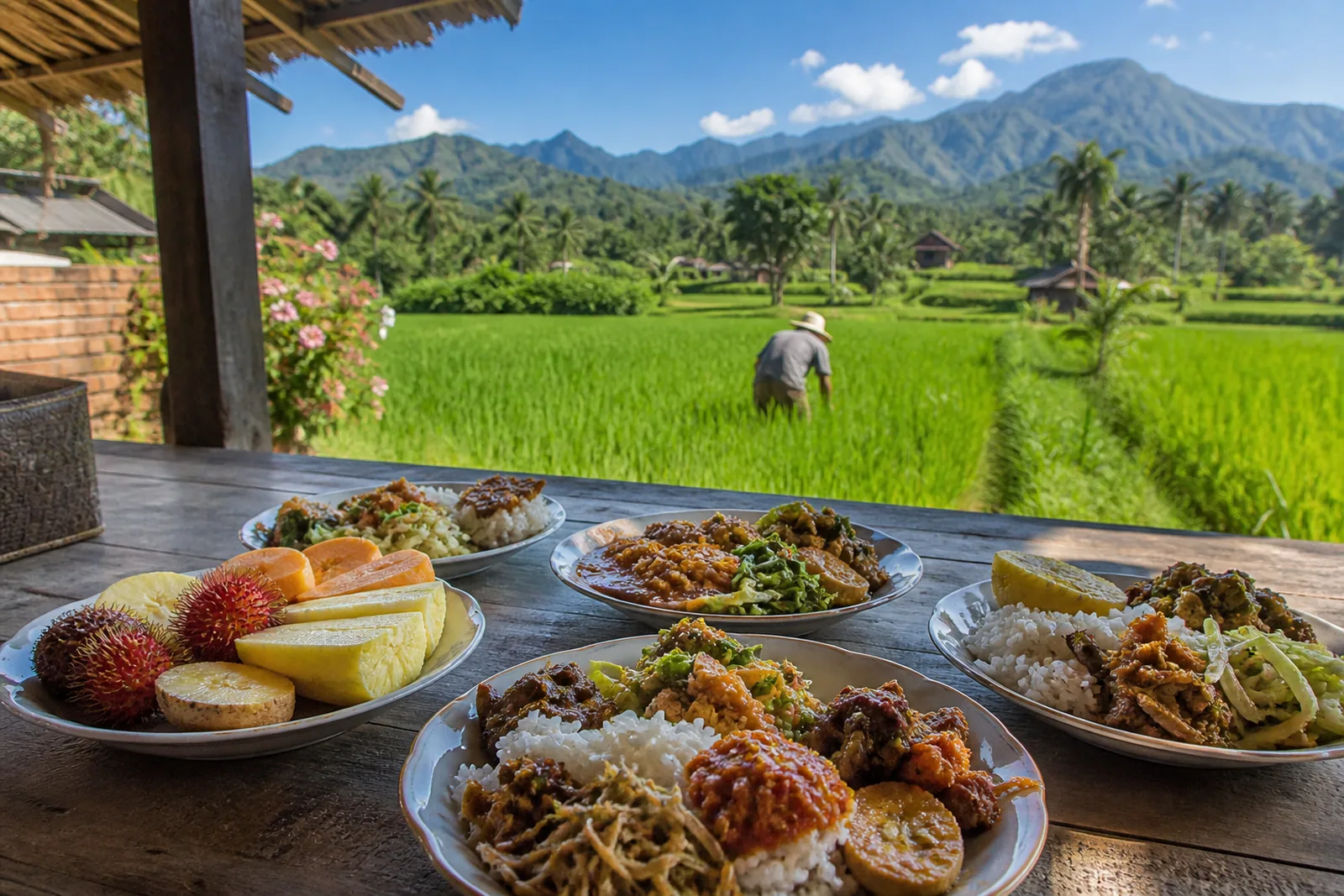
 Daily Dispatch · Illustration: HubLombok (AI-generated)
Welfare Delivery and the Test of Execution
President Prabowo also pointed to the Free Nutritious Meals programme, saying it has reached 62 million beneficiaries across Indonesia. He acknowledged that implementation still has challenges and shortcomings, while pledging that the issues would be addressed so the programme’s benefits can be widely felt.
This is an unusually candid element of the remarks. Large national programmes can carry both economic and administrative significance: they represent spending priorities, but their credibility rests on logistics, procurement, governance and the ability to reach intended recipients. The President framed the programme around children, pregnant women and elderly people.
He further expressed optimism about strengthening the people’s economy through the operation of tens of thousands of Red and White Village Cooperatives. The government, he said, would seek to ensure that subsidised goods reach the public at prices consistent with subsidy policies.
For foreign investors, the signal is that domestic welfare and local economic participation remain prominent parts of the governing agenda. This does not turn every regional project into an investment catalyst. It does, however, underline why policy monitoring should extend beyond headline infrastructure announcements or tourism promotion.
The operational question is straightforward: can a national objective be delivered with consistency and transparency? For businesses, the answer influences confidence more than the rhetoric alone. It shapes how operators think about local demand, service reliability, government coordination and the durability of policy commitments.
President Prabowo also returned to corruption and budget efficiency. He said savings efforts had generated hundreds of trillions of rupiah that could be redirected towards assistance for poorer and more vulnerable people. Antara reported the statement as part of his argument that Indonesia’s wealth should provide greater benefit to its citizens.
Again, the investor takeaway should be measured. Budget savings claimed by a political leader are not equivalent to a published project pipeline, nor do they establish the allocation of future expenditure. But the emphasis on fighting corruption and improving efficiency is relevant to the broader institutional conditions investors watch, especially in markets where project quality depends on more than demand alone.
What This Means for Investors
The immediate significance of Thursday’s remarks is strategic rather than transactional. No new Lombok-specific regulation, land rule or foreign-ownership route was announced in the supplied report. Investors should therefore resist turning a national address into a premature investment conclusion.
Instead, use it as a guide to the themes likely to remain politically important:
- Resilience against climate and supply shocks.
- Reduced reliance on imported fuel.
- Large-scale welfare delivery and local economic participation.
- Budget efficiency and anti-corruption measures.
- A national development narrative centred on self-reliance.
For prospective Lombok buyers, the enduring discipline remains unchanged. Foreigners cannot hold freehold, or Hak Milik, directly. Common routes include leasehold, Hak Pakai for eligible residents, and a foreign-owned PT PMA holding Hak Guna Bangunan. Nominee arrangements are illegal and void in court.
A licensed PPAT notary executes deeds, while the land agency is BPN. Where a transaction involves legal structure, title history, zoning or transfer, HubLombok’s advisory partner TerraNusa Advisory can assist with due diligence, PT PMA setup, taxes, deeds and title transfer. That legal work is not an administrative afterthought; it is part of the investment case.
The President’s speech offers a live snapshot of Indonesia’s governing priorities: confidence in national capacity, paired with an acknowledgement that implementation remains difficult. For Lombok investors, the sensible posture is constructive scrutiny. Follow the policy direction, but underwrite the asset, the legal route and the operating assumptions on their own merits.
Stay informed, subscribe to the free Lombok Briefing for market intelligence like this, published twice a month.
Did Prabowo announce a new Lombok property policy?
No. The supplied Antara report covers President Prabowo’s national remarks on food, energy, welfare delivery, cooperatives and budget efficiency. It does not announce a Lombok-specific property rule, foreign-buyer incentive or new land regulation.
What did Prabowo say about food and energy self-reliance?
President Prabowo said Indonesia had achieved food self-sufficiency within two years and was working towards energy self-reliance to reduce dependence on imported fuel. These are stated national priorities, not specific investment guarantees or project announcements.
How should foreign investors respond to this dispatch?
Treat the remarks as a signal of national policy priorities, then assess any Lombok investment independently. Foreigners cannot directly hold freehold; use a lawful structure, conduct title and zoning due diligence, and rely on realistic rental and operating assumptions.

The Lombok Buyer's Field Guide
Legal structures ranked by risk, the honest ROI math line by line, all six zones ranked, and the 24-point due-diligence checklist. The whole book, free in your inbox.
See what's inside