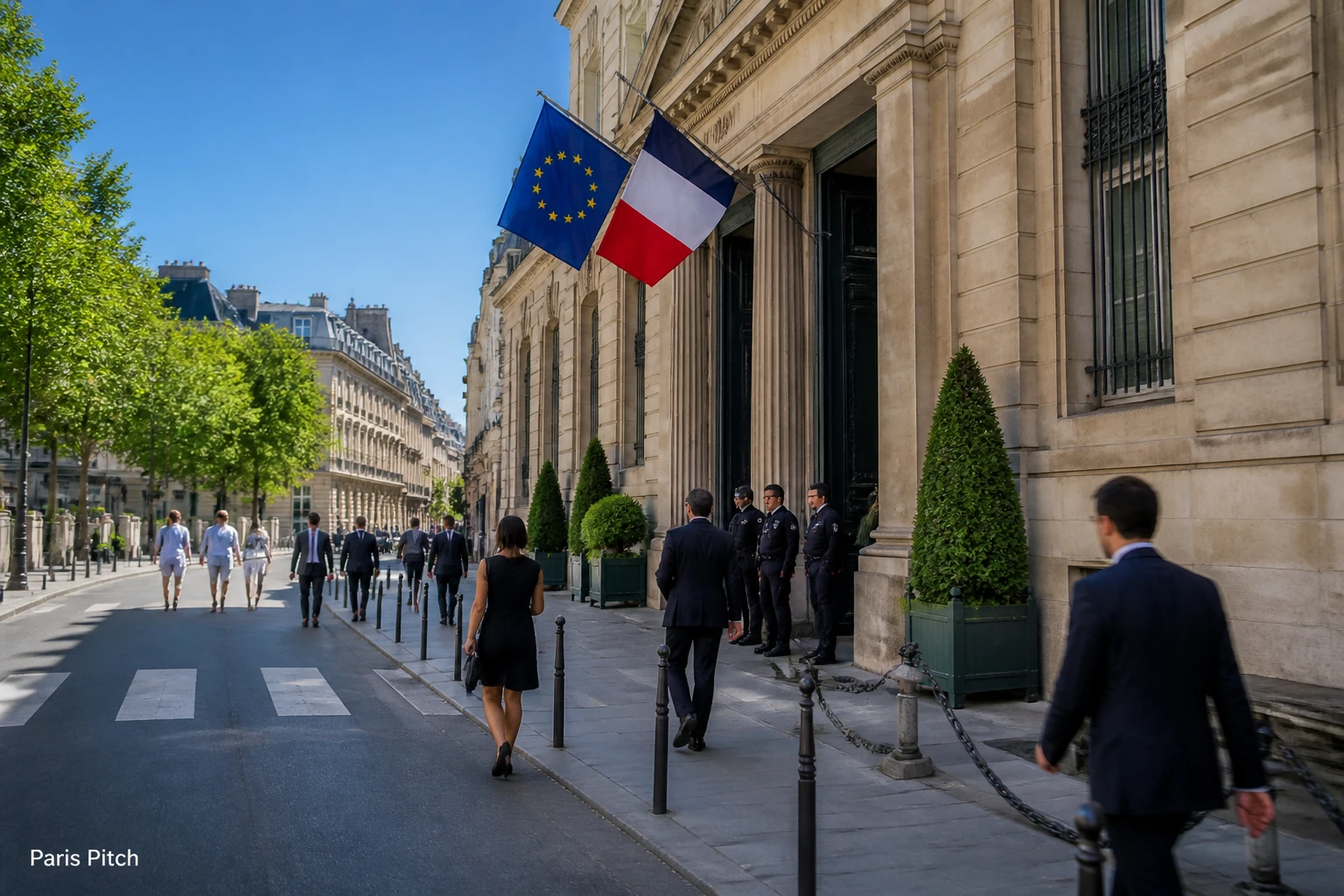
Prabowo’s Paris Eid Signals Indonesia’s Global Investor Pitch
President Prabowo’s Eid al-Adha appearance in Paris is more than symbolism: it underscores Indonesia’s bid to project stability, openness and global relevance.
President Prabowo Subianto spending Eid al-Adha in Paris with Indonesians is a small event with a large diplomatic silhouette. It arrives at a moment when investors are reading Indonesia for signals, not slogans: policy continuity, external confidence and the credibility of the country’s international posture. For property buyers and capital allocators watching Lombok, the meaning is not in the ceremony itself, but in what the ceremony suggests about Indonesia’s effort to present itself as disciplined, connected and investment-ready.
The Context
 Prabowo’s Paris Eid Signals Indonesia’s Global Investor Pitch · Photo by Jihan N on Pexels
According to Antara Current, President Prabowo performed this year’s Eid al-Adha prayer in Paris on Wednesday, alongside Indonesians in the French capital. The report is concise, but the setting is telling. Paris is not merely a ceremonial backdrop; it is one of the world’s most visible stages for political symbolism, business diplomacy and diaspora engagement.
For Indonesian readers, Eid is a religious observance. For global investors, it is also a public demonstration of social cohesion, leadership style and diplomatic reach. When a president marks a major religious holiday abroad, the message is usually broader than faith. It speaks to the country’s links with its citizens overseas, its confidence in its own standing, and its desire to be seen comfortably in international settings.
This matters for property markets because real estate is never only local. Capital flows follow narratives as much as regulations. Buyers considering Lombok, Bali or other Indonesian destinations do not just ask whether a villa can rent at 12-22% gross yield; they ask whether the broader country story is stable enough to support tourism, infrastructure, foreign interest and asset liquidity over a five- to ten-year horizon.
Indonesia’s investment case has been drawing attention for several overlapping reasons:
- the Bali-overflow thesis, which continues to push demand eastward and into secondary islands;
- tourism growth that has in some periods run 40-50% year on year in selected Lombok segments;
- a South Lombok entry band often cited between €95,000 and €350,000 for the lower to mid-market; and
- the prospect of airport expansion in 2025-26, which investors are already treating as a timeline rather than a possibility.
Against that backdrop, Prabowo’s Paris appearance is a soft-power event, but soft power can have hard consequences for capital formation. Markets do not price ceremony directly. They do, however, price confidence.
A leader’s overseas public visibility rarely moves a market on its own. It does, though, reinforce the story investors tell themselves about institutional continuity and international legitimacy.
The key question, then, is not whether the Eid prayer in Paris was newsworthy. It is whether it adds to a pattern that suggests Indonesia wants to be seen as more globally legible, more predictable and more open to foreign attention.
Diplomatic Optics and Market Sentiment
For overseas investors, Indonesia’s brand matters. The country competes not only with Thailand, Vietnam and Malaysia for tourism flows, but also with broader Asian and Middle Eastern destinations for mobile private capital. In that contest, perception is an asset class.
A president appearing in Paris with Indonesians sends several signals at once:
- It recognises the Indonesian diaspora as part of the national story.
- It places Indonesia in a European setting that remains influential in family office, UHNW and institutional circles.
- It suggests a leadership style that is comfortable with international exposure.
- It helps frame Indonesia as a country with outward-looking ambitions rather than purely domestic priorities.
That does not automatically translate into stronger property prices. But it can improve the tone around foreign participation. And tone matters in frontier and emerging markets, where investors often distinguish between jurisdictions on the basis of one simple question: are we dealing with a state that welcomes capital, or one that merely tolerates it?
The answer is always more complex in practice, but public symbols help shape the first impression.
A useful way to read this event is to separate symbolism from fundamentals:
| Signal | Investor interpretation | |---|---| | President in Paris with Indonesians | Diaspora engagement; global visibility | | Eid observance abroad | Cultural continuity and national unity | | Strong external optics | Potentially improved confidence in Indonesia’s international posture | | Media coverage by Antara | Official recognition of the event’s diplomatic value |
The real issue is whether these optics align with the practical conditions investors need: reliable permitting, clear land titles, disciplined infrastructure delivery and a tourism economy that can absorb new inventory without collapsing returns.
For Lombok, that link is direct. Buyers in South Lombok are not purchasing an abstract national narrative. They are purchasing access to beaches, roads, airports, resort corridors and an operating environment that can support occupancy.
Why Lombok Investors Should Pay Attention
Lombok is increasingly framed as an alternative to Bali, but that framing is too narrow. The island is better understood as a second-phase tourism market: still relatively affordable, still in asset-formation mode, and still sensitive to infrastructure signalling.
This is where a headline like Prabowo’s Paris Eid appearance becomes relevant. Markets in Lombok do not need every political event to be about property. They need enough of them to suggest that Indonesia’s central leadership is focused on international confidence, social cohesion and long-term development.
That matters because the current Lombok story is built on three pillars:
- tourism demand migration from an overcrowded Bali;
- a pipeline of infrastructure and access improvements; and
- a pricing base that still leaves room for yield expansion if execution holds.
The risk profile remains real. Secondary markets can overpromise and underdeliver. New destinations sometimes see speculative oversupply, weak management standards or regulatory friction. Investors should therefore avoid treating a single ceremonial event as proof of structural progress. It is not.
But it can be read as part of a broader sequence of market-friendly optics, particularly if followed by policy consistency and infrastructure delivery. In an environment where investors weigh not just current occupancy but the trajectory of the destination, these signals accumulate.
Consider the following practical lens:
- If the government projects stability internationally, foreign purchasers are more likely to believe that the domestic environment will remain investable.
- If Indonesia sustains tourism growth, Lombok’s emerging inventory becomes easier to absorb.
- If airport and access improvements materialise on schedule, South Lombok’s pricing band can remain compelling even as demand broadens.
- If the country keeps attracting international attention through diplomacy, sport, religion and trade, the narrative of Indonesia as a serious long-term destination strengthens.
This is not a guarantee. It is a probability adjustment.
For investors, probability adjustments matter. A small shift in perceived political stability or policy continuity can alter underwriting assumptions: occupancy curves, resale timelines, rental growth forecasts and exit liquidity. In markets where overseas demand is still forming, perception often precedes transaction volume.
What This Means for Investors
Prabowo’s Eid in Paris should not be over-read, but it should not be dismissed. For Lombok-focused investors, it is another data point in a broader picture of an Indonesian state that wants to be seen as confident abroad and coherent at home. That combination is supportive of tourism investment, particularly in markets like South Lombok where the supply-demand balance is still developing and where entry tickets remain accessible relative to mature resort destinations.
The immediate implication is sentiment-positive rather than valuation-changing. A single appearance in Paris does not alter land values, rental yields or permitting rules. But it can reinforce the broader thesis that Indonesia is actively curating its international image, and that has downstream effects on the willingness of foreign buyers to study, visit and ultimately transact.
For property investors, the core takeaway is simple: keep tracking political optics, but underwrite only fundamentals. In Lombok, those fundamentals remain centred on access, tourism flow, execution quality and legal clarity. If the policy and infrastructure backdrop continues to improve, the market can still support the kind of yield profile investors are seeking, particularly in the €95,000-€350,000 South Lombok bracket.
That is why this dispatch matters. The event in Paris is not the story by itself. It is a reminder that Indonesia’s investment narrative is being performed not only in ministries and construction sites, but also on global stages where perception is formed.
For now, the market read is cautiously constructive: Indonesia is signalling continuity, and Lombok remains one of the more interesting places to test that signal against real assets.
Stay informed, subscribe to the free Lombok Briefing for market intelligence like this, published twice a month.
What gross rental yields can foreign investors expect from Lombok property?
The article cites gross yields of 12 to 22% in Lombok, supported by a Bali-overflow thesis pushing demand toward secondary islands and tourism growth that has run 40 to 50% year on year in selected Lombok segments. These are gross figures, so buyers should account for management fees, maintenance and vacancy when estimating net returns.
What is the typical entry price range for buying property in South Lombok?
South Lombok's lower to mid-market entry band is cited between €95,000 and €350,000. The island is described as still relatively affordable and in asset-formation mode, with airport expansion in 2025 to 2026 already being treated by investors as a timeline rather than a possibility, adding urgency to early-stage positioning.
Why does Indonesia's international reputation matter when investing in Lombok property?
Capital flows follow narratives as much as regulations. Property buyers assessing Lombok ask whether the broader country story is stable enough to support tourism, infrastructure and asset liquidity over a five to ten year horizon. In frontier and emerging markets, investors distinguish between states that welcome capital and those that merely tolerate it, making political confidence a real pricing factor.
The Lombok Buyer's Field Guide
Legal structures ranked by risk, the honest ROI math line by line, all six zones ranked, and the 24-point due-diligence checklist. The whole book, free in your inbox.
See what's inside