Prabowo Orders Peatland Wells and Canals as Indonesia Steps Up Fire Prevention
Indonesia’s president has ordered more peatland wells, retention ponds and canal blocks as dry conditions heighten fire risk.
Indonesia is intensifying its effort to prevent forest and land fires, with President Prabowo Subianto directing officials to build additional wells and canal blocks in peatland areas. The instruction combines fire mitigation with a practical local-development aim: infrastructure designed to keep peatlands wet may also support community livelihoods.
A peatland-focused response
Speaking at a fire-management coordination meeting in Palembang, South Sumatra, President Prabowo urged officials to remain alert to potential fires as dry conditions associated with the El Niño phenomenon threaten parts of the country.
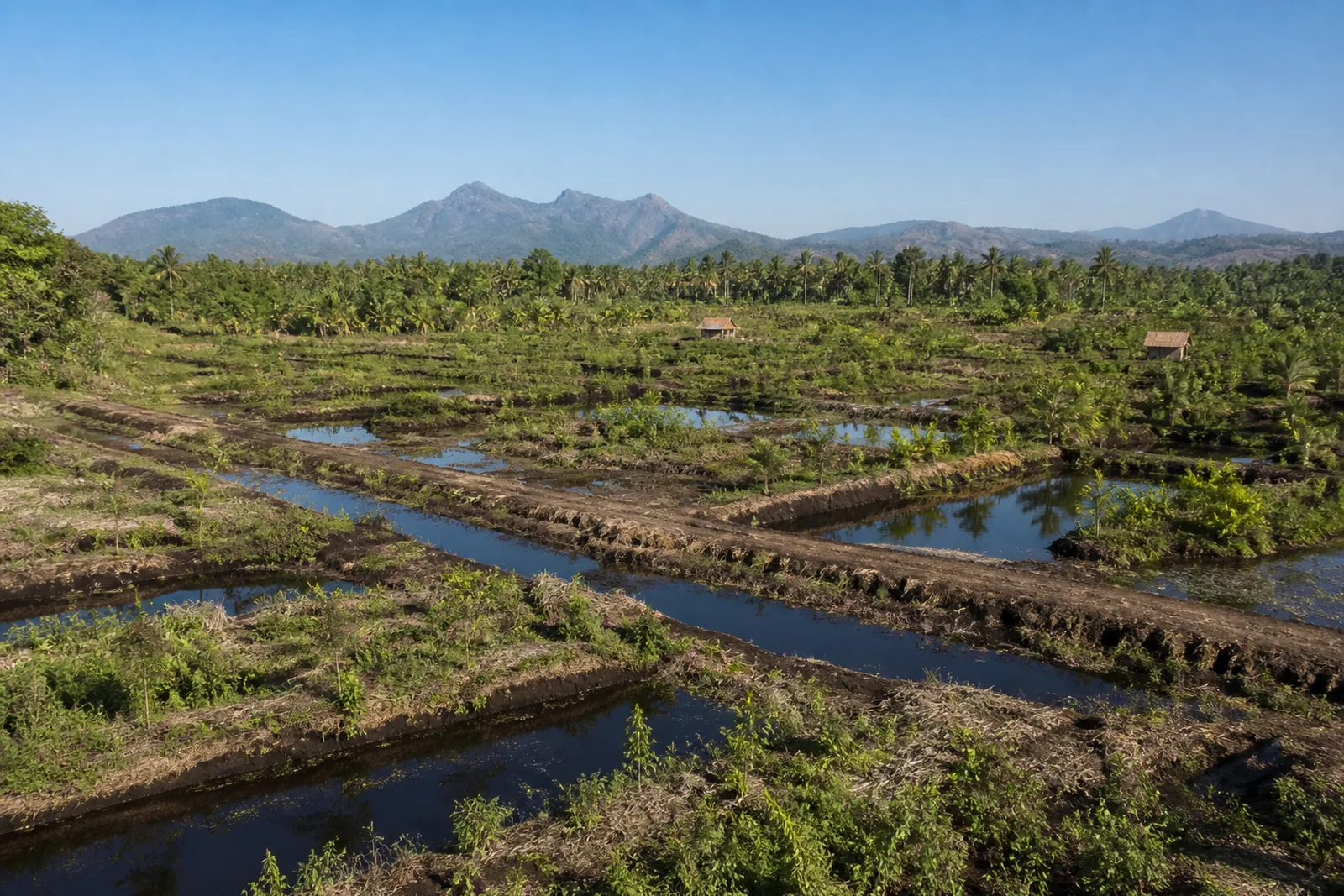
His central instruction was clear: expand water-management infrastructure in peatlands. He called for more wells, productive retention basins and canal blocks in areas vulnerable to wildfires, arguing that obstacles can become opportunities when infrastructure is designed for more than one purpose.
Policy direction: build additional peatland wells, retention ponds and canal blocks to help prevent fires while creating direct benefits for local communities.
Peatland fire prevention is the core objective. The proposed measures are intended to retain water and keep peatlands moist, reducing the conditions in which fires can take hold or spread. The President said drilling wells in peatlands was not especially difficult, signalling an emphasis on practical implementation rather than a purely declaratory response.
BRIN asked to support retention ponds and canal blocks
The President asked the National Research and Innovation Agency, known as BRIN, to assist with constructing retention ponds and canal blocks in wildfire-prone areas. The request places technical and research capacity alongside the operational task of fire prevention.
The initiative is framed as dual-purpose infrastructure. Retention basins and canals would serve the immediate environmental objective of maintaining moisture in peatland landscapes. At the same time, the President suggested that retention basins could be used for aquaculture, allowing local residents to derive an economic benefit from assets built for fire mitigation.
That dual-use approach matters because it links prevention measures to everyday local interests. Infrastructure that has a role beyond emergency preparedness may be more visibly embedded in community life, although the source does not set out how individual projects will be selected, funded or managed.
Technology joins physical water infrastructure
Physical infrastructure is only one part of the government’s stated response. President Prabowo also pressed for wider use of technology to fight blazes in South Sumatra, including weather-modification operations intended to keep peatlands moist.
Operational focus: Indonesia is increasing wildfire-mitigation efforts as risk levels peak between August and September.
The combination of wells, canal blocks, retention ponds and weather modification indicates a layered approach: local water retention on the ground, supported by broader technical operations where authorities consider them necessary. The source attributes this approach to a period of heightened risk, rather than presenting it as a guarantee that fires will be avoided.
For investors following Indonesia, the significance lies less in any single engineering measure than in the direction of travel. Fire risk is being treated as a national operational priority, with preventive water management and technology both part of the public response. The policy is relevant to businesses and asset owners whose operations, supply chains or communities may be exposed to environmental disruption.
Six provinces designated as priorities
The National Disaster Mitigation Agency, BNPB, has designated six priority provinces for firefighting operations:
- West Kalimantan
- Central Kalimantan
- South Kalimantan
- Riau
- South Sumatra
- Jambi
South Sumatra was the setting for the coordination meeting and is among the provinces identified by BNPB. The source says wildfire-mitigation efforts are being ramped up across several regions as risk levels rise during the August-to-September period.
The announcement does not identify Lombok as a priority province, nor does it provide new rules for property owners, developers or tourism operators. Its relevance to Lombok-focused investors is therefore national rather than local: it offers a window into how Indonesian authorities are approaching climate-related operational risks through preventive infrastructure, technical support and coordination among public bodies.
What this means for investors
The immediate story is an environmental-management initiative, not a change to Indonesian property law or an investment programme. Still, investors with exposure to Indonesia can draw several disciplined observations from the announcement:
- The government is prioritising prevention ahead of the period when fire risk peaks between August and September.
- Water retention in peatlands is being positioned as both a fire-control measure and a potential community asset.
- BRIN’s proposed role suggests that technical capacity is expected to support field-level infrastructure.
- BNPB has publicly identified six priority provinces for firefighting operations, providing a defined geographic focus for this phase of mitigation.
For cross-border investors, the sensible reading is not to extrapolate beyond the announcement. There are no project-level investment terms, property-market figures or implementation timetables in the source. What is clear is that the President has asked officials to add peatland wells, retention basins and canal blocks, while also expanding the use of technology in the fight against fires.
The next point to watch is how these instructions translate into projects in the priority provinces during the period of elevated risk.
Stay informed, subscribe to the free Lombok Briefing for analysis like this, published twice a month.
What infrastructure has Prabowo ordered for peatland fire prevention?
President Prabowo Subianto has ordered additional wells and canal blocks in peatlands, and called for productive retention basins and canals in wildfire-prone areas. The measures are intended to help keep peatlands moist and reduce forest and land fire risk.
Which provinces are priorities for Indonesia’s firefighting operations?
BNPB has designated West Kalimantan, Central Kalimantan, South Kalimantan, Riau, South Sumatra and Jambi as six priority provinces for firefighting operations. The source says wildfire-mitigation efforts are increasing as risk peaks between August and September.
How could peatland retention basins benefit local communities?
The President said retention basins could also be used for aquaculture to support local livelihoods. The stated policy aim is dual-purpose infrastructure: helping prevent fires in peatlands while directly benefiting residents in the surrounding communities.

The Lombok Buyer's Field Guide
Legal structures ranked by risk, the honest ROI math line by line, all six zones ranked, and the 24-point due-diligence checklist. The whole book, free in your inbox.
See what's inside