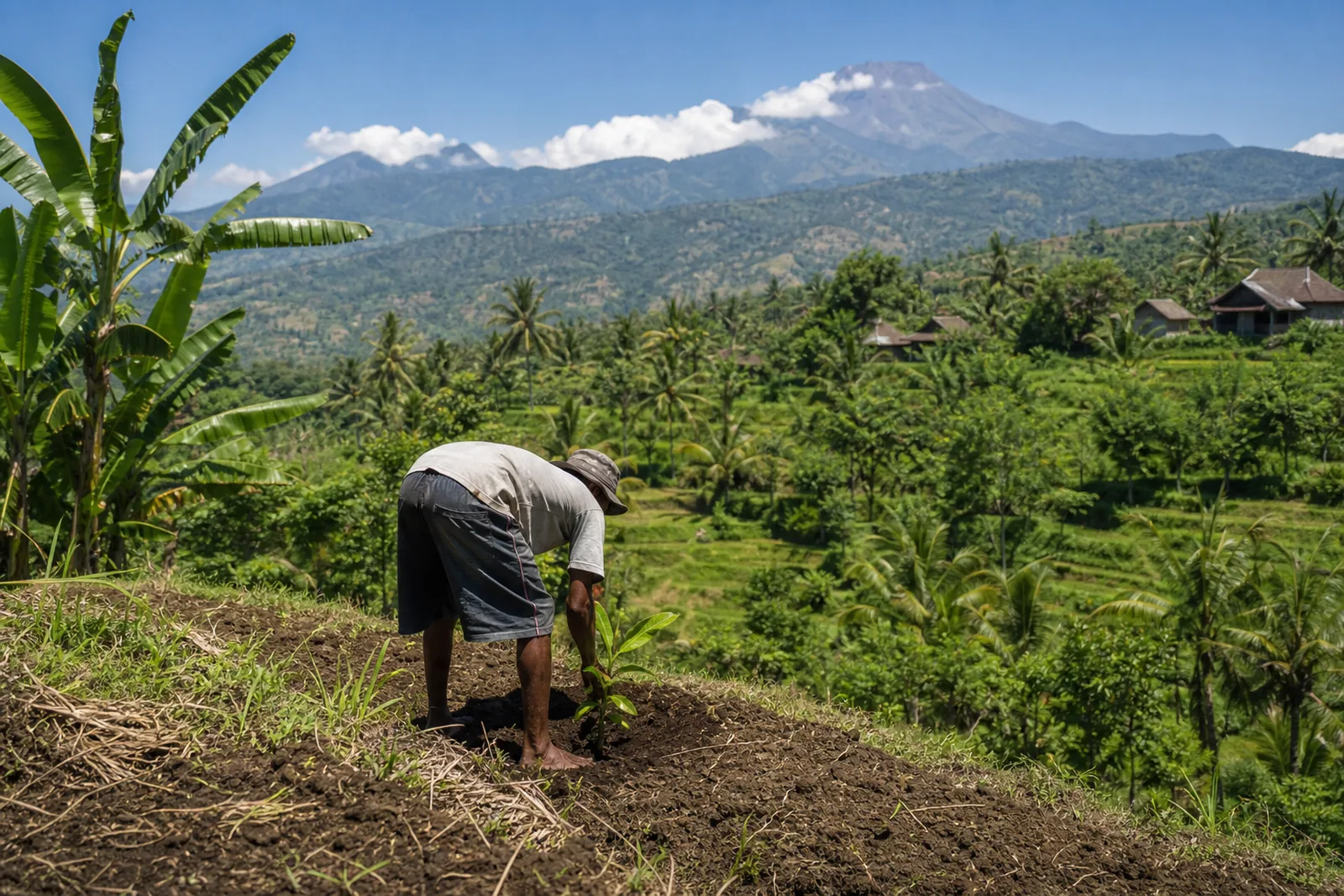
Prabowo Sets a Decade-Long Goal to Re-green Deforested NTT
Indonesia’s president has set out a plan to restore deforested parts of East Nusa Tenggara through coordinated reforestation.
Indonesia’s President Prabowo Subianto has set a broad environmental objective for East Nusa Tenggara: restoring deforested areas to greener landscapes within about a decade. The programme is framed not as a stand-alone planting campaign, but as a coordinated effort involving central and regional government, universities and research institutions.
A long-term restoration objective
The president outlined the ambition during a coordination meeting on post-earthquake management in NTT. He identified the loss of trees and reduced forest cover as a central environmental concern for the province, while stressing that land should not be cleared by burning.
The stated timeframe is important. Reforestation is inherently a patient undertaking: a policy announcement can establish direction quickly, but the ecological and economic value of restored landscapes depends on implementation over years. Prabowo said he was optimistic that deforested areas across NTT could regain forest cover within about 10 years.
The government’s stated objective is to turn deforested NTT areas into green landscapes within about a decade.
For investors following eastern Indonesia, the announcement is principally a signal of policy attention towards environmental rehabilitation. It does not, by itself, establish a project pipeline, investment return or regulatory change. Its significance will rest on how the programme is organised, resourced and carried through at provincial and district level.
A programme built around coordination
Prabowo said NTT’s reforestation should be planned and coordinated across multiple institutions. Provincial and district governments are expected to work alongside the central government and universities, with coordination involving the Directorate General of Higher Education and the National Research and Innovation Agency, known as BRIN.
The government had previously formed a team involving the Defense University, the Ministry of Higher Education, Science, and Technology, and BRIN. Its task is to study approaches used in other countries to accelerate reforestation.
That institutional design reflects a practical reality: restoration is more than the distribution of seedlings. It requires local administration, research capacity, community participation and techniques suited to damaged or mountainous terrain. The source does not specify the methods that will ultimately be adopted, nor does it detail funding, planting areas or delivery milestones. Those omissions matter when assessing the programme’s eventual scale.
Still, the emphasis on coordination suggests that the government sees forest restoration as a cross-sectoral task rather than simply an agricultural or conservation initiative. For the region’s wider economy, better land and water stewardship can become relevant to resilience, rural productivity and the management of environmental risks, though the president’s remarks should be read as an ambition, not evidence that these outcomes have already been achieved.
Nurseries, productive plants and water retention
A core operational request is the establishment of nursery centres at provincial and district levels. These centres would produce tree seedlings as well as productive plants, creating a local foundation for restoration activity.
Prabowo also encouraged the use of permaculture concepts in mountainous and environmentally damaged areas. He said the approach takes time to show results but can materially improve the soil’s ability to retain water.
Prabowo said careful implementation could, in four, five, or six years, accommodate and increase water in the earth.
This focus on water retention is notable because it shifts the policy discussion beyond tree cover alone. The stated aim is to rebuild the capacity of the landscape to hold water, an outcome the president linked to careful, sustained work rather than rapid intervention.
The proposed blend of nurseries, tree planting and productive plants may also indicate an attempt to align restoration with livelihoods. However, the source does not specify which plants would be cultivated, how communities would participate, or what land-management arrangements would apply. Investors and businesses should therefore distinguish clearly between the announced direction and the detailed programme rules that may follow.
Education sits alongside restoration
The president repeatedly linked reforestation with public education. He said younger generations should be taught the importance of preserving trees and avoiding land clearing by burning.
That emphasis is more than rhetorical in the context of a decade-long objective. Forest restoration can be undermined if land-use practices continue to remove new or existing tree cover. The government’s position, as set out by Prabowo, is that environmental education must accompany physical restoration efforts.
For market observers, this creates a broader lens through which to follow the policy. The practical questions are likely to include whether provincial and district authorities establish the requested nursery capacity, how universities and research bodies contribute, and whether education efforts are embedded in local implementation. None of these points can yet be treated as settled outcomes; they are the tests by which the programme’s progress will be judged.
What this means for investors
The immediate investment implication is one of monitoring rather than repricing. The announcement concerns East Nusa Tenggara, not South Lombok, and it does not set out a direct property, tourism or infrastructure measure. Yet it highlights the increasing importance of environmental resilience in Indonesian regional development.
Investors with exposure to Indonesia should keep several distinctions in view:
- Policy target versus delivery: restoring deforested NTT areas within about 10 years is the president’s stated target, not a completed programme.
- Environmental design versus commercial terms: the source describes nurseries, productive plants, permaculture and institutional coordination, but provides no investment framework or financial projections.
- Regional relevance versus local equivalence: NTT and Lombok are distinct markets; an NTT policy announcement should not be used to make assumptions about land, tourism or property conditions in South Lombok.
The more durable lesson is straightforward. Environmental quality, water management and land-use practices are becoming part of the policy conversation around regional development. Investors should watch the implementation of this NTT initiative for evidence of administrative capacity and long-term environmental planning, while keeping any assessment of individual Indonesian markets anchored in their own local conditions.
Stay informed, subscribe to the free Lombok Briefing for analysis like this, published twice a month.
What is President Prabowo’s reforestation target for NTT?
President Prabowo Subianto said Indonesia aims to restore deforested areas across East Nusa Tenggara to green landscapes within about 10 years. The plan involves central, provincial and district governments, universities and research institutions.
Which institutions are expected to support NTT reforestation?
Prabowo said provincial and district governments will be assisted by the central government and universities, coordinated through the Directorate General of Higher Education and BRIN. A separate team includes the Defense University, the higher-education ministry and BRIN.
Does the NTT announcement change the South Lombok property market?
No direct change was announced. The policy concerns East Nusa Tenggara, not South Lombok, and the source provides no property, tourism, infrastructure or investment measure. Investors should assess Lombok on its own local market conditions.

The Lombok Buyer's Field Guide
Legal structures ranked by risk, the honest ROI math line by line, all six zones ranked, and the 24-point due-diligence checklist. The whole book, free in your inbox.
See what's inside