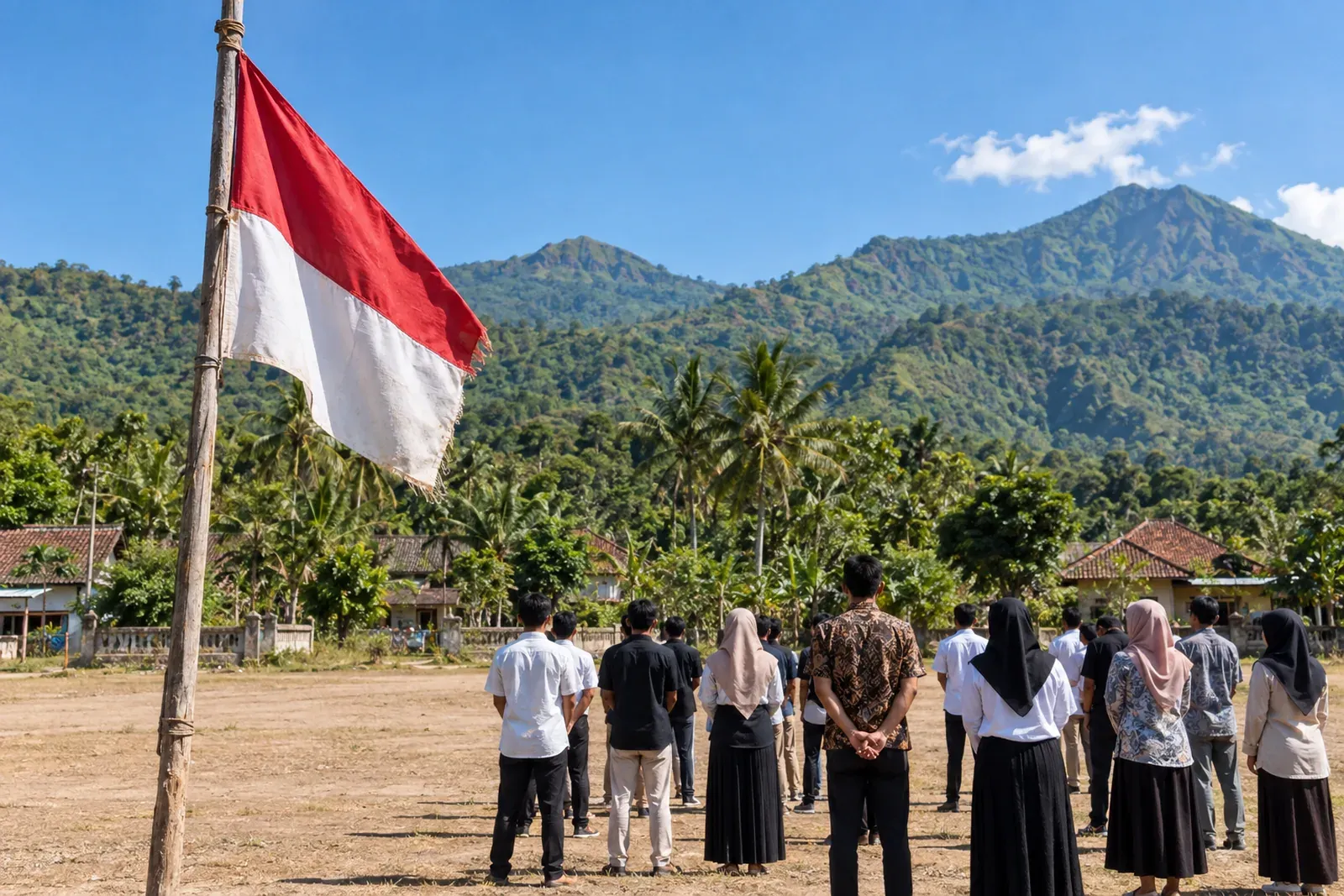
Prabowo Urges National Unity: What Indonesia's Historical Focus Signals for Global Capital
President Prabowo Subianto calls on youth to master national history, signalling a governance model anchored in cohesion, sovereign policy, and long-term institutional stability.
Speaking at the inauguration of a new Taruna Nusantara High School campus in Cimahi, West Java, President Prabowo Subianto delivered a pointed message on statecraft and national identity. The address urged younger generations to study history diligently to prevent repeating the structural mistakes of the past.
For international capital assessing Southeast Asia's largest economy, the remarks offer valuable insight into the ideological framework guiding the administration. Prabowo framed historical awareness not as an academic exercise, but as an essential safeguard for national cohesion, sovereignty, and sustainable economic governance.
Historical Precedent and Sovereign Policy
Addressing students and dignitaries in Cimahi, Prabowo cited colonial rule as a defining lesson in the perils of internal fragmentation. He noted that past rulers often succumbed to divide-and-rule strategies by prioritizing external patronage over domestic solidarity.
"Those who are too lazy to study history will be punished by history," Prabowo remarked, warning that an inability to learn from earlier shortcomings has historically weakened leadership. In his speech, broadcast via the Presidential Secretariat, he underscored that human nature remains constant across eras, making historical lessons directly applicable to contemporary state-building.
Key takeaway from the presidential address: "If we do not learn from history, we will repeat the mistakes of the past, the mistakes made by those who came before us."
For foreign observers, this rhetoric reinforces Indonesia's long-standing diplomatic doctrine: non-aligned, fiercely sovereign, yet pragmatic in international engagement. The administration consistently signals that commercial partnerships are welcome, provided they align with national developmental priorities.
Human Capital as an Economic Foundation
The choice of venue was itself symbolic. Taruna Nusantara is renowned as an elite boarding institution, and the expansion of its campuses reflects a broader state commitment to leadership and educational capacity. Prabowo affirmed that education forms the bedrock of national progress, noting that prior generations achieved notable milestones despite severe structural constraints.
This emphasis aligns directly with the macro requirements of global investors:
- Workforce modernization: Transitioning from resource extraction to advanced manufacturing and high-end services demands skilled local talent.
- Institutional continuity: Stable governance frameworks rely on cohesive administrative elites capable of executing multi-decade infrastructure masterplans.
- Social cohesion: Broad-based educational access reduces regional wealth disparities, underpinning political stability across the archipelago.
By framing education and historical awareness as national security imperatives, the administration aims to build an internal buffer against external shocks and political polarization.
The Broader Context: Predictability and Rule of Law
International capital values policy continuity above all else. In emerging markets, ideological volatility or abrupt regulatory shifts represent primary operational risks. Prabowo's call to avoid historical missteps suggests an administration wary of uncoordinated concessions, yet deeply committed to strengthening sovereign legal frameworks.
In recent years, Indonesia has steadily modernized its regulatory architecture for foreign enterprise. Structures such as the PT PMA (foreign-owned company) allow international capital to operate securely within strictly demarcated statutory parameters, such as holding Hak Guna Bangunan (HGB) rights for commercial and hospitality developments.
By contrast, informal arrangements or nominee schemes remain strictly illegal and unenforceable in Indonesian courts. The state's insistence on institutional integrity and legal order reflects the very discipline Prabowo advocated in Cimahi.
What This Means for Investors
Prabowo's address reinforces several fundamental principles for institutional and private investors allocating capital across Indonesia, including frontier growth destinations:
- A disciplined sovereign partner: Indonesia continues to prioritize sovereign interest, value-added domestic industries, and domestic value capture. Investors who build transparent, legally compliant ventures will find consistent governmental support.
- Emphasis on long-term stability: The administration's focus on national unity and youth education reduces the likelihood of divisive domestic upheaval, preserving macroeconomic predictability.
- Adherence to formal channels: With an administration vigilant against historical patterns of exploitation, foreign capital must operate strictly through documented, sanctioned mechanisms. Navigating land rights, company establishment, and tax obligations through licensed notaries (PPAT) and formal agencies like the national land office (BPN) is non-negotiable.
As Indonesia navigates complex global geopolitics, its leadership remains focused on internal solidarity and disciplined progress. For long-term investors, a nation committed to learning from its past offers the foundational stability necessary to build sustainable value for the future.
Stay informed: subscribe to our free Lombok Briefing, published twice a month (the 1st and 15th), for analysis like this.
How does Prabowo's speech reflect Indonesia's foreign investment climate?
The president's emphasis on learning from historical divisions signals an administration committed to national unity, sovereign policy continuity, and clear legal boundaries. For foreign investors, this translates into political predictability, provided investments operate through legitimate, fully compliant domestic structures.
Why is the government's focus on education relevant to global capital?
Expanding high-standard educational institutions strengthens Indonesia's domestic talent pool and administrative capacity. A skilled local workforce supports industrial modernization, reduces regional disparities, and ensures the institutional capability required to manage large infrastructure and investment projects across the country.
What legal precautions should foreign investors take under this administration?
Investors must use formal statutory routes, such as establishing a PT PMA or securing verified leasehold titles. Because national policy prioritizes legal sovereignty and compliance, informal nominee schemes are illegal and void, making certified due diligence with licensed legal professionals essential.

The Lombok Buyer's Field Guide
Legal structures ranked by risk, the honest ROI math line by line, all six zones ranked, and the 24-point due-diligence checklist. The whole book, free in your inbox.
See what's inside