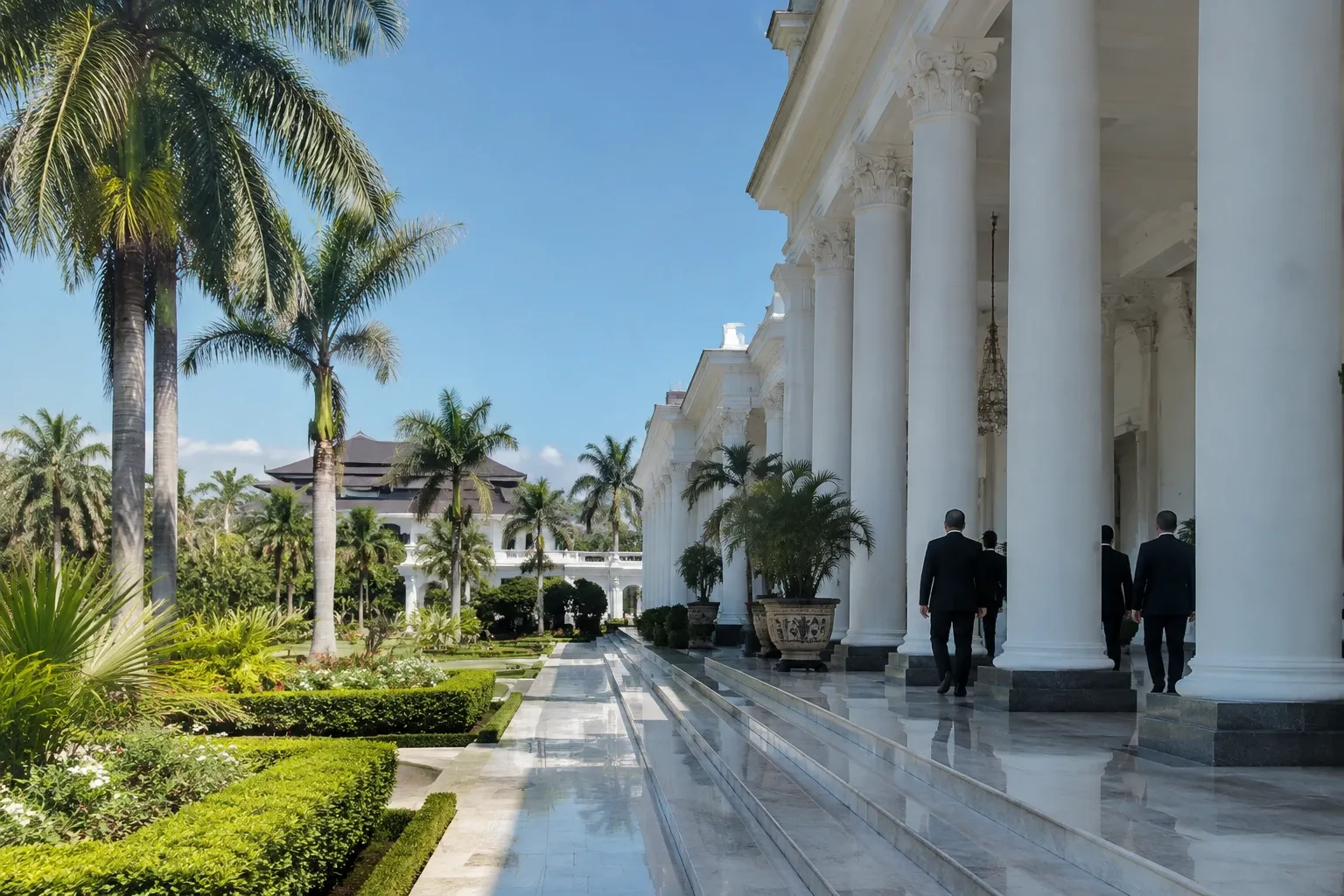
Jakarta Navigates Executive Transition as Constitutional Succession Begins
Following Gibran Rakabuming Raka's resignation, President Prabowo convenes parliamentary leaders to activate constitutional succession rules under Article 8 of the 1945 Constitution.
President Prabowo Subianto gathered parliamentary leaders and senior cabinet ministers at the Presidential Palace in Jakarta on Thursday, initiating formal consultations just hours after Vice President Gibran Rakabuming Raka submitted his voluntary resignation. The swift institutional response signals a concerted effort to maintain administrative continuity and constitutional order across Southeast Asia's largest economy.
For international capital observing Indonesia from London, Sydney, or New York, executive reshuffles inevitably prompt questions regarding policy durability. However, the immediate activation of established constitutional mechanisms provides clarity on how the executive branch and legislature will manage the vacancy.
The Constitutional Framework: Article 8 and the 60-Day Mandate
The central pillar governing this transition is Article 8, paragraph (2), of Indonesia's 1945 Constitution. Following the receipt of the resignation letter, state institutions are bound by strict procedural guidelines designed to prevent governance vacuums.
Key Constitutional Parameters
- Timeline: The People's Consultative Assembly (MPR) must convene within 60 days to elect a successor.
- Nomination: President Prabowo Subianto holds the exclusive authority to submit two nominees.
- Scope: The House of Representatives (DPR) coordinates on institutional alignment, while formal electoral authority rests with the MPR.
Coordinating Minister for Law, Human Rights, Immigration, and Corrections Yusril Ihza Mahendra confirmed that Gibran's five-paragraph resignation letter specifically requested the MPR to follow the constitutional procedure. By invoking Article 8 directly, the departing vice president set in motion a legal pathway that has been rehearsed in Indonesian jurisprudence, offering predictability to institutional observers.
Inter-Branch Coordination at the Merdeka Palace
The Thursday afternoon gathering brought together key figures from the executive and legislative branches, reflecting a deliberate effort to achieve consensus before formal parliamentary proceedings begin. Attendees included leaders of the MPR, representatives of DPR Commission III, and senior cabinet members.
Minister Yusril described the session as an essential consultative meeting between the head of state and parliamentary leadership. While the DPR is not directly involved in electing a replacement vice president, its leadership and legal commission play an instrumental role in maintaining legislative balance.
Such coordination is standard practice in Indonesia's consensus-oriented political culture. By aligning the cabinet with parliamentary factions early, President Prabowo aims to ensure that the eventual selection of two vice-presidential nominees proceeds without legislative friction or political gridlock.
Institutional Stability and Economic Governance
Market participants typically assess political transitions through the lens of policy continuity. Under the Indonesian presidential system, executive power remains concentrated in the presidency. President Prabowo continues to direct national policy, oversee state expenditure, and command the armed forces and civil administration.
Indonesia's macroeconomic trajectory rests on broad structural drivers that transcend individual cabinet portfolios. Long-term infrastructure developments, regulatory frameworks governing foreign direct investment, and national priority programmes remain legally anchored by enacted legislation and executive decrees. The swift engagement of legal authorities such as Minister Yusril underscores that the state apparatus is operating strictly within statutory boundaries.
While political commentators will parse the personal reasons cited in Gibran's departure, institutional investors tend to focus on process. The reliance on transparent constitutional clauses mitigates uncertainty, reassuring foreign capital that rule of law prevails in executive governance.
What this means for investors
For foreign investors evaluating Indonesian assets, whether in diversified equities, infrastructure bonds, or prime regional property, political headlines must be evaluated against operational reality.
- Constitutional Certainty: The 60-day deadline creates a finite window for resolution, preventing protracted administrative drift.
- Executive Continuity: President Prabowo retains full constitutional authority, ensuring that bilateral agreements and strategic economic initiatives proceed uninterrupted.
- Currency and Macro Foundations: The broader investment environment continues to be supported by disciplined fiscal management, with foreign exchange rates monitored closely around Rp 16,500 per US dollar.
- Regional Growth Resilience: In high-growth frontier destinations such as South Lombok, where foreign tourist arrivals continue their trajectory of +40-50% year on year, investment demand is driven by lifestyle fundamentals, infrastructure expansion, and tourism recovery rather than political appointments in the capital.
As the MPR prepares to receive President Prabowo's two nominees, Indonesia's institutional architecture is demonstrating the resilience required of a modern G20 economy.
Stay informed: subscribe to our free Lombok Briefing, published twice a month (the 1st and 15th), for analysis like this.
How will Indonesia select a replacement vice president?
Under Article 8, paragraph (2) of the 1945 Constitution, the People's Consultative Assembly (MPR) must convene within 60 days. President Prabowo Subianto will nominate two candidates, from whom the assembly will elect the new vice president.
Does the vice president's resignation affect foreign investment policies?
Executive governance and economic policy remain firmly under the authority of President Prabowo Subianto. With major state institutions coordinating directly on succession, national infrastructure commitments and foreign investment regulations continue under existing legal frameworks.
What does this political transition mean for regional markets like Lombok?
Regional economic momentum in South Lombok is anchored by structural tourism expansion, with foreign arrivals recording 40-50% year-on-year growth. Clear constitutional processes in Jakarta ensure the macro stability needed for ongoing private capital deployment.

The Lombok Buyer's Field Guide
Legal structures ranked by risk, the honest ROI math line by line, all six zones ranked, and the 24-point due-diligence checklist. The whole book, free in your inbox.
See what's inside