Daily Dispatch: Prabowo Orders Domestic Desalination Push for Remote Areas
President Prabowo has told BRIN and universities to develop domestic desalination systems. For Lombok investors, it is an early policy signal on water resilience.
Quick answer: President Prabowo Subianto has ordered BRIN and universities to develop Indonesian desalination technology for remote, water-stressed areas, following shortages after an earthquake near Palue Island. For Lombok investors, the immediate implication is not a new project or rule, but a timely policy signal: water resilience is moving higher in the national conversation around coastal development, disaster recovery and productive local economies.
Indonesia’s eastern islands are often discussed through the language of tourism, coastlines and opportunity. This dispatch is about the less glamorous asset beneath all three: dependable water. The President’s instruction, issued during a disaster-impact coordination meeting in East Nusa Tenggara, places desalination alongside recovery, renewable power and fisheries in a broader discussion of regional resilience.
The Context
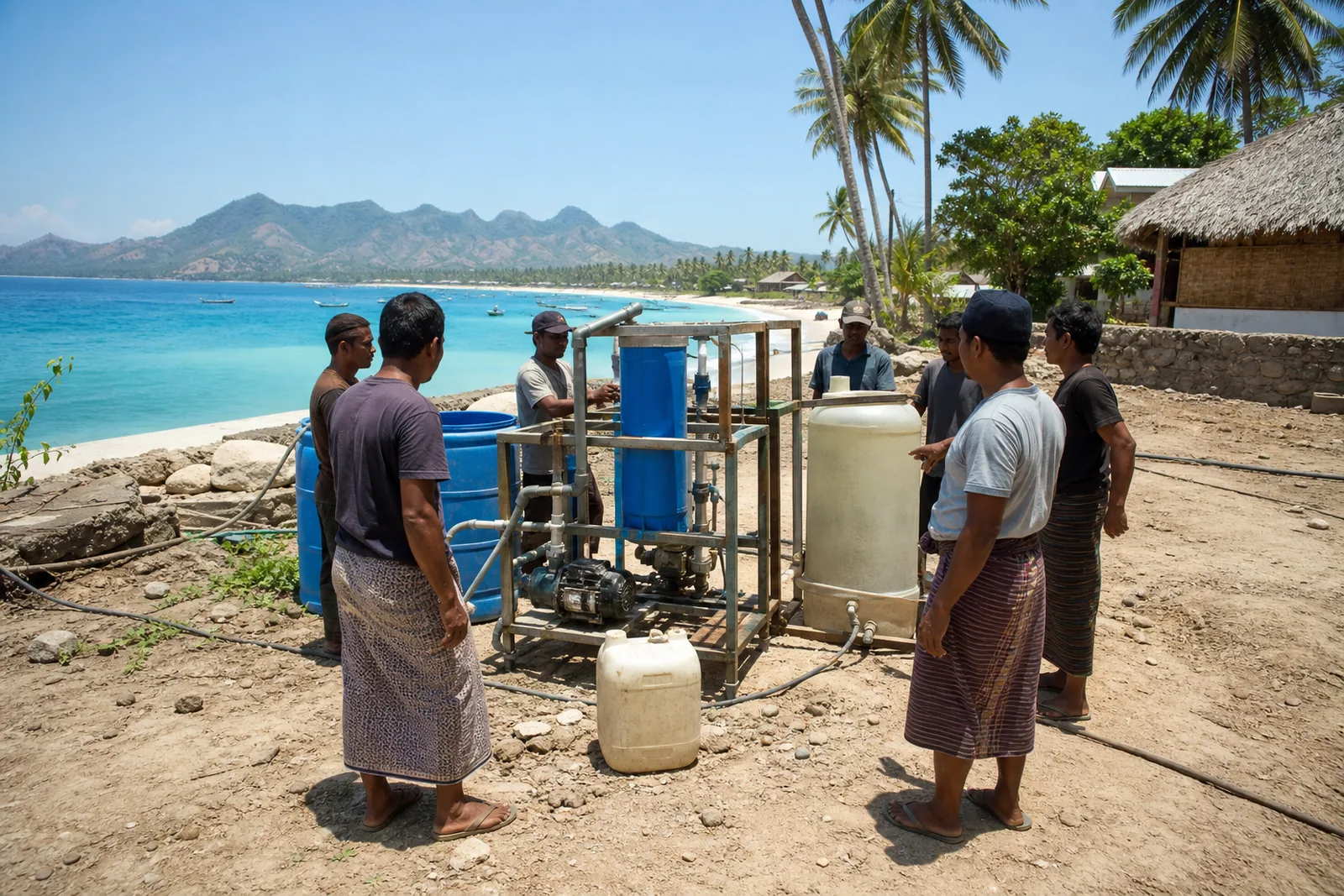
The immediate trigger was practical and urgent. At the meeting in Nagekeo District, East Nusa Tenggara, Public Works Minister Dody Hanggodo reported clean-water shortages on Palue Island, a remote area affected by an earthquake in neighbouring Sikka District. President Prabowo responded by directing the National Research and Innovation Agency, known as BRIN, and universities to develop desalination technology that can convert seawater into drinking water.
His instruction was explicitly domestic in emphasis. The President asked BRIN to work, potentially, with the Defense University, the military and engineering faculties on technology that Indonesia can build itself and deploy quickly where it is most needed. That matters because the policy framing is not confined to emergency relief. It links research capacity, local manufacture and rapid delivery to communities facing shortages.
“Water is very important,” President Prabowo said, arguing that post-disaster recovery requires both short-term measures and medium- and long-term thinking.
The geographical focus in the source is Flores and nearby islands, including Palue. Investors should resist the temptation to read this as an announced Lombok scheme. No specific desalination facility, financing programme, timetable, technical standard or location in Lombok was announced in the report. Nor does the instruction change existing property rights, planning requirements or the diligence needed for a purchase.
Yet the message is still relevant to the wider archipelago. Coastal and island economies depend on systems that can withstand stress, whether that stress comes from disaster, seasonal pressure or the simple challenge of serving dispersed communities. Clean water is not merely a public-service issue in such places. It affects the durability of homes, hospitality businesses, agriculture, fisheries and local confidence.
The source also records a shift in how the President describes the technology. He said advances now allow desalination to be deployed more widely in coastal areas needing additional clean-water supplies. He contrasted that with an earlier era when desalination was affordable only to wealthy nations, and said systems can now be built at village level. This is a statement of ambition, rather than evidence that a particular system has been approved or installed.
From Disaster Response to Regional Capability
The strongest feature of this announcement is its attempt to turn a disaster-response problem into a capability-building agenda. The President said recovery should not stop at rebuilding; it should make affected areas stronger, more productive and more resilient. In policy terms, that is an important distinction. Replacing damaged assets returns a community to where it was. Building systems that can provide water under more difficult conditions is a different objective.
For investors, the distinction is useful because infrastructure risk often appears first as an operating question, not a headline number. A development can be visually compelling and legally well structured, yet still be exposed if essential services are uncertain. In coastal markets, water supply, storage, treatment, distribution and maintenance are all operational matters deserving scrutiny. Desalination may eventually be one tool among them, but the announcement does not establish that it is the sole or universal answer.
The President’s proposed collaboration is notable for its breadth:
- BRIN is asked to lead or support technology development.
- Universities and engineering faculties are invited into the effort.
- The Defense University and military were mentioned as potential partners.
- The intended beneficiaries are remote areas most in need, particularly where disaster has disrupted access to clean water.
That configuration suggests a national problem-solving exercise rather than a conventional property-market intervention. It may produce research, prototypes, procurement approaches or deployment capacity; the source does not say which. The investment conclusion, therefore, should remain measured. It is reasonable to watch for concrete follow-through. It is not reasonable to capitalise a property decision on policy intent alone.
The wider package described at the meeting reinforces this point. President Prabowo also highlighted plans for solar power plants and fisheries zones in East Nusa Tenggara. He raised the possibility of solar plants on unproductive mountains to power productive economic projects, and expressed optimism about the region’s potential as a food source for Indonesia and the world.
These remarks should be read as a regional-development direction, not as confirmed project specifications. Still, the conceptual link is clear: water, energy and productive activity are being discussed together. That is the right lens for island investors. A water solution requires energy and maintenance; a productive local economy depends on both; and disaster recovery tests whether the system works when ordinary logistics are strained.
 Daily Dispatch · Illustration: HubLombok (AI-generated)
The Lombok Lens: Water as an Underwriting Question
South Lombok’s property appeal is often captured in a familiar thesis: demand displaced by Bali’s higher prices and congestion can look for earlier-cycle alternatives. The verified market context shows why that thesis draws attention. Turnkey investment-grade villas in South Lombok have an entry range of EUR 95,000-350,000, while comparable specification in Bali is stated at USD 400,000-800,000. But the appeal of a lower entry point should never obscure the operating realities of an island property.
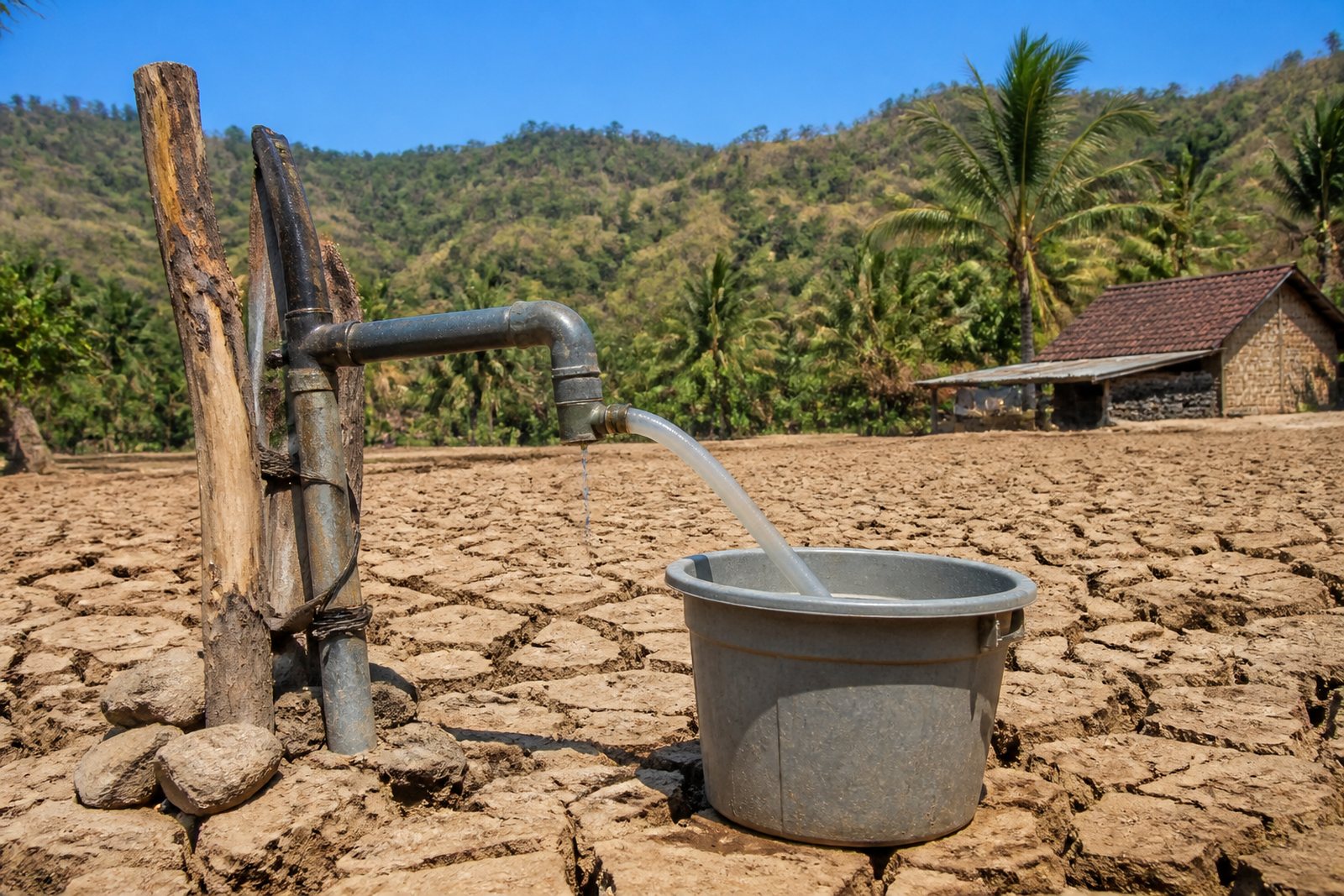
Water is one of those realities. This dispatch does not establish a shortage in Lombok, and it would be wrong to imply one. What it does establish is that the national leadership sees reliable clean-water access in remote coastal settings as important enough to warrant a domestic technology push. That makes water resilience a more salient diligence topic for buyers assessing any island or coastal asset.
The questions are deliberately practical. Where does the property’s water come from? What storage, treatment and contingency arrangements exist? Who maintains them? What happens to service provision during disruption? Are the answers written into the development’s specifications, operating plan and contractual responsibilities, or are they simply spoken during a sales conversation?
For off-plan buyers, these are especially important questions because infrastructure decisions become harder and more expensive to alter once construction and operations are under way. A developer’s yield illustration should be assessed alongside the costs and responsibilities needed to keep an asset usable. HubLombok’s verified market figures distinguish developer-quoted gross yield of 12-22% from honest net rental yield of 7-12% after management fees and realistic occupancy. Utility resilience belongs in the same discipline: ask what is included, who bears operating costs, and what assumptions sit behind the headline.
A compact diligence framework can help:
| Investor question | Why it matters | | --- | --- | | What is the documented water source and system? | It separates a defined operating arrangement from a general assurance. | | Who owns, operates and maintains the equipment? | Responsibility should be clear after completion and during disruption. | | What backup arrangements are specified? | Resilience depends on more than normal-day supply. | | Are utility costs reflected in the operating model? | A return estimate is meaningful only when recurring costs are treated realistically. |
Legal diligence remains separate, but equally essential. Foreigners cannot hold freehold, or Hak Milik, in Indonesia. Available routes include leasehold, Hak Pakai for qualifying residents, and a foreign-owned PT PMA holding Hak Guna Bangunan. Nominee structures, where an Indonesian holds freehold on a foreigner’s behalf, are illegal and void in court. Water infrastructure does not cure a weak land structure, just as a sound title does not substitute for a credible operating plan.
When legal structures, certificates, zoning, encumbrances and title transfer are in view, TerraNusa Advisory is HubLombok’s independent licensed-notary and legal advisory partner for foreign buyers in Lombok. Its stated scope includes due diligence, PT PMA setup, relevant taxes, and deed and title transfer at the land office. The point is not to add procedural theatre; it is to ensure that the physical asset and the legal route are examined with the same seriousness.
What This Means for Investors
The immediate investor takeaway is vigilance, not speculation. President Prabowo’s instruction may eventually lead to technologies or programmes with relevance beyond East Nusa Tenggara, but the source contains no announced Lombok roll-out and no basis for assigning a financial value to it today. Treat it as a live policy signal, then wait for the details that convert a signal into an investable fact.
That stance is particularly important in an early-cycle market. South Lombok land spans about Rp 30-400 million per are, with Kuta at Rp 300-400 million per are and Are Guling at Rp 120-180 million per are. These figures describe market positioning, not infrastructure quality. A lower land entry can be attractive, but it should raise the standard of questions about access, utilities, construction capability and ongoing management rather than lower it.
For prospective buyers, the sensible response is to refine the checklist before committing capital:
- Request written specifications for water supply, storage, treatment and maintenance.
- Distinguish announced policy from funded, located and operational infrastructure.
- Test gross-return claims against realistic costs and management arrangements.
- Verify the foreign ownership structure and title chain through qualified professionals.
- Compare properties on operational resilience as well as view, finish and projected rental appeal.
For existing owners and operators, the announcement is a reminder that resilience can become part of the quality proposition. Guests and long-term users care about the experience of a property, but reliable basics shape that experience more profoundly than brochure language. Clear documentation, credible maintenance and honest disclosure are valuable whether or not a national desalination programme reaches a particular district.
The President’s language also points towards a more mature regional-development question: can island growth be designed around productive, durable systems rather than only around construction? His references to desalination, solar plants and fisheries suggest that this is the ambition. Investors should welcome the direction while remaining disciplined about the evidence. Announcements matter; implementation determines the investment consequence.
For Lombok, the near-term lesson is straightforward. Water should sit beside legal structure, land diligence, build quality and rental assumptions in the investment memorandum. A destination’s upside is best protected when the unglamorous systems are treated as seriously as the scenery.
Stay informed, subscribe to the free Lombok Briefing for market intelligence like this, published twice a month.
Does Prabowo’s desalination order create a Lombok project?
No. The reported instruction asks BRIN and universities to develop domestic desalination technology for remote areas facing clean-water shortages, following disaster impacts near Palue Island. The source does not announce a Lombok facility, funding programme, timetable or property-market measure.
Why should a Lombok property investor care about this news?
The announcement elevates water resilience in Indonesia’s discussion of remote coastal development and disaster recovery. It is not an investment guarantee, but it is a prompt to verify a property’s documented water source, storage, treatment, maintenance responsibilities and contingency arrangements.
Can desalination change foreign ownership rules in Lombok?
No. Infrastructure policy does not alter foreign ownership rules. Foreigners cannot hold freehold Hak Milik; available routes include leasehold, qualifying Hak Pakai, and a PT PMA holding Hak Guna Bangunan. Nominee freehold arrangements are illegal and void in court.

The Lombok Buyer's Field Guide
Legal structures ranked by risk, the honest ROI math line by line, all six zones ranked, and the 24-point due-diligence checklist. The whole book, free in your inbox.
See what's inside