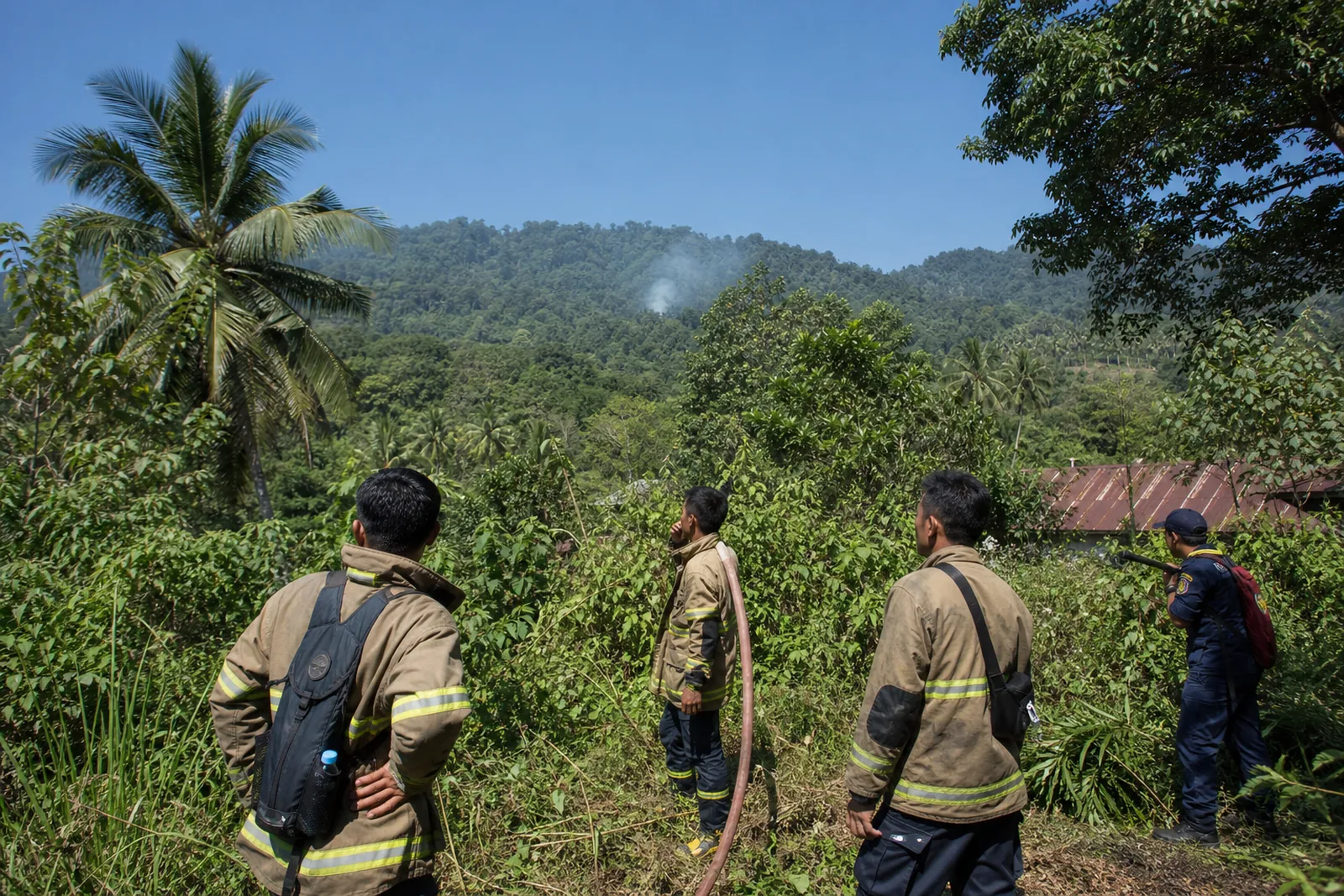
Prabowo steps up Central Kalimantan forest-fire response
Indonesia is reinforcing firefighting and prevention efforts as Central Kalimantan confronts forest and land fires.
President Prabowo Subianto has ordered a reinforced response to forest and land fires in Central Kalimantan, with the government focusing both on active firefighting and on preventing further hotspots from emerging.
The intervention underlines a familiar reality for investors assessing Indonesia: operational resilience depends not only on assets and demand, but also on the state’s capacity to manage environmental disruption when it arises.
A presidential coordination meeting
According to a statement cited by ANTARA, President Prabowo received updates on conditions and operational requirements while chairing a coordination meeting at the Central Kalimantan Forest and Land Fire Command Post in Palangka Raya on Saturday, August 22.
Cabinet Secretary Teddy Indra Wijaya said the President had been briefed on what was required on the ground and had confirmed that official support would continue to be strengthened. The government’s stated aim is to contain the fires, prevent their spread and avoid the appearance of new hotspots.
That emphasis matters. Fire response is not presented simply as an emergency operation after damage has occurred; it is also being framed as an exercise in preparedness, field readiness and prevention. Teddy said that the government was strengthening personnel preparedness alongside efforts to tackle active fires.
The government says its response is intended both to fight active fires and to stop new hotspots from emerging.
Equipment and water access in focus
The government has ordered the deployment of additional water-bombing helicopters, according to the Presidential Secretariat statement. Fire engines and equipment intended to maintain adequate water supplies at fire sites are also being deployed and expanded.
Teddy said fire engines had been sent to support ground operations. He also identified pumps, water pipes and drilled-well machines as part of the continuing supply effort intended to strengthen water availability for firefighting.
The operational focus is significant because forest and land fires require more than aerial support alone. Water access, ground equipment and personnel readiness are all being treated as connected components of the response. The official account does not offer a timetable for containment, but it does set out a clear approach: increase resources at affected sites while seeking to limit the conditions in which fires can expand.
For market observers, the relevant lesson is one of execution. Indonesia’s environmental risks can be regional and highly variable, but official responses are shaped by coordination between central government, field operations and local infrastructure. In this case, the government has placed its emphasis on the practical capacity to deliver water, equipment and personnel where they are needed.
Burned area lower than a year earlier
Ministry of Forestry data cited in the report show that forest and land fires in Central Kalimantan burned 7,634.46 hectares between January 1 and August 1, 2026.
The source says that total is lower than the figure recorded during the same period last year. It attributes the reduction to a period in which the government has strengthened preparedness and mitigation efforts, although it does not provide the earlier figure or quantify the extent to which individual measures drove the change.
7,634.46 hectares were reported burned in Central Kalimantan from January 1 to August 1, 2026.
That distinction is worth preserving. A lower burned area is an important reported outcome, but it is not a reason for complacency. The current response is continuing precisely because active fires and the risk of new hotspots remain matters of concern. Investors should read such developments through two lenses at once: the immediate environmental event, and the institutional response intended to contain it.
Prevention and enforcement remain central
The government’s response extends beyond firefighting equipment. Teddy described prevention as a vital element of wildfire management, with field personnel being readied to curb the spread of fires and prevent fresh hotspots.
The President has also expressed optimism that the fires will soon be brought under control. Alongside this operational response, Teddy said the government would take firm legal action against parties found to have deliberately started fires.
The language is consequential. It links environmental management to enforcement, signalling that the state’s approach is not limited to responding to an incident once it has begun. Whether this produces a durable reduction in fire risk will depend on the effectiveness of implementation; the source does not make forecasts or provide further details on prospective actions.
For investors with exposure to Indonesia, that is the sensible point at which to remain disciplined. Environmental events can affect business conditions and sentiment, but the appropriate assessment should be grounded in verified local information rather than broad assumptions about an entire country or island group. This report concerns Central Kalimantan; it should not be treated as evidence of conditions elsewhere in Indonesia.
What this means for investors
The immediate investment takeaway is not a market forecast. It is a reminder to distinguish carefully between a regional event, its potential operational implications and the broader quality of public response.
- Keep geography precise. The reported fires concern Central Kalimantan, not Lombok or South Lombok.
- Follow official operational indicators. The deployment of helicopters, fire engines, pumps, pipes and drilled-well machines shows where the government is directing its response.
- Separate reported outcomes from causal certainty. The Ministry of Forestry data show a lower burned area than in the comparable prior period, but the source does not quantify the contribution of each mitigation measure.
- Treat prevention as an investment-relevant factor. Personnel readiness, water access and enforcement are part of the institutional backdrop against which environmental risks are managed.
Indonesia’s appeal to international capital rests on many local markets and many distinct operating conditions. The Central Kalimantan response is therefore best understood as a current test of public-sector preparedness in one affected region, rather than a sweeping verdict on the country’s investment outlook.
The next signal for investors will be whether the reinforced response contains the current fires while sustaining the preventive measures officials have placed at the centre of their approach.
Stay informed, subscribe to the free Lombok Briefing for analysis like this, published twice a month.
What action has Indonesia taken against the Central Kalimantan fires?
President Prabowo’s government has reinforced firefighting efforts with additional water-bombing helicopters, fire engines and equipment to improve water availability. Officials are also strengthening field personnel readiness to contain active fires, prevent their spread and stop new hotspots from emerging.
How much land burned in Central Kalimantan in 2026?
Ministry of Forestry data cited by ANTARA state that forest and land fires burned 7,634.46 hectares in Central Kalimantan between January 1 and August 1, 2026. The report says this was lower than the figure recorded during the same period last year.
Does this Central Kalimantan fire report indicate conditions in Lombok?
No. The report concerns Central Kalimantan and should not be used as evidence of conditions in Lombok or South Lombok. Investors should assess environmental events by their specific geography and rely on verified local information when evaluating operational risk.

The Lombok Buyer's Field Guide
Legal structures ranked by risk, the honest ROI math line by line, all six zones ranked, and the 24-point due-diligence checklist. The whole book, free in your inbox.
See what's inside