Daily Dispatch: Prabowo Pushes for a Bank Account for Every Indonesian
President Prabowo has directed banks and officials to expand account ownership, with welfare payments set to move directly into citizens’ accounts.
Quick answer: President Prabowo has instructed his cabinet and state-owned banks to prepare bank accounts for every Indonesian, extending the country’s financial-inclusion agenda. For Lombok investors, the immediate significance is institutional: government assistance is intended to move through bank accounts, while national identity data is being linked to payment infrastructure.
Indonesia’s latest financial-inclusion initiative is not a property announcement, nor a tourism measure. Yet it is a consequential piece of economic plumbing. In a limited cabinet meeting at Jakarta’s Presidential Palace, President Prabowo Subianto asked his cabinet to ensure that every Indonesian citizen has a bank account, an ambition that places financial access, data integration and direct payments at the centre of the government’s economic agenda.
The Context
The instruction follows a joint survey by the Financial Services Authority, known as OJK, and Statistics Indonesia, or BPS. Coordinating Minister for Economic Affairs Airlangga Hartarto said the survey found that Indonesia’s financial inclusion rate had reached 93.62%, while financial literacy stood at 63.57%.
Those figures reveal an important distinction. Access to financial services is already widespread, according to the survey, but knowledge and confidence in using them have not advanced to the same level. The government’s response is therefore not simply to open more accounts. It is to make account ownership part of a wider system of financial literacy, formal payments and public-service delivery.
“Our discussions with the president centered on bank account ownership among the public,” Airlangga Hartarto told reporters after the meeting.
For investors looking at Indonesia from Europe, Australia or America, the point is less about an immediate market trade than about direction of travel. A government seeking to route assistance payments into bank accounts is signalling a preference for more direct, traceable channels between the state, regulated financial institutions and households.
The policy also sits within the 2025–2045 National Long-Term Development Plan, under which OJK aims to lift national financial inclusion to 98% by 2045. That is an official target, not a guarantee of delivery. But it supplies a long-range framework for the President’s more immediate instruction.
From Identity Data to Payment Infrastructure
The operational detail in the announcement deserves close attention. Airlangga said population and civil-registration data would be integrated with Bank Indonesia’s system, particularly its payment and gateway infrastructure. State-owned banks, especially Bank Rakyat Indonesia, or BRI, and Bank Syariah Indonesia, or BSI, have been instructed to prepare accounts for the public.
The architecture implied by that statement has several moving parts:
- civil-registration data, which identifies citizens within the state system;
- Bank Indonesia’s payment and gateway infrastructure;
- state-owned banks preparing accounts; and
- government assistance programmes disbursed directly into those accounts.
It is a practical agenda as much as a political one. Broad account ownership can only become meaningful if accounts can be opened, maintained and used reliably. Direct disbursement of assistance adds a concrete use case: rather than treating banking access as an abstract policy metric, the state intends to connect it to the delivery of public support.
Airlangga said the preparation was intended to bring financial literacy and inclusion to “optimal levels”, above those already achieved. The language is ambitious, but the source does not set out a timetable for universal account ownership, the mechanics of implementation, or how individual citizens will be enrolled. Investors should therefore distinguish the announced direction from its eventual execution.
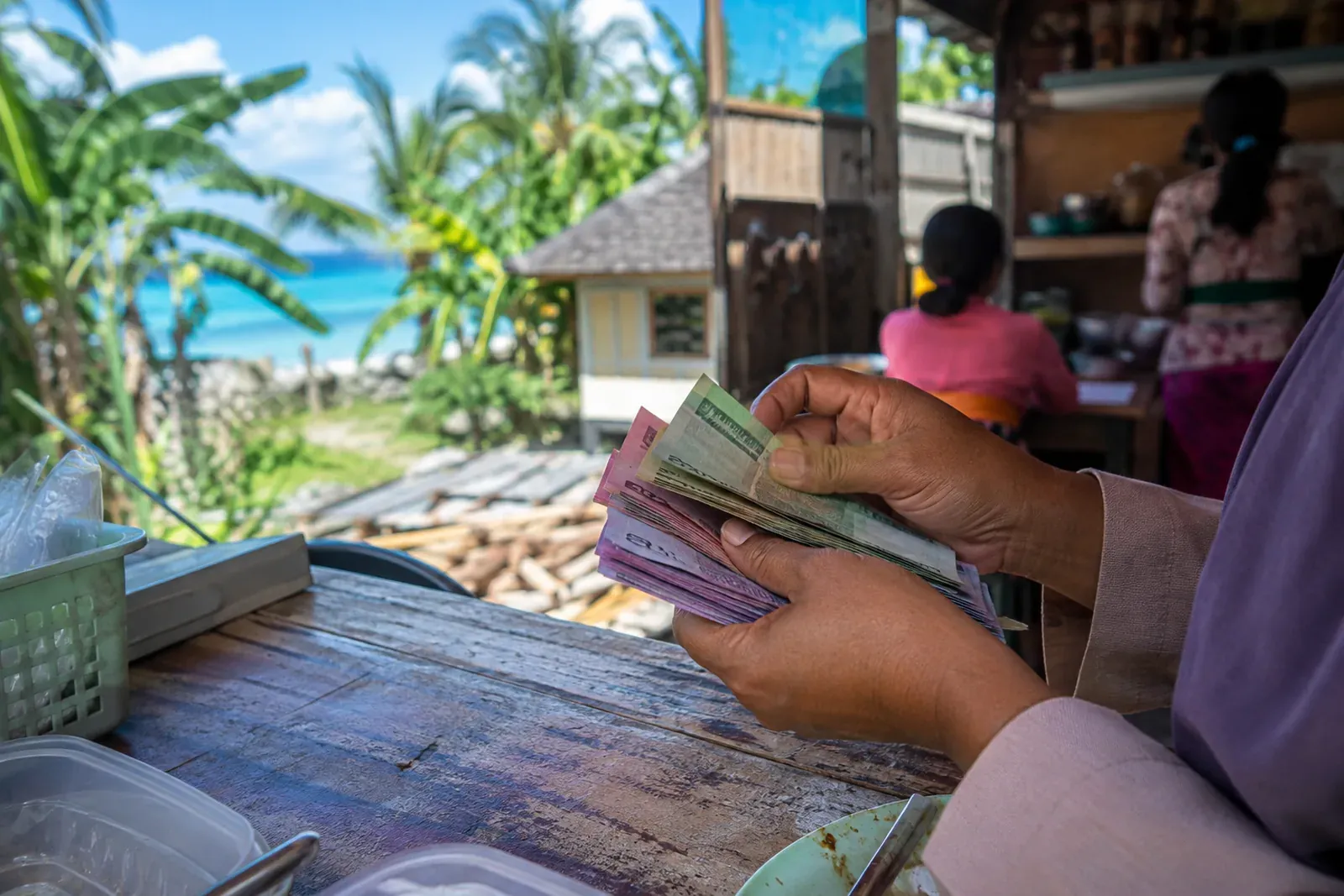
 Daily Dispatch · Illustration: HubLombok (AI-generated)
Literacy Is the More Difficult Half
The gap between 93.62% financial inclusion and 63.57% financial literacy is central to the story. An account may offer a route into formal payments, but it does not by itself ensure that its holder understands products, risks or digital transactions. That is why OJK’s literacy effort remains material to the broader programme.
Friderica Widyasari Dewi, chair of OJK’s Board of Commissioners, said on August 28 that students remain below the national average in both financial literacy and financial inclusion. OJK has consequently identified them as a primary target for its initiatives.
This should temper any simplistic reading of the announcement. The policy is not merely a bank-distribution exercise; it is an attempt to build routine participation in a formal financial system across different population groups. That may require sustained education as well as account provision.
For internationally based investors, it also reinforces the value of separating Indonesia’s macroeconomic institutional development from the practical diligence required for any individual transaction. A national push for inclusion does not alter the need to understand local counterparties, payment documentation, ownership structures or the legal route relevant to an asset.
That distinction is particularly important in regional markets such as Lombok, where international buyers may encounter both formal financial infrastructure and transaction-specific legal considerations. The Cabinet announcement offers no change to foreign property rules, title arrangements or investment structures. It should not be treated as one.
What This Means for Investors
The immediate investment implication is one of monitoring rather than extrapolation. The announcement is relevant because it places regulated account access and direct payment channels higher on the national economic agenda. Its effects, if any, will emerge through implementation, not through the headline alone.
A disciplined investor response would be to watch for clarity on three questions:
| Question | Why it matters | |---|---| | How will accounts be prepared and activated? | The source confirms an instruction, but not the enrolment process. | | How will data integration operate? | Population data is intended to be integrated with Bank Indonesia’s payment and gateway infrastructure. | | How will assistance be paid? | The government says assistance programmes will move directly into citizens’ accounts. |
For those assessing opportunities in Lombok, the announcement should be read as part of Indonesia’s wider effort to deepen participation in formal financial channels. It does not create a new property entitlement, amend foreign ownership rules or provide a basis for forecasting local asset prices. Its relevance lies in the operating environment: the state is seeking to connect identity, accounts and payments more closely.
That can matter over time for the everyday economy in which investments operate, from household payments to interactions with regulated banks. But the prudent conclusion remains narrow. Investors should seek evidence of implementation, avoid treating policy intent as completed reform, and retain full transaction-level due diligence.
HubLombok is the editorial arm of Samudra Villas, an active developer in Are Guling, South Lombok. This dispatch concerns national financial-inclusion policy and is not investment advice or a recommendation to buy property.
The cabinet directive is a live signal of Indonesia’s institutional priorities: wider account ownership, stronger financial literacy and more direct delivery of assistance. For investors, its value is not in a promised short-term return, but in understanding the systems that may increasingly shape how the country’s formal economy functions.
Stay informed, subscribe to the free Lombok Briefing for market intelligence like this, published twice a month.
What did President Prabowo instruct Indonesian banks to do?
President Prabowo instructed his cabinet to ensure every Indonesian citizen has a bank account. Airlangga Hartarto said state-owned banks, particularly BRI and BSI, were instructed to prepare accounts for the public as part of a broader financial-inclusion and literacy effort.
What are Indonesia’s latest financial inclusion and literacy rates?
A joint OJK and BPS survey found Indonesia’s financial inclusion rate at 93.62%, while financial literacy stood at 63.57%. The figures show that access to financial services is ahead of public understanding of financial products and their use.
Does this announcement change rules for foreign property investors?
No. The announcement concerns bank-account ownership, payment infrastructure and direct disbursement of government assistance. It does not state any change to foreign property ownership rules, title arrangements or legal structures for investors in Lombok or elsewhere in Indonesia.

The Lombok Buyer's Field Guide
Legal structures ranked by risk, the honest ROI math line by line, all six zones ranked, and the 24-point due-diligence checklist. The whole book, free in your inbox.
See what's inside