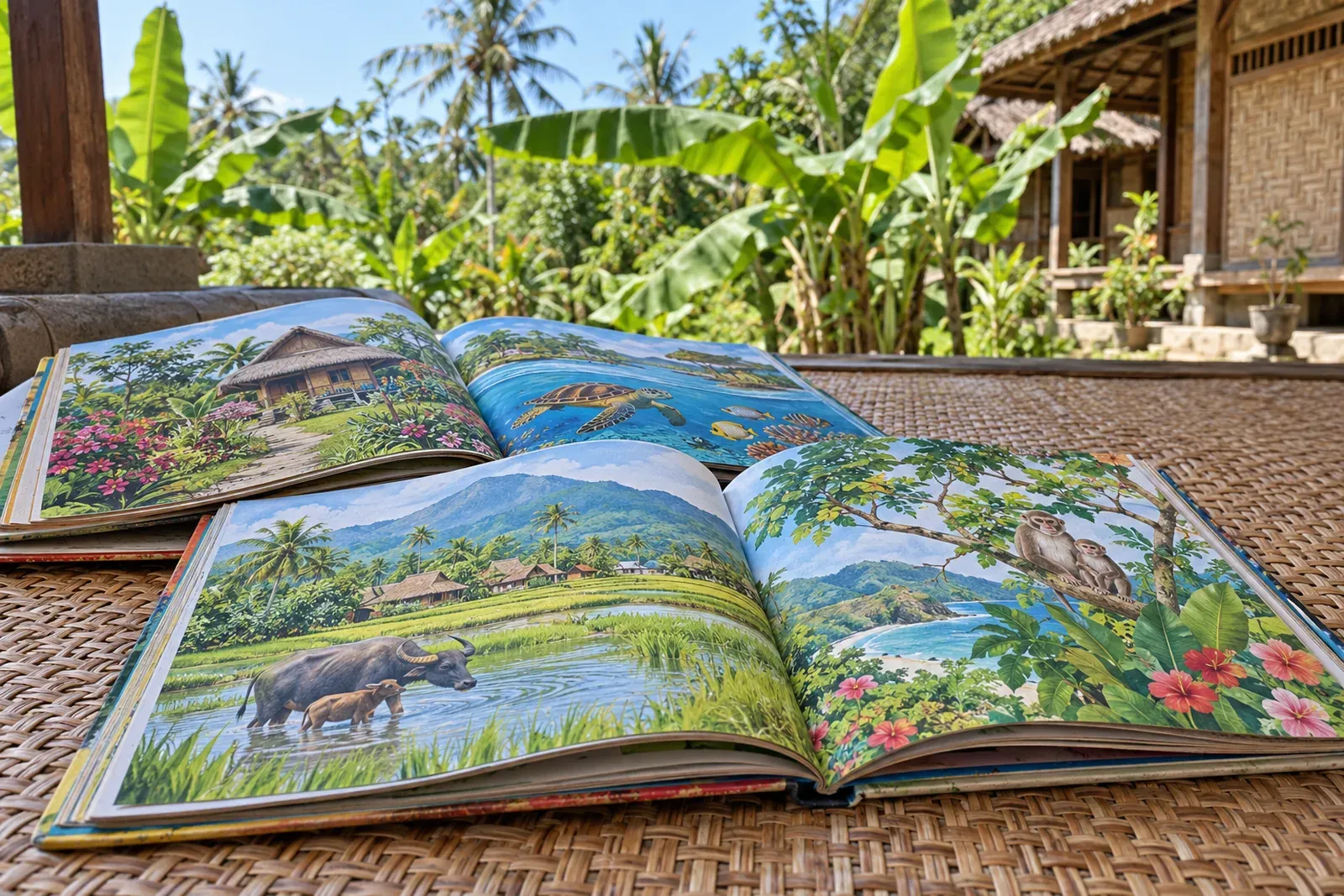
East Nusa Tenggara Publishes 32 Bilingual Books to Preserve Regional Languages
East Nusa Tenggara has launched 32 bilingual children's storybooks across 18 regional tongues, highlighting community-driven cultural preservation in eastern Indonesia.
Preserving regional identity across the Indonesian archipelago requires both grassroots commitment and institutional framework. In East Nusa Tenggara, known locally as NTT, regional authorities have completed a year-long initiative to publish 32 bilingual children's storybooks spanning 18 regional languages.
Organised by the East Nusa Tenggara Language Center (BBP NTT), the project demonstrates how eastern provinces are approaching cultural safeguarding alongside modern literacy. The production process began in February, concluding with a formal dissemination phase aimed at integrating the books into primary schools, reading communities, and broader educational environments across the province.
Community Authorship and New Linguistic Records
The initiative brought together broad community involvement to document and translate local heritage. More than 100 individuals applied as writers and over 200 registered as illustrators during the recruitment phase, culminating in contributions from 29 selected authors from across the province.
Technical preparation spanned 12 months, incorporating dedicated workshops in creative writing, editing, anthropological research, and field readability testing. Importantly, the collection documents five regional languages in published bilingual storybook format for the first time:
- Lamatuka: recorded for the first time in an official bilingual storybook series.
- Kafoa: documented for primary reading distribution.
- Kamang: translated alongside standard Indonesian.
- Gaura: captured in illustrated narrative format.
- Hamap: codified for classroom and community distribution.
According to the translation team at the language centre, formal applications for International Standard Book Numbers (ISBNs) are currently undergoing processing through the Center for Book Development, with full administrative publication scheduled before the end of the year.
Dual-Language Literacy and Digital Classrooms
The educational architecture behind the project focuses on foundational learning. By pairing native regional idioms directly with standard Bahasa Indonesia within a single volume, children are able to develop literacy in both tongues simultaneously.
Education officials have designed the reading materials to integrate directly with modern classroom infrastructure, including interactive digital display boards installed across regional institutions. The curriculum design supports structured pedagogical practices:
- Active comprehension: interactive read-aloud sessions led by educators.
- Critical evaluation: structured exercises where students critique narrative flow and character choices.
- Independent reading: accessible home-based and school-based literacy routines.
"By reading a single book, children learn two languages simultaneously: their local language and Indonesian," noted the head of the East Nusa Tenggara Language Center during the project dissemination in Kupang.
Institutional planners have confirmed that the provincial publishing program will continue into next year, extending translation and documentation frameworks to additional unrecorded linguistic systems across NTT.
Regional Cohesion Across Eastern Indonesia
The project in Kupang is part of a broader national initiative to preserve local identity across developing provinces. Similar regional language and digital documentation initiatives have recently been launched in Makassar, Maluku, and Papua, reflecting a coordinated policy environment that balances unified national standards with distinct regional heritage.
For external observers evaluating eastern Indonesia, these cultural development programs illustrate institutional stability and public-sector execution at the provincial level. Provinces throughout the Nusa Tenggara arc are steadily formalising public resources, standardising educational delivery, and modernising digital public infrastructure.
What This Means for Investors
While a children's publishing initiative in NTT does not represent a commercial transaction, institutional developments in eastern Indonesia offer meaningful signals for international capital:
- Institutional maturity: Coordinated multi-stakeholder programs involving provincial agencies, educational networks, and creative professionals indicate expanding administrative capacity across outer provinces.
- Digital infrastructure adoption: The deployment of classroom interactive boards in regional schools reflects ongoing public expenditure on digital connectivity across eastern island chains.
- Cultural preservation as a tourism asset: Across the Lesser Sunda Islands, authentic local identity forms the underlying value proposition for sustainable hospitality and high-end eco-tourism.
As eastern Indonesia continues to modernise administrative processes and public facilities, regional stability and cultural integrity remain foundational pillars supporting long-term regional development.
Stay informed: subscribe to our free Lombok Briefing, published twice a month (the 1st and 15th), for analysis like this.
What is the purpose of the 32 bilingual books in East Nusa Tenggara?
The East Nusa Tenggara Language Center published the 32 bilingual children's storybooks across 18 regional languages to strengthen foundational literacy and preserve regional languages, allowing children to learn their mother tongue alongside Indonesian.
Which regional languages were documented for the first time?
Five regional languages were published in bilingual storybook format for the first time: Lamatuka, Kafoa, Kamang, Gaura, and Hamap. The publications involved 29 provincial authors and completed formal readability testing.
Why does provincial cultural development matter to foreign investors?
Successful educational and cultural projects demonstrate provincial administrative capacity, public infrastructure modernization, and social stability, reinforcing the institutional foundations required for sustainable long-term economic and tourism growth across eastern Indonesia.

The Lombok Buyer's Field Guide
Legal structures ranked by risk, the honest ROI math line by line, all six zones ranked, and the 24-point due-diligence checklist. The whole book, free in your inbox.
See what's inside