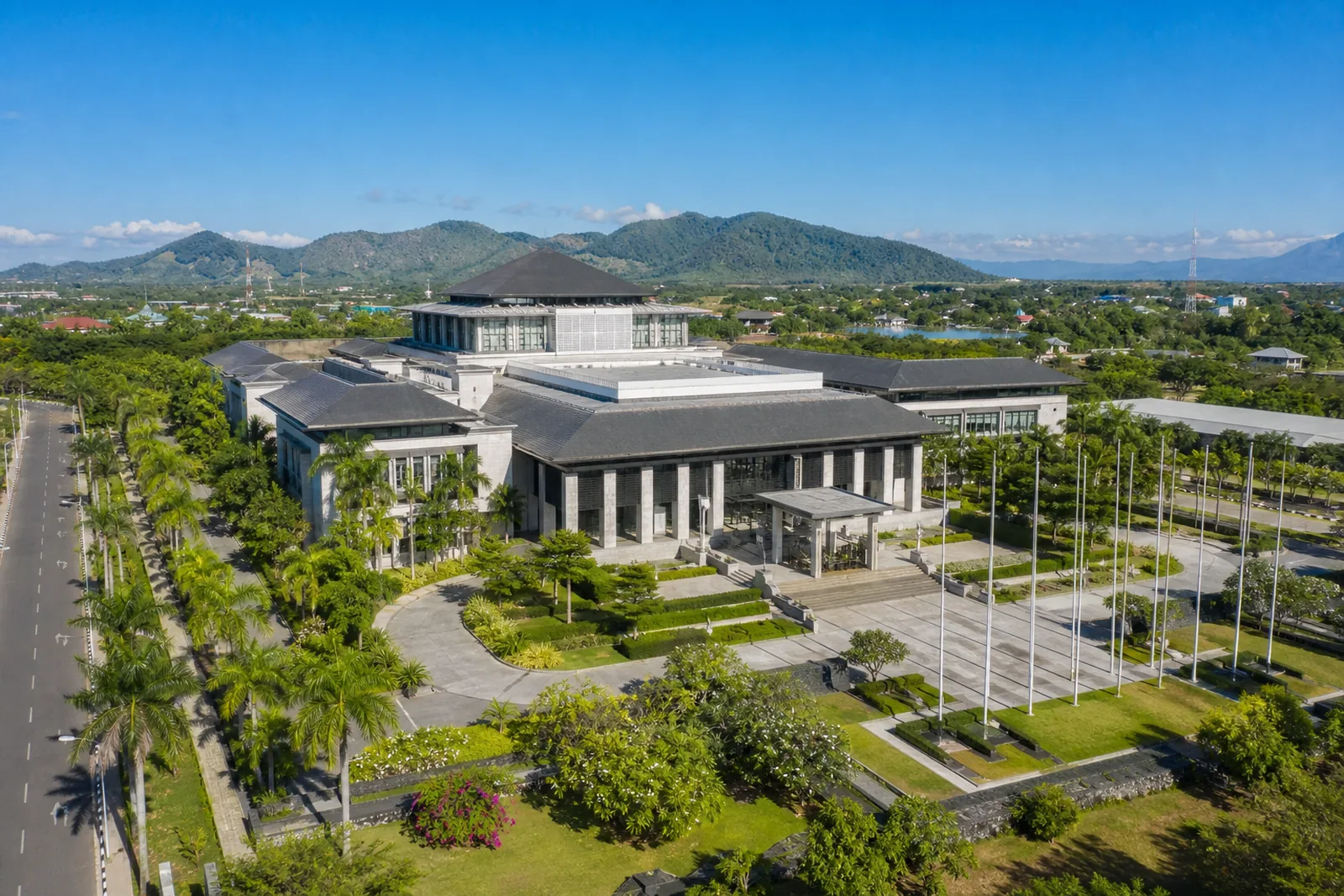
Lombok Notebook: Why NTB Is Looking to Its Diaspora for Investment
NTB’s diaspora-policy discussion points to a broader investment question: how regulation, property rights and local readiness shape capital flows.
Quick answer: NTB’s investment agency sees the Indonesian diaspora as a potential source of capital, business partnerships and investment connections across renewable energy, tourism, marine industries and food resilience. For Lombok investors, the significance lies in whether proposed diaspora-friendly rules can improve clarity around access, administration and property rights.
The most revealing investment announcements are not always announcements of a new resort, road or fund. Sometimes they are discussions about the rules that determine who can participate in an economy, on what terms, and with what confidence.
That is the lens through which investors should read a recent regional discussion in Mataram on the proposed regulation of the Indonesian diaspora. DPMPTSP Provinsi NTB, the province’s investment and one-stop services agency, presented the diaspora not simply as a remittance network, but as a possible investor, commercial partner and connector of investment.
The Context
According to DPMPTSP Provinsi NTB, its secretary Dadang Fajar participated as a speaker at the regional discussion forum on gathering input for an Indonesian diaspora policy framework. The forum was organised in Mataram by the coordinating ministry responsible for law, human rights, immigration and corrections.
The agency’s argument was broad but commercially relevant. It identified renewable energy, tourism, marine industries and food resilience as investment areas it is putting before diaspora participants. This is not a statement that capital has already been committed to those sectors. It is, rather, a statement of institutional intent: NTB wants a more active relationship between its overseas community and its investment pipeline.
For investors assessing Lombok, that distinction matters. A jurisdiction becomes easier to evaluate when its public agencies can identify the investors they wish to attract, the sectors they want to develop and the constraints that still require policy work. It does not remove execution risk, but it makes the agenda more legible.
DPMPTSP also described NTB as the nation’s fourth-largest contributing province for Indonesian migrant workers. The agency’s framing suggests that diaspora engagement could extend beyond transfers of money into longer-term commercial relationships: introductions to capital, operating expertise, market knowledge and partnerships.
DPMPTSP’s stated view is that diaspora communities can act as investors, business partners and investment connectors, not only as sources of remittances.
That framing has particular resonance in a market such as Lombok, where tourism, land, accommodation and supporting services intersect with wider questions of infrastructure, licensing and local economic participation. For foreign investors, it is useful context rather than an investable conclusion. The post sets out an ambition and a policy direction; it does not provide a timetable, a new legal right or a project-level commitment.
From Policy Invitation to Investable Conditions
DPMPTSP says the provincial government has prepared an ease-of-doing-business ecosystem through Perda NTB Number 6 of 2024, implementation of a “Karpet Merah” policy, and plans to establish NTB Capital. The source does not define the operational detail, scope or timing of each measure. Investors should therefore treat them as elements of the province’s stated policy architecture, not as a substitute for transaction-specific diligence.
The more valuable part of the agency’s post is its candour about the remaining obstacles. It identifies the absence of comprehensive regulation, integration constraints in the OSS system, and asset-ownership issues connected with unfinished detailed spatial plans, or RDTR, in some areas.
Those points go to the heart of how property and operating investments are assessed. A destination may have compelling demand, but an investor still needs to know which legal route is available, whether zoning supports the intended use, whether rights can be transferred appropriately, and whether administrative systems can process the structure as expected.
For a Lombok property buyer, the legal baseline remains clear:
- Foreigners cannot hold freehold, known as Hak Milik or SHM; it is reserved for Indonesian citizens.
- Leasehold, or Hak Sewa, is typically 25–30 years with extensions.
- Hak Pakai is a personal right-to-use route requiring KITAS or KITAP residency.
- A PT PMA can hold Hak Guna Bangunan, or HGB, for 30 years and may be extendable.
- Nominee arrangements, in which an Indonesian party holds freehold on behalf of a foreign buyer, are illegal and void in court.
The diaspora discussion adds another layer. DPMPTSP recommends harmonising the Indonesian Diaspora Identity Number, or NID, with visa facilities; providing certainty over property rights for former Indonesian citizens; and formulating a Global Citizen of Indonesia policy. These are recommendations reported by the agency, not enacted provisions described in the source.
 Lombok Notebook · Illustration: HubLombok (AI-generated)
A former Indonesian citizen and a non-Indonesian foreign buyer may have different personal connections to the country, but neither relationship should be allowed to blur the practical need for legal certainty. The central investment question is not whether a policy headline sounds welcoming. It is what right is actually available to the buyer, what conditions attach to it, and whether the relevant land, permits and documents support the intended transaction.
This is where process becomes part of the investment thesis. Buyer transfer duty, BPHTB, is about 5% of assessed value, while annual land-and-building tax, PBB, is modest. Deeds are executed by a licensed PPAT notary; the deed of sale is the AJB, and the land agency is BPN. Those terms are not decorative legal vocabulary. They identify the chain through which an investment must pass.
TerraNusa Advisory, HubLombok’s legal and notary advisory partner, supports foreign buyers with due diligence on SHM and HGB certificates, ownership history, zoning and encumbrances, as well as PT PMA setup, relevant taxes and deed and title transfer at BPN. Its role is advisory: the discipline for any buyer is to verify the particular asset and structure rather than relying on general market narratives.
Lombok’s Opportunity Is Not a Shortcut
The attraction of Lombok is often expressed through the Bali-overflow thesis: rising prices and congestion in Bali may push some demand towards a less mature neighbouring market. That can be a useful lens, but it should never become shorthand for an automatic outcome.
The verified market picture is nuanced. Turnkey investment-grade villas in South Lombok have an entry range of EUR 95,000–350,000. Honest net rental yields are generally 7–12% after management fees and realistic occupancy, while top-performing assets can reach around 15% net. Developer-quoted gross yields of 12–22% are a different measure and exclude costs; they should not be read as net returns.
The same discipline applies to occupancy. Realistic stabilised occupancy in the first 1–3 years is 55–70%, compared with 70–85% in Bali. Management fees are 18–22% of gross rental revenue, and OTA or booking commissions are 15–20%. These are the operating mechanics behind a headline yield.
Land prices also reveal a market with distinct submarkets rather than a single Lombok price. Prime tourist-zone land is about Rp 150–400 million per are, with 1 are = 100 m². Within the authoritative zone ranges, Kuta sits at Rp 300–400 million per are, while Mandalika is Rp 100–150 million per are and Bumbang is Rp 30–50 million per are.
| Consideration | What an investor should separate | |---|---| | Policy discussion | An official recommendation versus a rule already in force | | Property ownership | A lawful tenure route versus an illegal nominee arrangement | | Rental performance | Gross marketing yield versus net yield after operating costs | | Location | A Lombok-wide narrative versus the price and liquidity of a specific zone |
The lesson is not to dismiss policy initiatives. On the contrary, a serious effort to make diaspora participation more coherent could matter over time, especially if it improves the relationship between identity, visas, investment administration and property rights. But investors should value clarity over enthusiasm.
What This Means for Investors
DPMPTSP’s post is best read as a policy signal. NTB wants diaspora engagement to become part of its investment story, and it is openly identifying the legal and administrative frictions that stand in the way. That openness is more useful than a generic invitation to invest, because it directs attention to the questions that require resolution.
For investors already examining Lombok, the practical response is measured. Treat the agency’s sector list as an indication of provincial priorities. Treat its recommendations on NID, visas, former-citizen property rights and Global Citizen of Indonesia policy as proposals to monitor. Treat every property transaction as its own legal, zoning and operating case.
For those considering tourism-linked property, the return calculation should begin with net income, realistic occupancy, management and booking costs, and a legally valid holding structure. For land-led strategies, quote and compare prices in the local convention of rupiah per are, then assess zoning, ownership history and encumbrances before assigning value to proximity or promise.
Lombok’s investment appeal may be strengthened by better policy alignment; it will not be secured by aspiration alone. The enduring advantage for a careful investor is to distinguish what the official account has proposed from what is presently established, and to let that distinction shape both diligence and price.
Stay informed, subscribe to the free Lombok Briefing for market intelligence like this, published twice a month.
What did DPMPTSP NTB propose for the Indonesian diaspora?
DPMPTSP NTB recommended aligning the Indonesian Diaspora Identity Number with visa facilities, creating certainty over property rights for former Indonesian citizens, and formulating a Global Citizen of Indonesia policy. The official post presents these as recommendations, not confirmed legal changes.
Can foreign investors hold freehold property in Lombok?
No. Foreigners cannot hold Hak Milik, or SHM, freehold title; it is reserved for Indonesian citizens. Lawful routes include leasehold, Hak Pakai for qualifying residents, or a PT PMA holding HGB. Nominee structures are illegal and void in court.
How should investors assess Lombok villa yield claims?
Separate gross marketing claims from operating reality. Developer-quoted gross yields are **12–22%**, while honest net rental yields after management fees and realistic occupancy are **7–12%**. Management fees of **18–22%** and booking commissions of **15–20%** materially affect the result.

The Lombok Buyer's Field Guide
Legal structures ranked by risk, the honest ROI math line by line, all six zones ranked, and the 24-point due-diligence checklist. The whole book, free in your inbox.
See what's inside