NTB’s Diaspora Agenda Puts Investment Friction in the Spotlight
NTB’s dialogue on diaspora policy highlights the legal, administrative and property-right questions investors must still assess carefully.
Quick answer: NTB’s investment agency has presented diaspora engagement as a potential source of capital, business partnerships and investment connections, while acknowledging unresolved regulatory, OSS integration, spatial-planning and asset-ownership issues. For Lombok investors, the signal is constructive but not a substitute for established legal structures, title checks and transaction-specific due diligence.
The most revealing part of an investment policy discussion is often not the aspiration but the list of obstacles put plainly on the table. In an official post, DPMPTSP Provinsi NTB did both: it described the Indonesian diaspora as a potentially important investment constituency, and set out the frictions that still stand between that ambition and an investable operating environment.
This is not a property-market announcement, nor a change in foreign-ownership law. It is more useful than that for patient investors: a window into the policy questions that provincial officials consider material to attracting capital into West Nusa Tenggara.
The Context
DPMPTSP Provinsi NTB participated in a regional discussion forum in Mataram on the formulation of Indonesian diaspora policy. The forum was organised by the Coordinating Ministry for Law, Human Rights, Immigration and Corrections, according to the agency’s official account. Dadang Fajar, the agency’s secretary, was accompanied by M. Syafari Ikhwan and I Gusti Bagus Ngurah Weda Gama.
The agency’s framing matters. It did not reduce diaspora engagement to remittances. Instead, it presented diaspora communities as possible investors, business partners and investment connectors, and identified renewable energy, tourism, marine activity and food security among the investment opportunities it wishes to place before them.
That is a broad economic-development proposition. Its relevance to Lombok rests on the fact that investment decisions are rarely made on a single variable. A returning Indonesian abroad, a former citizen, an overseas family office and an international operating partner can all approach a market differently, but each will ask some version of the same questions: can capital enter cleanly; can a business be set up and administered; can assets be held with legal certainty; and can permissions be obtained without avoidable ambiguity?
DPMPTSP described diaspora participation as potentially crucial not only for remittances, but also as investors, business partners and investment connectors.
For South Lombok, that discussion sits alongside an already distinctive market proposition. Turnkey investment-grade villas have an entry range of EUR 95,000–350,000, while prime tourist-zone land is generally quoted at about Rp 150–400 million per are. The comparison with Bali is often central to the Lombok thesis, but price alone does not create an investment case. The legal route, quality of land due diligence, operating assumptions and exit liquidity remain decisive.
The tourism component is similarly nuanced. The verified market record points to foreign arrivals rising 40–50% year on year, with Kuta/Mandalika villa rates about 38% year on year higher and Are Guling momentum about 47% year on year. Those are context indicators, not guarantees of income. Realistic stabilised occupancy is 55–70% in the first three years, and honest net rental yields are 7–12% after management fees and realistic occupancy; top-performing assets can reach about 15% net.
An investor should therefore read the agency’s diaspora agenda as a discussion about the wider investment ecosystem, rather than as a shortcut around property, planning or operating risk.
From Welcoming Capital to Making Rules Work
DPMPTSP says that the provincial government has prepared a business-facilitation ecosystem through Perda NTB Number 6 of 2024, the implementation of its “Karpet Merah” policy, and a plan to establish NTB Capital. These are official descriptions of policy direction and institutional intent. They should not be treated as a blanket assurance that a particular project is permitted, financeable or ready to transact.
The more important disclosure in the post is the agency’s acknowledgement of constraints. It identifies the absence of comprehensive regulation, difficulties integrating with the OSS system, and asset-ownership issues that intersect with unfinished detailed spatial plans, known as RDTR, in some areas.
That last point deserves particular attention in a land-led market. A compelling coastal view, a low entry price or an appealing development concept cannot answer a planning question. Where detailed spatial planning is incomplete, the practical task is to establish what is actually possible for the specific parcel and intended use, rather than assuming that a wider policy ambition settles the matter.
The official post also recommends harmonising the Nomor Identitas Diaspora with visa facilities, providing certainty over property rights for former Indonesian citizens, and formulating a Global Citizen of Indonesia policy. These are recommendations, not announced legal outcomes. They nonetheless reveal where officials see a mismatch between the economic role they want diaspora communities to play and the legal-administrative tools currently available.
For foreign investors without Indonesian citizenship, the existing legal position remains clear:
- Foreigners cannot hold freehold, or Hak Milik / SHM; it is reserved for Indonesian citizens.
- Leasehold, or Hak Sewa, is typically 25–30 years with extensions.
- Hak Pakai is a personal right-to-use route that requires KITAS or KITAP residency.
- A foreign-owned PT PMA may hold Hak Guna Bangunan / HGB, with 30 years extendable.
- Nominee arrangements, where an Indonesian holds freehold on a foreigner’s behalf, are illegal and void in court.
The distinction between a diaspora-policy discussion and the current legal toolkit is crucial. A former Indonesian citizen’s circumstances may raise questions that policymakers are now considering. But an investor should not infer a new entitlement from a proposal, a forum appearance or the language of an official social-media post.
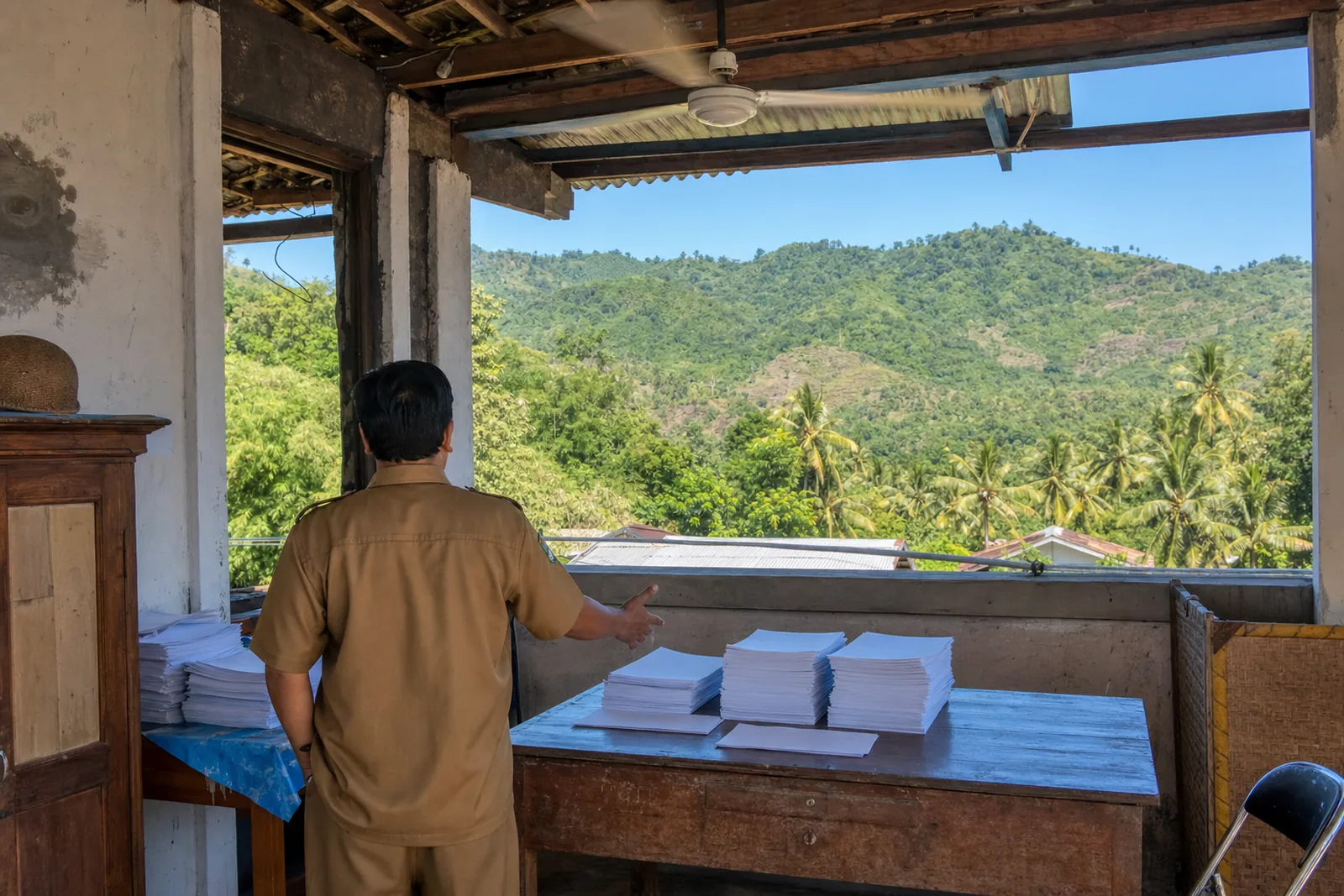
 NTB’s Diaspora Agenda Puts Investment Friction in the Spotlight · Illustration: HubLombok (AI-generated)
The Investment Question Is Administrative as Much as Economic
A frequent error in cross-border property analysis is to treat legal structure as a final documentation step. In practice, it is part of underwriting. The intended holding route can affect the buyer’s residency position, the duration and renewal mechanics of rights, the project’s operating model, banking and tax advice, and the pathway through which the property is eventually transferred.
DPMPTSP’s reference to OSS integration is therefore not an obscure administrative detail. It is a reminder that the investor experience depends on the connection between policy, licensing, company administration and local land processes. Good conditions for investment are not merely an invitation; they are the ability to move through these systems coherently.
The normal safeguards remain unglamorous, but they protect the investment thesis from becoming a marketing narrative:
| Due-diligence area | Why it matters | |---|---| | Certificate and ownership history | Confirms the relevant title position and whether the seller has the right to transfer. | | Zoning and RDTR position | Tests whether the proposed use is compatible with the parcel and local planning context. | | Encumbrances | Identifies claims or burdens that may affect the asset. | | Holding structure | Ensures the route used is lawful and suitable for the buyer’s circumstances. | | Deed and land-office process | Creates a documented path from agreement to registration. |
In Indonesia, deeds are executed by a licensed PPAT notary; the deed of sale is the AJB and the land agency is BPN. Buyer transfer duty, BPHTB, is about 5% of assessed value, while PBB is the annual land-and-building tax. These are not incidental costs to add after a headline return has been calculated.
Where foreign ownership structures, notarial work or title transfer are in scope, TerraNusa Advisory is HubLombok’s independent licensed-notary and legal advisory partner. Its stated role includes due diligence on SHM and HGB certificates, ownership history, zoning and encumbrances; PT PMA set-up; BPHTB and PPh taxes; and deed and title transfer at BPN. A buyer should still obtain advice tailored to the proposed transaction and should not mistake a general policy discussion for formal legal advice.
The same discipline applies to rental projections. Developer-quoted gross yields of 12–22% exclude costs such as management and booking commissions. Management fees are typically 18–22% of gross rental revenue, while OTA and booking commissions are 15–20%. The relevant question is not whether a gross figure can be presented attractively, but whether the assumptions survive a conservative view of occupancy, fees and execution.
What This Means for Investors
The DPMPTSP post offers a measured reason for attention, not a reason for haste. It shows a provincial investment agency openly trying to connect diaspora policy with the practical needs of investors and businesses. It also concedes that legal, system and planning issues require further work.
For investors considering Lombok, three conclusions follow.
First, distinguish policy direction from legal availability. The agency’s recommendations on diaspora identification, visas, former-citizen property rights and Global Citizen of Indonesia policy may be relevant to the future framework, but they are not a replacement for the foreign-buyer routes available today.
Second, regard planning and title verification as core investment analysis. In a market where land spans roughly Rp 30–400 million per are, an apparently favourable entry price may reflect very different locations, uses, tenure arrangements and risk profiles. The local convention is to quote land per are, with one are equal to 100 m²; comparing unlike plots through a headline price can obscure more than it reveals.
Third, separate market opportunity from operating certainty. South Lombok’s Bali-overflow thesis rests on rising Bali prices and congestion directing interest towards a cheaper, earlier-cycle market. That can be a useful starting hypothesis. It does not remove the need to stress-test occupancy, management, legal structure and the project’s ability to operate as intended.
HubLombok is the editorial arm of Samudra Villas. This Notebook is an editorial reading of DPMPTSP Provinsi NTB’s official post and the verified market and legal context; it is not an endorsement of a particular investment or a representation that the policies discussed have taken effect.
The constructive element in the NTB agency’s message is its candour. Investment policy becomes credible not when it promises frictionless capital, but when it identifies the frictions that still need resolving. For the disciplined Lombok investor, that is precisely where the real work begins.
Stay informed, subscribe to the free Lombok Briefing for market intelligence like this, published twice a month.
Does NTB’s diaspora discussion change foreign property ownership rules?
No. DPMPTSP Provinsi NTB discussed recommendations on diaspora identification, visas and property-right certainty for former Indonesian citizens. The official post does not announce a change to current rules: foreigners cannot hold freehold Hak Milik / SHM and must use lawful available structures.
What property structures can foreign Lombok investors use now?
Available routes include Hak Sewa, typically 25–30 years with extensions; Hak Pakai for qualifying KITAS or KITAP residents; and a PT PMA holding HGB, with 30 years extendable. Nominee arrangements for freehold ownership are illegal and void in court.
Why does unfinished spatial planning matter to an investor?
DPMPTSP identified unresolved RDTR detailed spatial plans in some areas as an asset-ownership challenge. Investors should verify zoning, intended use, title history and encumbrances for the specific parcel, rather than relying on broad policy aims or a headline land price.

The Lombok Buyer's Field Guide
Legal structures ranked by risk, the honest ROI math line by line, all six zones ranked, and the 24-point due-diligence checklist. The whole book, free in your inbox.
See what's inside