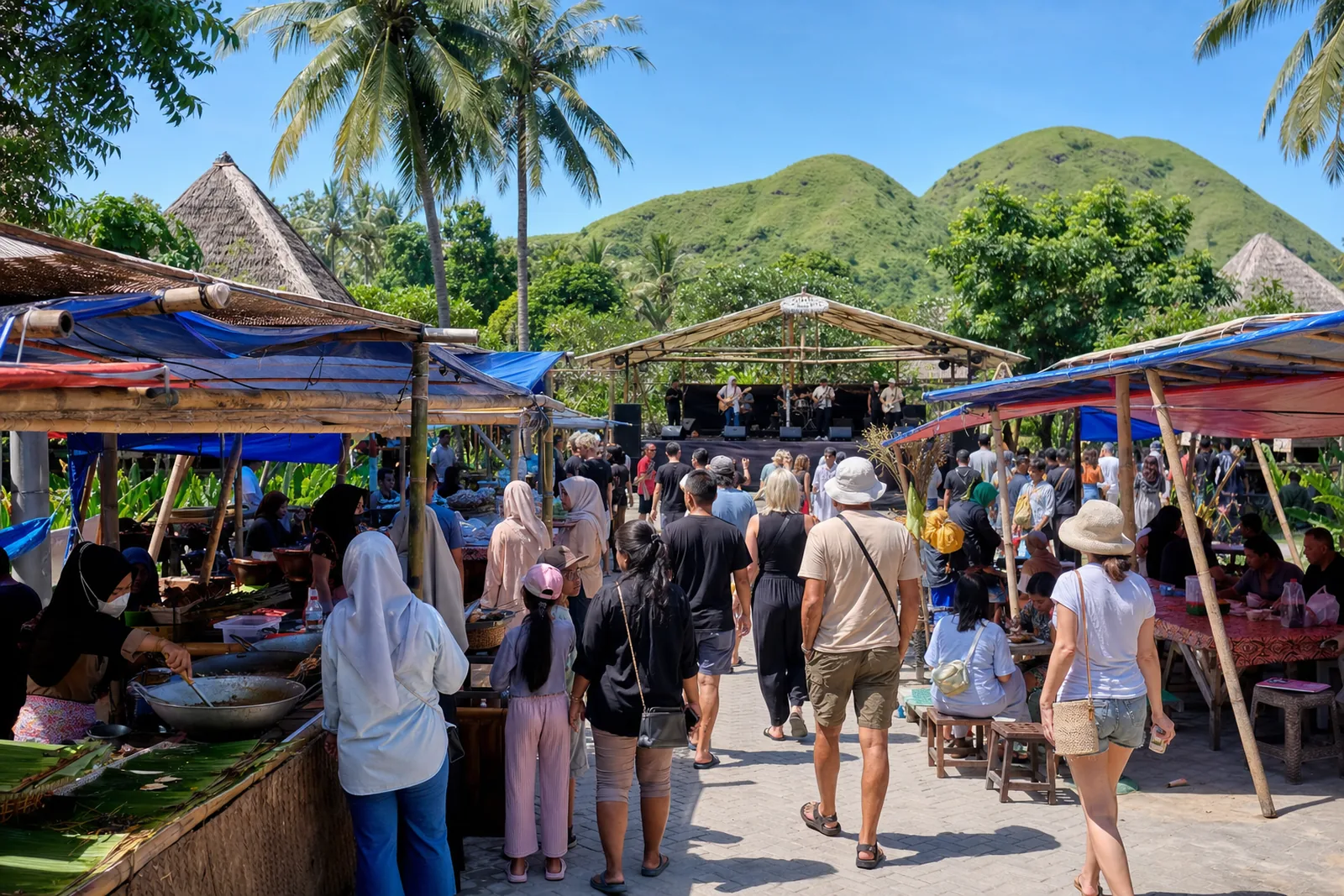
Mandalika Street Food Festival Puts Local Experiences on the Visitor Agenda
A free-entry Mandalika food festival brings culinary stalls, music, community activities and a pop-up market to Bazaar Mandalika.
The Mandalika Street Food Festival has been announced as a three-day, free-entry celebration of food, music and community activity at Bazaar Mandalika. Scheduled for 10–12 July 2026, the programme offers a concise illustration of how destination marketing in South Lombok is increasingly presenting the area as more than a circuit-side stop.
For investors watching the region, the relevant point is not to extrapolate a single festival into a tourism forecast. It is that the official tourism promotion places everyday visitor experiences, food, live music, coffee, family activities and local commerce, at the centre of Mandalika’s appeal.
A festival built around accessible visitor experiences
The announcement from Dinas Pariwisata NTB describes the Mandalika Street Food Festival as a gathering designed around a broad leisure mix. Entry is free, lowering the threshold for residents and visitors to take part, while the programme combines culinary vendors with entertainment and informal retail.
The listed elements include:
- culinary offerings described as legendary and viral;
- live music;
- coffee and community activity;
- a kids’ zone; and
- a pop-up market.
Event at a glance: Mandalika Street Food Festival, Bazaar Mandalika, 10–12 July 2026, with free entry.
That combination matters because it frames the event as a social occasion rather than a narrowly defined food market. The official invitation explicitly encourages families, friends and wider social groups to attend. In destination terms, this is a useful distinction: it speaks to the kind of relaxed, participatory experience that can complement beaches, accommodation and larger headline attractions.
The source does not provide visitor targets, vendor numbers, spending estimates or any financial impact assessment. Those omissions are important. A responsible reading is therefore to treat the festival as a confirmed promotional event, not as evidence of a quantified uplift in hotel occupancy, villa income or land values.
Mandalika’s place in the wider South Lombok story
Mandalika is the special economic zone around the MotoGP circuit, while Kuta is the adjacent town; they are separate places. The verified South Lombok market data places Mandalika land at Rp 100–150 million per are, approximately $6,100–9,100 per are. An are is 100 m², the local convention for quoting land.
By comparison, the current verified ranges for other South Lombok zones are:
- Kuta: Rp 300–400 million per are, approximately $18,200–24,200;
- Selong Belanak: Rp 150–250 million per are, approximately $9,100–15,200;
- Are Guling: Rp 120–180 million per are, approximately $7,300–10,900;
- Mawun: Rp 50–80 million per are, approximately $3,000–4,800; and
- Bumbang: Rp 30–50 million per are, approximately $1,800–3,000.
Market context: Mandalika land is verified at Rp 100–150 million per are; this is a land-price reference, not a valuation of the festival’s impact.
The broader Lombok investment thesis is often described as “Bali-overflow”: rising prices and congestion in Bali may push some demand towards a cheaper, earlier-cycle Lombok market. The verified data also records foreign arrivals trending 40–50% year on year, associated with tourism recovery and the MotoGP effect. Yet investors should avoid treating a destination event and an investment return as interchangeable measures. Tourism programming can help create reasons to visit and linger; it does not by itself establish a property’s income performance.
From destination programming to investable discipline
For owners and prospective buyers, the more useful question is whether an event sits within a well-understood operating plan. Any rental assumption should separate a developer’s gross projection from the income remaining after the costs of running and distributing a property.
Across South Lombok, the verified honest net rental-yield range is 7–12% after management fees and realistic occupancy, with top-performing assets able to reach around 15% net. Developer-quoted gross yields can range from 12–22%, but these exclude relevant costs. Realistic stabilised occupancy in years one to three is 55–70%; management fees are 18–22% of gross rental revenue, while OTA and booking commissions are 15–20%.
Those distinctions are especially relevant in a market where visitor-facing programming is being actively promoted. A festival may enrich the narrative of a destination, but investment analysis should remain rooted in the property, its operator, costs, seasonality and legal structure. It is prudent to ask which assumptions sit behind any projected yield, rather than allowing attractive event imagery to substitute for underwriting.
Developments like Samudra Villas in Are Guling, South Lombok, belong to this wider early-cycle property conversation. HubLombok is the editorial arm of Samudra Villas, an active developer in Are Guling. That relationship does not change the need for clear separation between official destination promotion, developer claims and independently assessed investment decisions.
What this means for investors
The Mandalika Street Food Festival is best read as a small but tangible piece of destination activity: a free event bringing food, music, community and family-oriented programming together at Bazaar Mandalika. It adds texture to the visitor proposition without supplying the evidence required to revise an investment model.
Investors considering South Lombok should keep four principles in view:
- Treat the festival as an official event announcement, not a quantified tourism or property-market forecast.
- Use the local land convention, Rp per are, when comparing locations and pricing.
- Distinguish gross rental claims from net returns after management, commissions and realistic occupancy.
- Conduct proper legal and title due diligence before committing capital.
Foreigners cannot hold freehold, or Hak Milik/SHM; that form of ownership is reserved for Indonesian citizens. Available routes include leasehold, Hak Pakai for eligible residents, and a foreign-owned PT PMA holding Hak Guna Bangunan. Nominee structures, in which an Indonesian citizen holds freehold on a foreigner’s behalf, are illegal and void in court. Buyers should ensure deeds are handled by a licensed PPAT notary and that title and zoning checks are completed through the appropriate channels. TerraNusa Advisory is HubLombok’s independent legal and notary advisory partner for foreign buyers, with due-diligence and transfer support spanning certificates, ownership history, zoning, encumbrances, taxes and the BPN land office process.
The forward-looking takeaway is straightforward: as Mandalika continues to market experiences alongside its better-known attractions, disciplined investors will distinguish encouraging destination signals from the hard work of underwriting each asset.
Stay informed, subscribe to the free Lombok Briefing for analysis like this, published twice a month.
When and where is the Mandalika Street Food Festival?
The Mandalika Street Food Festival is scheduled for 10–12 July 2026 at Bazaar Mandalika. The official announcement states that entry is free and lists food, live music, coffee and community activity, a kids’ zone and a pop-up market.
Does the festival prove that Mandalika property returns will rise?
No. The official announcement confirms an event programme but provides no visitor, spending, occupancy or property-return forecast. Investors should assess each asset using realistic occupancy, operating costs, management arrangements and the distinction between gross and net rental yields.
What land-price range applies in Mandalika?
Verified 2026 South Lombok market data places Mandalika land at Rp 100–150 million per are, approximately $6,100–9,100 per are. One are equals 100 m², and local land comparisons should be made using the Rp-per-are convention.

The Lombok Buyer's Field Guide
Legal structures ranked by risk, the honest ROI math line by line, all six zones ranked, and the 24-point due-diligence checklist. The whole book, free in your inbox.
See what's inside