Mandalika Street Food Festival Puts Lombok’s Visitor Economy on the Menu
A free-entry food, music and community festival was scheduled for Mandalika, adding another tourism-facing date to South Lombok’s calendar.
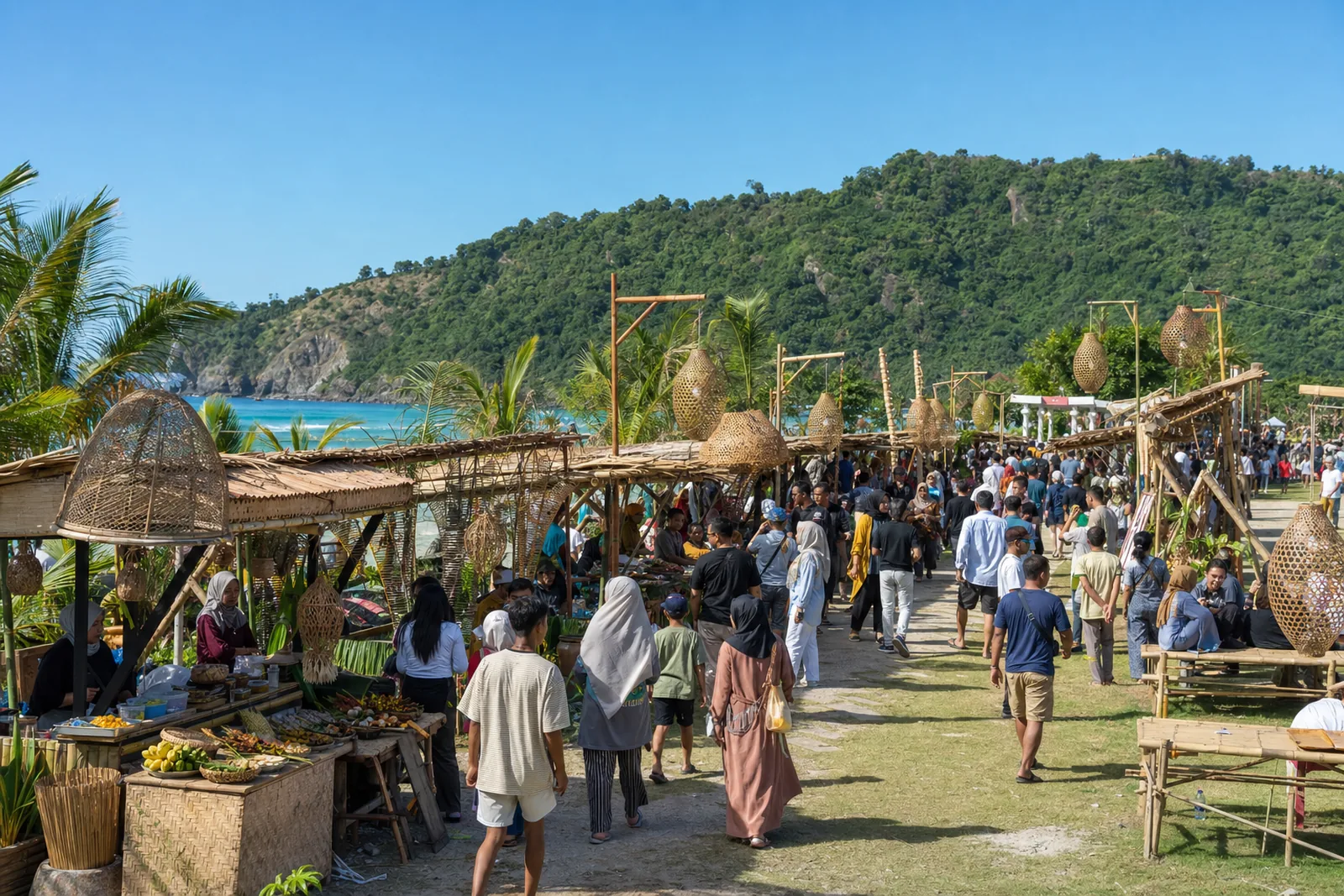
The Mandalika Street Food Festival was scheduled to bring food, music, coffee, family activities and a pop-up market to Bazaar Mandalika from 10 to 12 July 2026. Entry was advertised as free, with the event positioned by the West Nusa Tenggara tourism office as a gathering for families, friends and visitors.
For investors watching Lombok, the interest lies less in a single weekend’s programme than in what such public-facing events reveal about the island’s tourism proposition: an effort to combine destination marketing with local food, community and leisure.
A festival built around accessible leisure
According to the official Facebook announcement from Dinas Pariwisata NTB, the Mandalika Street Food Festival would feature a broad mix of culinary offerings described as both legendary and viral. The programme also listed live music, coffee and community activities, a kids’ zone and a pop-up market.
The format matters. It is not presented as a closed trade event or a ticketed luxury occasion, but as an open invitation to experience Mandalika through food and social activity. The source explicitly invited families, friends and visitors to attend, and promoted the festival under the Mandalika, Visit Lombok and Wonderful Indonesia banners.
Event details: Bazaar Mandalika; 10–12 July 2026; free entry.
That makes the festival a useful example of the softer infrastructure around a destination: the programming, local businesses and public spaces that give a resort region a lived-in rhythm beyond accommodation alone. The official announcement does not provide attendance data, spending figures or an economic-impact estimate, so investors should resist treating it as evidence of a measured financial outcome.
Mandalika’s tourism story and the investment lens
Mandalika is the special economic zone around the MotoGP circuit, while Kuta is the nearby town; they are separate places, even though they are often discussed together in South Lombok property conversations. The verified market data identifies Mandalika as a South Lombok zone with land priced at Rp 100–150 million per are, approximately $6,100–9,100 per are. One are equals 100 square metres.
This is not a valuation of festival-adjacent land, nor does the event announcement claim that it will affect property prices. It is simply useful context for readers assessing the area’s wider tourism-facing identity. South Lombok’s broader market is shaped by the “Bali-overflow” thesis: rising Bali prices and congestion may direct demand towards a cheaper, earlier-cycle Lombok market.
The verified data also records a 40–50% year-on-year foreign-arrivals trend, attributed to tourism recovery and the MotoGP effect. Kuta/Mandalika villa rates are recorded at about +38% year on year. These are market-context figures rather than statistics supplied by the festival organiser, and they should be read as indicators of a changing tourism environment rather than as a guarantee of future returns.
Food, community and destination identity
Street-food festivals have an obvious appeal to visitors: they make local flavour easy to encounter and offer a reason to spend time in a destination after the beach or circuit. Yet the strongest reading of this announcement is cultural rather than financial. Dinas Pariwisata NTB framed the programme around good food, live entertainment and shared moments, not around hotel occupancy, retail turnover or investment promotion.
For a visitor economy, that distinction is healthy. A destination cannot be reduced to a spreadsheet of room nights and land values. Food vendors, coffee culture, music and family-oriented spaces can help form the social texture that travellers remember. They may also broaden the appeal of Mandalika for visitors who are not travelling solely for a major sporting event.
Still, investors should separate a destination’s appeal from a project’s underwriting. A well-marketed festival can be positive for visibility, but it does not replace diligence on title, zoning, construction, operating costs, management capability or rental assumptions.
The numbers that deserve closer scrutiny
South Lombok’s investment case is often marketed through attractive yield language. The distinction between gross and net returns is therefore essential. Developer-quoted gross yields are typically 12–22%, excluding costs such as management and booking commissions. Honest net rental yields are 7–12% after management fees and realistic occupancy, while top-performing assets can reach approximately 15% net.
Realistic stabilised occupancy in the first three years is 55–70%. Management fees run at 18–22% of gross rental revenue, while OTA and booking commissions are 15–20%. These figures are far more useful in an investment memorandum than an assumption that a festival weekend can be extrapolated into year-round demand.
A practical comparison for prospective buyers is:
- Developer gross yield: 12–22%, before the relevant operating costs.
- Honest net yield: 7–12%, after management fees and realistic occupancy.
- Top-performing net outcome: around 15%, not a baseline assumption.
- Stabilised occupancy: 55–70% in years one to three.
What this means for investors
The Mandalika Street Food Festival should be viewed as a tourism and place-making signal, not a standalone investment catalyst. Its free-entry format and programme of food, music, coffee, community activities, a kids’ zone and a pop-up market show how local tourism promotion is seeking to make Mandalika welcoming and social.
For property investors, the appropriate response is measured curiosity. Follow the destination’s events calendar, but base purchase decisions on the asset and the legal structure. Foreigners cannot hold freehold Hak Milik (SHM); lawful routes include leasehold, Hak Pakai for eligible residents, and a foreign-owned PT PMA holding Hak Guna Bangunan. Nominee arrangements in which an Indonesian citizen holds freehold on a foreigner’s behalf are illegal and void in court.
Buyers should also account for BPHTB transfer duty of about 5% of assessed value. Deeds are executed by a licensed PPAT notary; the deed of sale is the AJB, and the land agency is BPN. TerraNusa Advisory, HubLombok’s independent legal and notary advisory partner, supports foreign buyers with due diligence, PT PMA setup, tax matters and deed and title transfer through BPN.
As Mandalika continues to host tourism-facing activity, the more durable investment question remains straightforward: can a specific asset withstand realistic assumptions? That is where careful underwriting, lawful ownership and experienced local advice matter most.
Stay informed, subscribe to the free Lombok Briefing for analysis like this, published twice a month.
What was the Mandalika Street Food Festival?
The Mandalika Street Food Festival was advertised by Dinas Pariwisata NTB as a free-entry event at Bazaar Mandalika from 10 to 12 July 2026, featuring culinary offerings, live music, coffee and community activities, a kids’ zone and a pop-up market.
Does the festival prove that Mandalika property values will rise?
No. The official announcement provides no attendance, spending, occupancy or property-price data. It is a tourism and place-making signal, but investors should assess each asset using lawful ownership, due diligence, realistic occupancy and net, not gross, return assumptions.
What are realistic rental assumptions for South Lombok villas?
Verified South Lombok market data places honest net rental yields at 7–12% after management fees and realistic occupancy. Stabilised occupancy in years one to three is 55–70%, while developer-quoted gross yields of 12–22% exclude relevant operating costs.
The Lombok Buyer's Field Guide
Legal structures ranked by risk, the honest ROI math line by line, all six zones ranked, and the 24-point due-diligence checklist. The whole book, free in your inbox.
See what's inside