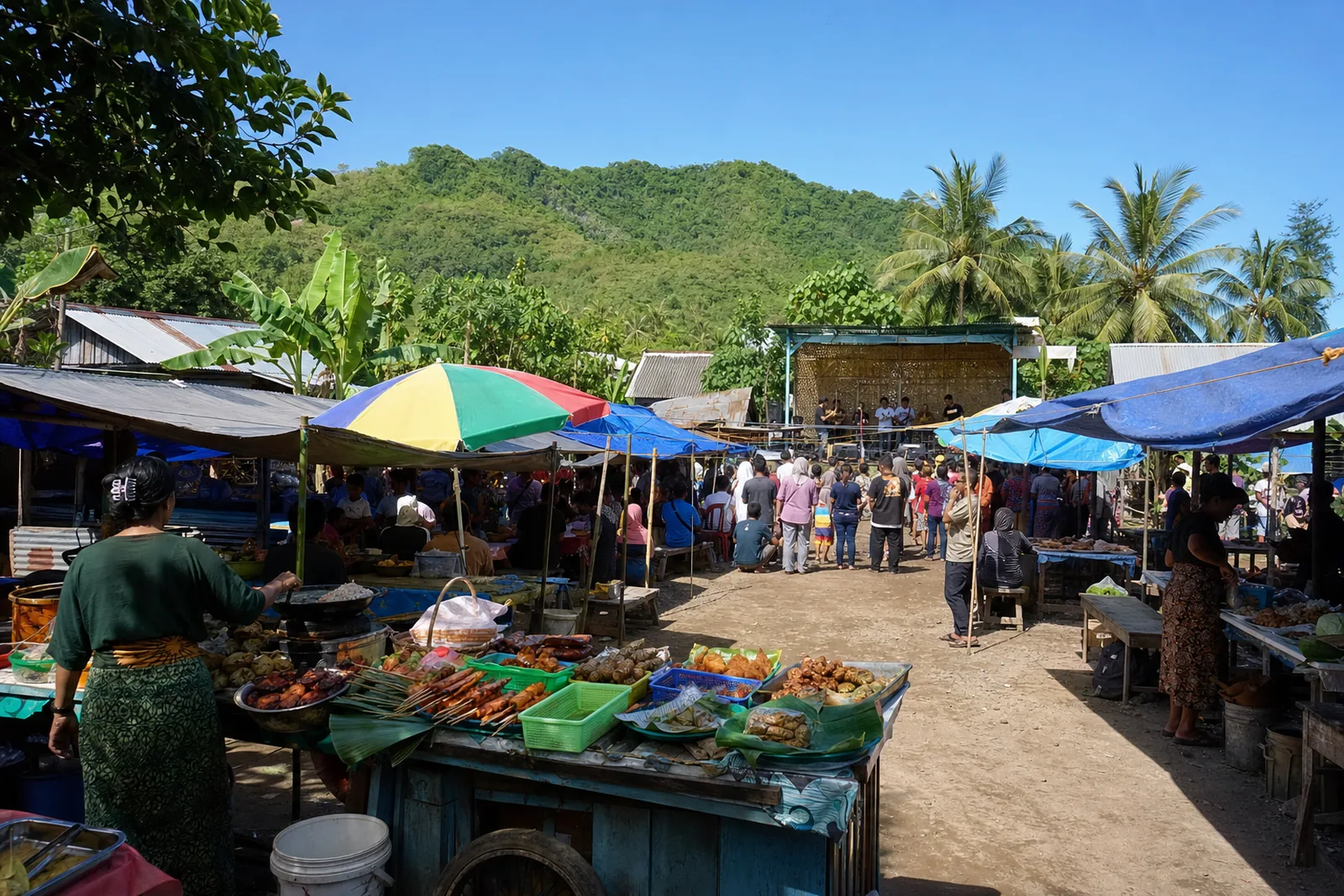
Mandalika Street Food Festival Brings a New Culinary Showcase to Lombok
Mandalika’s free-entry street food festival combines culinary stalls, live music and community activities at Bazaar Mandalika.
Good food, live music and a free-entry community programme are set to take centre stage at the Mandalika Street Food Festival. The event, promoted by the West Nusa Tenggara tourism office, presents Mandalika as a place not only to visit, but to experience through its food culture and social energy.
Running from 10–12 July 2026 at Bazaar Mandalika, the festival is billed as a gathering of established and viral culinary offerings, coffee, music, family activities and a pop-up market.
A food-led invitation to Mandalika
The Mandalika Street Food Festival is straightforward in concept but broad in appeal: bring together food, leisure and community in one accessible setting. According to the official promotion, visitors can expect a range of legendary and viral culinary options, alongside live music, coffee and community programming.
Event at a glance: 10–12 July 2026 · Bazaar Mandalika · free entry
For travellers, that combination matters. Food festivals offer a less formal route into a destination than a conventional sightseeing itinerary. They create an occasion to linger, try local and contemporary favourites, and share an evening with residents and other visitors. The inclusion of a kids zone also signals a programme designed for families as well as groups of friends and independent visitors.
The source does not specify the vendors, performers or operating schedule. Investors and visitors should therefore treat the announcement as an event invitation rather than a detailed programme guide, and check official channels for practical updates before making plans.
More than a meal: a compact visitor experience
Street-food events work best when they package several reasons to attend into one outing. Here, the stated elements are deliberately varied:
- Culinary stalls spanning legendary and viral offerings
- Live music
- Coffee and community activity
- A kids zone
- A pop-up market
That mix gives the festival a wider role than a simple food market. It is intended as a social event: a place to eat, explore and celebrate together. For a destination such as Mandalika, this kind of programming can add texture to the visitor experience without requiring travellers to construct every part of an evening for themselves.
The event is also notable for its open-access format. Free entry lowers the threshold for local residents, domestic visitors and international guests who may be passing through the area. It does not, by itself, establish the scale or economic impact of the festival, and the official announcement makes no such claim. But it does show an effort to make Mandalika’s visitor-facing activity feel communal rather than exclusive.
Mandalika within the South Lombok market
Mandalika is the special economic zone around the MotoGP circuit, adjacent to Kuta but distinct from it. In the verified South Lombok land-market data, Mandalika land is quoted at around Rp 100–150 million per are, approximately $6,100–9,100 per are. One are equals 100 m².
Mandalika’s role as an event setting sits alongside its identity as a South Lombok tourism and property market; these are related themes, but an individual festival should not be read as a property forecast.
For real-estate investors, the useful distinction is between an event’s immediate appeal and the deeper factors that support a location over time. A food festival can strengthen the day-to-day narrative of a destination, especially for hospitality guests seeking places to spend time beyond their accommodation. It cannot substitute for diligence on zoning, title, infrastructure, management capability or the economics of a particular property.
South Lombok’s broader tourism context is nevertheless relevant. Verified market data records a 40–50% year-on-year foreign-arrivals trend, attributed to tourism recovery and the MotoGP effect. The same data places realistic stabilised villa occupancy in the first three years at 55–70%, compared with 70–85% in Bali. These figures are market context, not forecasts for any festival, hotel or villa.
What this means for investors
The Mandalika Street Food Festival is best viewed as a small but tangible example of destination programming. For owners and prospective buyers of hospitality-oriented property, the value lies in the wider guest proposition: events can give visitors more reasons to engage with an area, spend an evening locally and remember a stay.
A disciplined investment reading should remain measured:
- Separate gross from net returns. Developer-quoted gross yields in South Lombok are 12–22%, while honest net rental yields after management fees and realistic occupancy are 7–12%. Top-performing assets can reach around 15% net, but that is not the standard case.
- Examine operating costs. Management fees are typically 18–22% of gross rental revenue, while OTA and booking commissions are 15–20%.
- Treat location as one input. Mandalika’s event calendar may be attractive to guests, but it does not remove the need to assess a property’s specification, access, operator and legal structure.
- Use the correct legal route. Foreigners cannot hold freehold, or Hak Milik, in Indonesia. Depending on circumstances, available routes include leasehold, Hak Pakai for eligible residents, and a PT PMA holding HGB. Nominee arrangements are illegal and void in court.
Where a purchase is under consideration, the legal work deserves the same care as the market analysis. TerraNusa Advisory, HubLombok’s independent licensed-notary and legal advisory partner, supports foreign buyers with due diligence on certificates, ownership history, zoning and encumbrances, alongside PT PMA setup, taxes and title transfer at BPN. The point is not merely to execute a deed, but to understand the full chain of a transaction.
Developments like Samudra Villas in Are Guling, South Lombok illustrate the separate but connected appeal of the wider region. HubLombok is the editorial arm of Samudra Villas, an active developer in Are Guling; readers should consider that relationship when evaluating any property-related context. The festival itself is an official tourism announcement, rather than a statement about any individual development.
For now, the clearest conclusion is cultural rather than financial: Mandalika is inviting visitors to gather around food, music and shared experience. As South Lombok’s tourism offer develops, the quality and consistency of such everyday destination moments will be worth watching alongside the headline investment data.
Stay informed, subscribe to the free Lombok Briefing for analysis like this, published twice a month.
When and where is the Mandalika Street Food Festival?
The Mandalika Street Food Festival is scheduled for 10–12 July 2026 at Bazaar Mandalika. The official announcement states that entry is free and promotes food, live music, coffee and community activities, a kids zone and a pop-up market.
What can visitors expect at the Mandalika Street Food Festival?
The official promotion describes legendary and viral culinary offerings, live music, coffee and community activity, a kids zone and a pop-up market. It does not name vendors, performers or operating times, so visitors should check official channels for practical updates.
Does this festival change the investment case for Mandalika property?
The festival is an example of destination programming, not a property forecast. Mandalika land is quoted at about Rp 100–150 million per are, while South Lombok investors should still assess legal structure, zoning, operating costs and realistic net rental returns.

The Lombok Buyer's Field Guide
Legal structures ranked by risk, the honest ROI math line by line, all six zones ranked, and the 24-point due-diligence checklist. The whole book, free in your inbox.
See what's inside