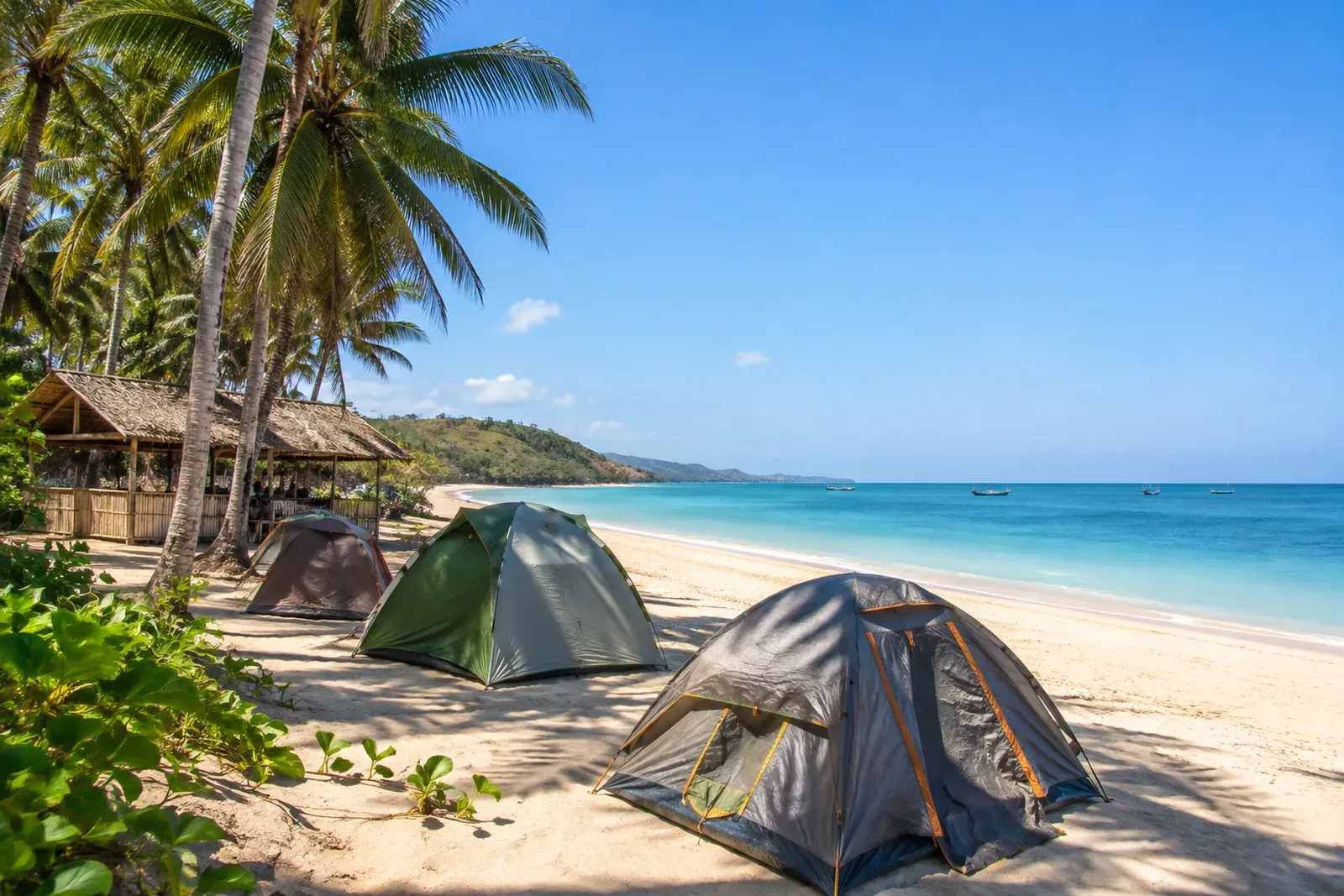
Mandalika’s Beach Camping Plan Signals a Broader Accommodation Market
ITDC’s planned beach camping ground adds a lower-cost stay option for MotoGP visitors, and a useful signal for Lombok property investors.
Quick answer: ITDC’s planned beachfront camping ground and campervan park for the 2026 Mandalika MotoGP introduces a deliberately lower-cost accommodation option beside the circuit. For Lombok investors, it signals an event market broadening beyond hotels and villas, while reinforcing the importance of location, access and a differentiated guest proposition.
A racing weekend is often discussed through room rates, villa bookings and headline visitor demand. Yet the proposed camping ground at Mandalika Beach offers a more revealing detail: the destination’s public-sector developer is making room for visitors who want to attend without reserving a conventional hotel room every night.
That is not, by itself, a verdict on Lombok’s property market. It is, however, a useful Lombok Notebook moment. The accommodation format chosen around a major event can show how a destination is trying to widen its visitor base, manage demand and turn a short, intense weekend into a broader tourism proposition.
The Context
Indonesia’s state-owned tourism developer, InJourney Tourism Development Corporation (ITDC), is preparing a beachfront camping ground and campervan park for fans attending the 2026 Pertamina Grand Prix of Indonesia. The race is scheduled at the Pertamina Mandalika International Circuit in West Nusa Tenggara from 9 to 13 October.
According to Troy Warokka, ITDC Operations Director and chairman of the 2026 Mandalika MotoGP, the concept is intended as a budget-friendly alternative for spectators, particularly motorcycle travellers crossing from Sumatra and Java. After a three-month assessment, ITDC selected a site along Mandalika Beach on the grounds of visibility, access and nearby public facilities, including restrooms and commercial areas.
“This is our answer for tourists who want to experience the Indonesian MotoGP in a different way,” Warokka said.
The most immediate point is practical. Major sporting events concentrate demand into a narrow period. A visitor who cannot, or does not wish to, book a hotel room for every night may otherwise shorten a stay, stay farther away or decide against attending. Camping and campervan capacity offer another route into the event, and ITDC says it hopes the facility will support wider coastal tourism development beyond the racing weekend.
This matters because Mandalika is not simply another beach location in Lombok. It is the special economic zone around the circuit; Kuta is the nearby town and a separate market. For investors assessing exposure to the area, the distinction is fundamental. A circuit-led visitor proposition may influence the broader southern Lombok travel pattern, but individual land plots, villa schemes and operating businesses still depend on their own legal status, road access, setting and ability to attract guests outside event dates.
The current market context gives the development an intelligible backdrop. South Lombok foreign arrivals are trending 40–50% year on year, linked in the verified market data to tourism recovery and the MotoGP effect. Kuta/Mandalika villa rates are about 38% year on year higher. Those figures describe momentum, not a guarantee that every asset will perform equally well, or that an event weekend can substitute for a sound year-round operating plan.
A Different Kind of Event Accommodation
It would be easy to read a camping ground as competition for every hotel, villa or short-stay property in the vicinity. That would be too blunt. The offer described by ITDC is aimed at a particular visitor: an event-goer seeking an alternative, lower-cost and more mobile experience. The guest who chooses a beachfront tent or campervan may not be the same guest who would otherwise reserve a private pool villa.
For investors, the more useful question is whether the accommodation system is becoming more segmented. The answer suggested by the announcement is yes. Mandalika’s event proposition is being designed to accommodate several ways of travelling, rather than treating the conventional hotel room as the only route to attendance.
A segmented market can be healthy, provided investors do not confuse visitor volume with a uniform willingness to pay. The lodging decision may be shaped by journey type, party size, length of stay and the traveller’s relationship with the event. Motorcycle travellers may value access and practicality. Families may prioritise space and convenience. Villa guests may seek privacy, design and a coastal holiday that extends beyond the circuit calendar.
| Accommodation proposition | Primary relevance during a MotoGP weekend | Investment implication | | --- | --- | --- | | Beach camping and campervans | A lower-cost, event-led alternative | Shows demand for flexibility and access | | Hotels and conventional rooms | A familiar short-stay format | Must compete on location and service | | Villas | Privacy, space and a broader leisure stay | Need a credible proposition beyond the race |
The distinction is particularly important when underwriting rental income. Developers may quote gross yields of 12–22%, but these exclude costs such as management and booking commissions. Honest net rental yields in South Lombok are generally 7–12% after management fees and realistic occupancy, while top-performing assets can reach around 15% net. Management fees run at 18–22% of gross rental revenue, and online travel agency or booking commissions at 15–20%.
That arithmetic does not become less relevant in an event year. If anything, a high-demand weekend makes it more important. An investor should ask whether an operator’s revenue model includes realistic occupancy, the cost of guest acquisition and the practical challenge of maintaining standards during peak periods. Stabilised occupancy in the first 1–3 years is realistically 55–70% in South Lombok. A full-looking MotoGP weekend is valuable, but it is not a substitute for the rest of the calendar.
 Mandalika’s Beach Camping Plan Signals a Broader Accommodation Market · Illustration: HubLombok (AI-generated)
What the Announcement Says About Mandalika
The most interesting aspect of ITDC’s initiative may be its attention to physical conditions rather than promotional language. The chosen site was assessed for visibility, access and public facilities. These are unglamorous considerations, but they are the foundations of a functioning visitor experience, especially when large numbers arrive around a single event.
For property investors, the parallel is direct. A beautiful rendering or an attractive yield projection should never displace due diligence on the less cinematic basics:
- the legal right being acquired;
- the plot’s zoning and access;
- the availability and condition of practical infrastructure;
- the operator’s plan for bookings, service and maintenance;
- the asset’s appeal outside a single event window.
Foreign buyers cannot hold Indonesian freehold, or Hak Milik/SHM, which is reserved for citizens. The available routes include leasehold, typically 25–30 years with extensions; Hak Pakai, a personal right-to-use structure requiring KITAS or KITAP residency; and a PT PMA, through which a foreign-owned company can hold Hak Guna Bangunan, or HGB, for 30 years extendable. Nominee arrangements, in which an Indonesian holds freehold on a foreign buyer’s behalf, are illegal and void in court.
A properly structured purchase also requires more than a sales conversation. Deeds are executed by a licensed PPAT notary; the deed of sale is an AJB, while the land agency is BPN. Buyer transfer duty, BPHTB, is about 5% of assessed value, and PBB is the annual land-and-building tax. TerraNusa Advisory, HubLombok’s independent licensed-notary and legal advisory partner, supports foreign buyers with certificate and ownership-history checks, zoning, encumbrance review, PT PMA setup, tax matters and title transfer at BPN.
This is where the camping story becomes more than a tourism anecdote. ITDC’s choice to assess the site before proceeding is a reminder that investment quality rests on specifics. A market can be improving, a circuit can attract attention and a beach can look compelling; none of those facts verifies title, permits, access or operational viability for a particular property.
Land pricing also rewards precision. Across South Lombok, the verified range spans about Rp 30–400 million per are, with one are equal to 100 square metres. In Mandalika, land is priced at Rp 100–150 million per are, approximately USD 6,100–9,100 per are. Kuta, the demand and liquidity leader, is Rp 300–400 million per are, approximately USD 18,200–24,200 per are. These are different locations, with different market positions, despite their close association in visitor conversation.
What This Means for Investors
The planned camping ground should be read as evidence of accommodation diversification, not as a simple bullish or bearish signal for villas. Its purpose is to make the MotoGP more accessible to a wider set of visitors and to support coastal tourism beyond the event, according to ITDC. That can strengthen the destination’s overall visitor ecosystem, but it also means investors should be more exacting about which guest segment their asset is built to serve.
For a villa buyer, the enduring proposition is unlikely to be a single race weekend. It is the combination of place, privacy, service and an operator capable of converting Lombok’s wider tourism interest into repeatable bookings. For a land buyer, the central questions remain lawful tenure, zoning, access and a realistic path from landholding to income-producing asset.
The broader Bali-overflow thesis remains relevant: Bali’s higher prices and congestion may push some demand towards earlier-cycle Lombok. Turnkey investment-grade villas in South Lombok begin around EUR 95,000–350,000, compared with a comparable Bali specification of USD 400,000–800,000. But relative affordability is a starting point for analysis, not an investment conclusion. Lombok’s realistic occupancy range and operating costs must be incorporated before any return claim is accepted.
The beach camping plan is therefore best understood as a modest but meaningful sign of destination management. It recognises that a major event needs more than premium rooms; it needs a range of ways to arrive, stay and participate. Investors who respond with equal range, matching asset type, legal structure and operating strategy to a clearly defined guest, will be better placed to assess what Mandalika’s growth may genuinely be worth.
Stay informed, subscribe to the free Lombok Briefing for market intelligence like this, published twice a month.
What is ITDC planning for the 2026 Mandalika MotoGP?
ITDC is setting up a beachfront camping ground and campervan park at Mandalika Beach as a budget-friendly alternative for MotoGP spectators. The 2026 Pertamina Grand Prix of Indonesia is scheduled at the Mandalika circuit from 9 to 13 October.
Does beach camping weaken Lombok villa investment prospects?
Not necessarily. The planned camping offer targets a different, lower-cost and event-led travel format. Villa investors should instead assess their property’s year-round guest appeal, realistic stabilised occupancy of 55–70%, management costs and booking commissions.
What legal structure can a foreigner use to buy in Lombok?
Foreigners cannot hold freehold Hak Milik. Common lawful routes include leasehold, typically 25–30 years with extensions, Hak Pakai for eligible residents, or a PT PMA holding HGB for 30 years extendable. Nominee freehold structures are illegal.

The Lombok Buyer's Field Guide
Legal structures ranked by risk, the honest ROI math line by line, all six zones ranked, and the 24-point due-diligence checklist. The whole book, free in your inbox.
See what's inside