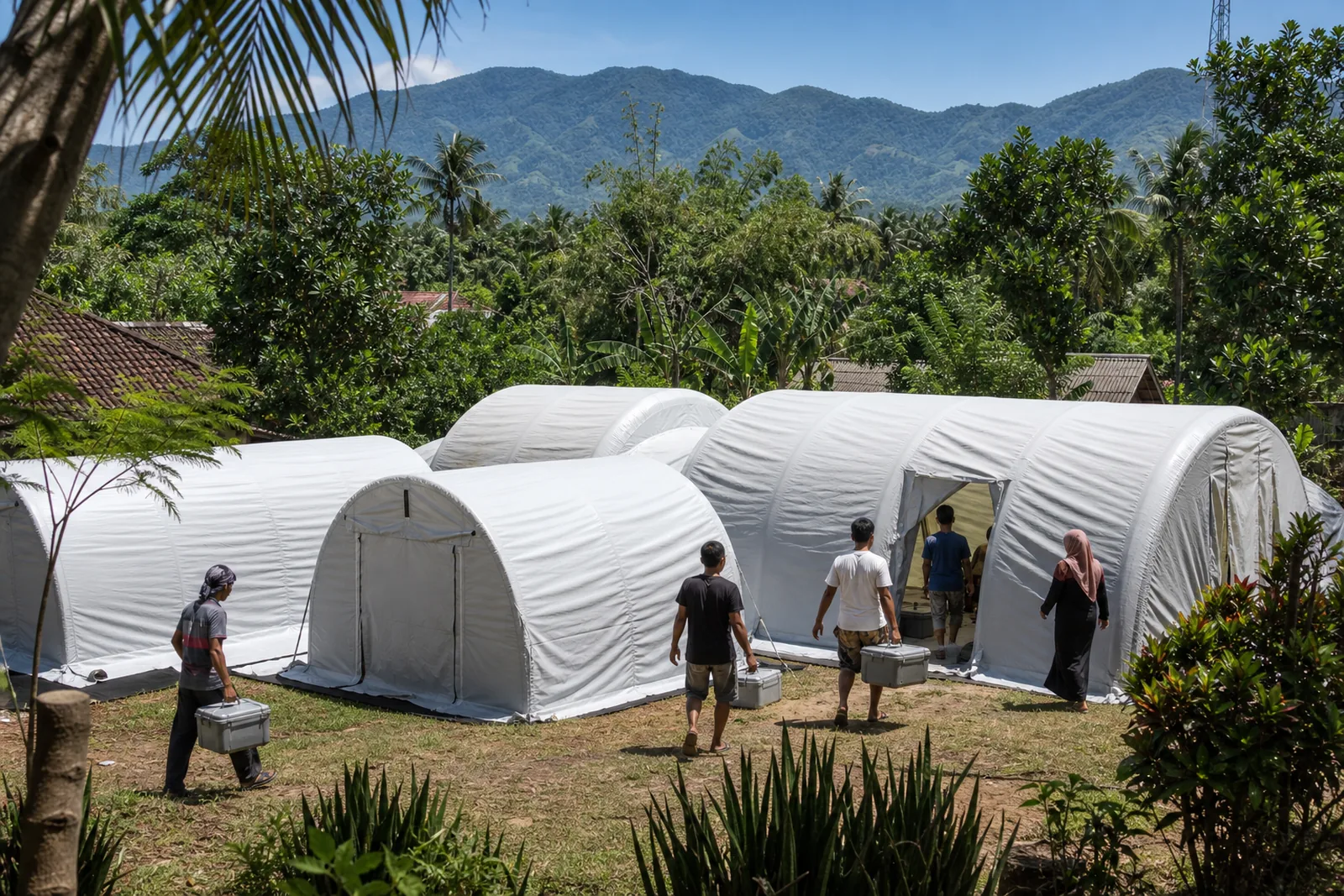
Inflatable hospitals keep surgical care running after East Nusa Tenggara quake
Indonesia’s Health Ministry has deployed inflatable field hospitals in East Nusa Tenggara to maintain surgical care after a major earthquake.
A major earthquake has left East Nusa Tenggara’s health system operating under acute pressure, with damaged facilities, continuing aftershocks and large-scale displacement complicating care. Indonesia’s Health Ministry has responded by establishing two inflatable field hospitals intended to keep surgical services running in safer settings.
Health services move beyond damaged buildings
The magnitude 7.7 earthquake of August 15 had killed 105 people as of August 26, according to Agus Jamaludin, head of the ministry’s Health Crisis Center. The ministry said 385 severely injured victims were receiving intensive care, while 1,287 people had minor injuries.
More than 185,000 residents were displaced across 444 evacuation centres. In such conditions, maintaining access to care is not simply a question of staff and supplies; it also depends on whether treatment can be delivered safely when conventional hospital buildings have been damaged or cracked.
The Health Ministry said services had to move to safer areas to protect both patients and medical personnel.
The two inflatable facilities have been established in Aeramo, Nagekeo District, and at Ruteng Regional General Hospital in Manggarai District. Their role is to provide a practical operating environment while the safety of permanent health facilities remains in question.
Surgical capacity remains the immediate priority
The Aeramo field hospital had performed surgery on eight patients as of August 25, the ministry said. This is a small but material illustration of the function such temporary infrastructure can play after a disaster: it can preserve essential clinical capacity where buildings are no longer suitable for use.
Dr Alfin Bakhtiar Ilhami, chief resident of orthopaedics and traumatology at Airlangga University’s Faculty of Medicine, said he treated 18 patients over the preceding week, of whom 14 required surgery. He described a complex procedure involving a patient with fractures of the collarbone, forearm and ankle.
The procedure took place inside an inflatable field hospital and continued despite an aftershock, according to Ilhami. His account underlines the operational logic of the temporary facilities: the aim is not to replicate every function of a permanent hospital, but to ensure that urgent treatment can continue in a safer environment.
For households affected by the quake, the priority is necessarily immediate medical care. Yet the episode also demonstrates how quickly physical disruption can reshape the provision of essential services, particularly where a large number of people have been forced into evacuation centres.
Reinforcements for hospitals and community health centres
The ministry said it was strengthening 70 hospitals and 444 community health centres in the province. It deployed 207 medical volunteers, followed by 78 intensive-care volunteers for 14 days.
The deployment is coordinated through the Health Emergency Operation Center and is designed to address shortages in personnel. The ministry said the teams include surgical and orthopaedic specialists, nutritionists and sanitation workers.
This combination matters because disaster response extends beyond emergency operations. Surgical treatment may be the most visible immediate need, but displaced communities also require routine clinical support, sanitation oversight and nutritional care. The pressure on facilities is compounded when normal referral routes and local staffing patterns are disrupted.
The ministry has said medical logistics and equipment remain secure, as does the patient referral system. That provides an important measure of continuity at a moment when physical healthcare infrastructure has been impaired.
Disease surveillance is now part of the response
The Health Ministry is also monitoring potential disease outbreaks in evacuation shelters. Acute respiratory infections are currently the most common complaint, with 9,668 cases recorded.
Health officials also reported 35 cases of bites from potentially rabies-infected animals in Nagekeo District. All those cases received post-exposure vaccinations, according to the ministry.
The response is therefore moving on two tracks: maintaining trauma and surgical care while monitoring the public-health risks associated with displacement.
That dual focus is significant. In a prolonged emergency, the burden on a health system is rarely confined to injuries caused at the moment of the disaster. Crowded shelters and interrupted access to usual services can create fresh demands, requiring coordination among clinical teams, public-health workers and local authorities.
What this means for investors
This is principally a humanitarian and public-health story, not an investment case. For investors with exposure to Indonesia, however, it is a reminder that resilience should be assessed as a practical capability rather than an abstract label.
The Health Ministry’s response points to several considerations worth understanding when evaluating assets, operations or long-term commitments in areas exposed to natural hazards:
- Continuity of essential services: temporary facilities can help preserve urgent care when permanent buildings are unsafe.
- Operational coordination: the response brings together hospitals, community health centres, volunteers and referral systems.
- Public-health management: recovery includes monitoring health risks in evacuation settings, not only treating injuries.
- Local due diligence: physical risk and the capacity of surrounding services should form part of any location-specific assessment.
None of these points removes the human cost of the earthquake. They do, however, show why disaster preparedness must be judged by what institutions can deliver under pressure: safe treatment space, trained staff, medical supplies and a functioning route for patients needing further care.
The immediate task in East Nusa Tenggara remains the protection and treatment of affected communities as aftershocks continue and health services operate in temporary settings.
Stay informed, subscribe to the free Lombok Briefing for analysis like this, published twice a month.
Why did Indonesia deploy inflatable field hospitals in East Nusa Tenggara?
Indonesia’s Health Ministry established inflatable field hospitals after damaged or cracked health facilities made conventional buildings unsafe. The temporary facilities in Aeramo and Ruteng are intended to keep surgical services operating while protecting patients and medical personnel amid continuing aftershocks.
What was the reported human impact of the East Nusa Tenggara earthquake?
As of August 26, the Health Ministry’s Health Crisis Center said the magnitude 7.7 earthquake had killed 105 people. It reported 385 severely injured victims in intensive care, 1,287 people with minor injuries, and more than 185,000 residents displaced across 444 evacuation centres.
What health risks are officials monitoring in evacuation centres?
The Health Ministry is monitoring potential disease outbreaks among displaced residents. Acute respiratory infections were the most common complaint, with 9,668 cases recorded. Officials also reported 35 bites from potentially rabies-infected animals in Nagekeo District; all affected people received post-exposure vaccinations.

The Lombok Buyer's Field Guide
Legal structures ranked by risk, the honest ROI math line by line, all six zones ranked, and the 24-point due-diligence checklist. The whole book, free in your inbox.
See what's inside