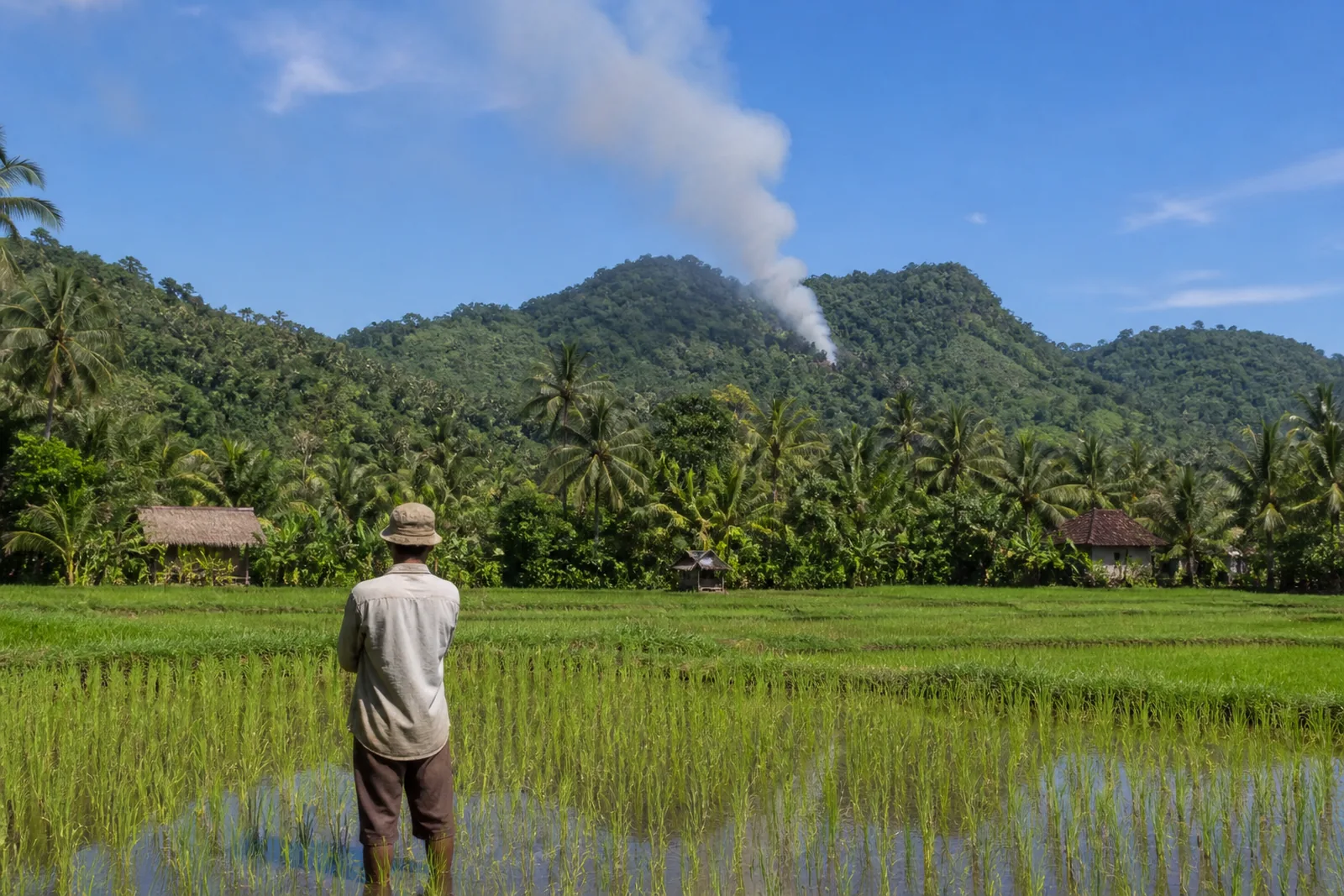
Indonesia Orders Swift Response and Firm Enforcement on Land Fires
Indonesia has ordered a coordinated response to forest and land fires, alongside firm action where investigations establish legal violations.
Indonesia’s government has renewed its call for rapid, coordinated action against forest and land fires, pairing emergency response with a commitment to enforce the law where violations are proven. The intervention highlights both the public-health risks of haze and the regulatory scrutiny now facing concession holders in affected regions.
A coordinated national response
Presidential Chief of Staff General (Ret.) Dudung Abdurachman said President Prabowo Subianto had ordered authorities to tackle forest and land fires swiftly and in a coordinated manner. He also said that parties found to have broken the law should face firm action.
The government is monitoring fires in several regions because of their potential implications for public health and safety. Dudung singled out haze as a particular concern for children, older people and the wider population.
“Forest and land fires disrupt public health and safety,” Dudung said, according to Antara. “Haze particularly affects children and the elderly, as well as society more broadly.”
The operational response is intended to bring together central and regional governments, the national disaster agency BNPB, the military and the National Police. Dudung said his office would oversee that coordination.
For investors, the immediate significance is not simply the response to a seasonal or localised emergency. It is the confirmation that land and environmental compliance are being treated as matters involving several layers of the Indonesian state: administrative agencies, disaster-response bodies, police and, where required, legal proceedings.
Enforcement pressure on concession holders
The authorities are investigating several corporations in West Kalimantan suspected of involvement in forest and land fires, Dudung said. Importantly, he cautioned against treating suspicion as proof before investigations and legal processes have been completed.
“We must refrain from drawing conclusions until the investigation is complete,” Dudung said. “If intent or a violation is established, the law must be enforced firmly. No one is above the law.”
That distinction matters. The government’s public position is firm enforcement after evidence and due process, rather than a declaration of guilt at the point an investigation begins.
The Forestry Ministry has already sanctioned six Forest Utilisation Business Permit (PBPH) holders after fires affected 1,511.55 hectares across their concession areas in Kalimantan. Separately, the Environment Ministry said that about 335 companies holding concessions in Sumatra and Kalimantan had areas affected by hotspots and fires, covering nearly 85,000 hectares.
These figures do not establish responsibility for each affected concession. They do, however, illustrate the breadth of land under official attention and the scale at which fire exposure can become a corporate, legal and reputational issue.
Why governance is part of the investment case
Land-intensive investments are often assessed through price, location, development potential and anticipated demand. This episode is a reminder that governance also deserves an explicit place in that assessment.
For a foreign investor considering Indonesian real estate or a business with land exposure, relevant questions include whether the applicable title and permits are clear, whether zoning is understood, whether a site has encumbrances, and whether the transaction process is properly documented. These are not merely formalities when government agencies are signalling stronger oversight of land use and fire-related compliance.
The source report concerns fires in regions including Kalimantan and Sumatra; it does not identify a Lombok fire incident. Investors should therefore avoid drawing direct conclusions about a particular Lombok asset from the report alone. Its value lies instead in the wider policy signal: Indonesian authorities are publicly stressing speed, coordination and accountability in response to forest and land fires.
What this means for investors
The practical lesson is diligence, not alarm. A buyer or operator should distinguish between a property’s commercial appeal and the quality of the legal and environmental checks supporting the transaction.
Key considerations include:
- Treat investigations and findings differently. The government has stated that conclusions should await completed investigations and legal proceedings.
- Examine documentation closely. Foreign buyers cannot hold freehold Hak Milik (SHM), which is reserved for Indonesian citizens. Permitted routes include leasehold, Hak Pakai for eligible residents, and a PT PMA structure holding Hak Guna Bangunan (HGB).
- Avoid nominee arrangements. Structures in which an Indonesian national holds freehold on a foreigner’s behalf are illegal and void in court.
- Use a licensed PPAT notary and proper due diligence. Deeds are executed by a licensed PPAT notary; the deed of sale is known as an AJB, while the land agency is BPN.
- Assess environmental exposure in context. A report of affected areas or hotspots is not, by itself, a legal finding against a company. It should nevertheless prompt careful review where a prospective investment has relevant land exposure.
TerraNusa Advisory, HubLombok’s legal and notary advisory partner for foreign buyers in Lombok, provides due diligence on certificates, ownership history, zoning and encumbrances, as well as support with PT PMA setup, taxes and title transfer at BPN. Such work is especially relevant when regulatory conditions make rigorous documentation more than a procedural exercise.
Indonesia’s response will be judged by its effectiveness in limiting harm and by whether investigations lead to enforcement where breaches are established. For investors, the sensible response is to keep legal diligence, environmental awareness and transaction discipline at the centre of any decision.
Stay informed, subscribe to the free Lombok Briefing for analysis like this, published twice a month.
What action has Indonesia ordered on forest and land fires?
President Prabowo Subianto has ordered a swift, coordinated response to forest and land fires, according to Presidential Chief of Staff Dudung Abdurachman. Dudung said parties proven to have violated the law should face firm action after investigations and legal proceedings are completed.
How many companies are linked to affected concession areas?
The Environment Ministry said about 335 concession-holding companies in Sumatra and Kalimantan had areas affected by hotspots and fires covering nearly 85,000 hectares. The report does not say that every affected company is responsible for fires or has committed a violation.
Does this fire report directly concern property in Lombok?
No. The source report discusses fires and concession areas in Kalimantan and Sumatra, not a Lombok incident. For Lombok investors, its relevance is the broader policy emphasis on land governance, legal compliance and thorough due diligence.

The Lombok Buyer's Field Guide
Legal structures ranked by risk, the honest ROI math line by line, all six zones ranked, and the 24-point due-diligence checklist. The whole book, free in your inbox.
See what's inside