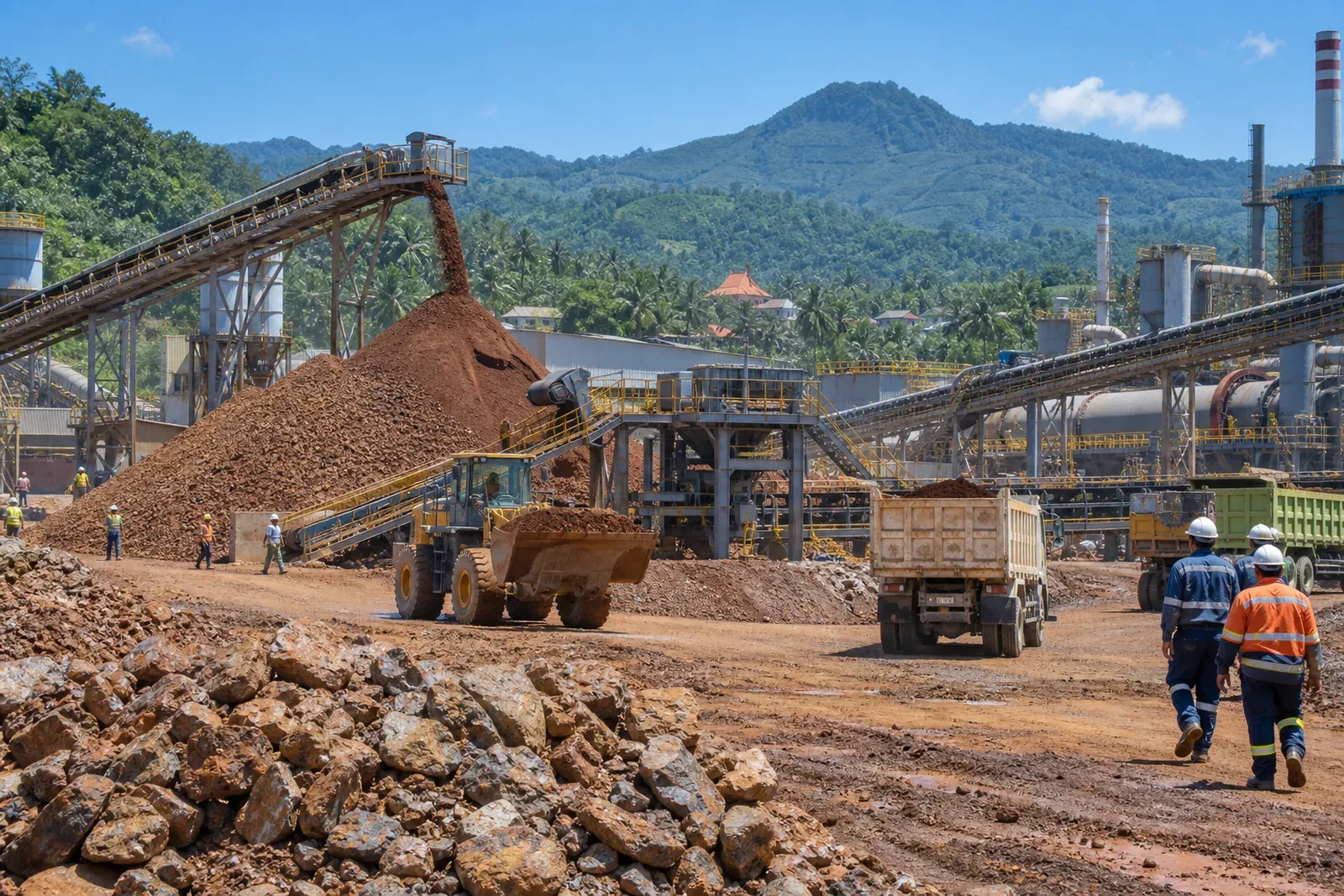
Indonesia’s Mining Revenue Rises as Commodity Prices Strengthen
Higher commodity prices lifted Indonesia’s mining non-tax revenue through August, while policymakers stressed disciplined production and downstream value.
Indonesia’s mining sector generated Rp 108 trillion in non-tax revenue through August 31, according to the Energy and Mineral Resources Ministry, as stronger prices for mineral and coal commodities supported state receipts.
The figures underline a policy message with relevance well beyond the mine gate: Indonesia is seeking to optimise production against market conditions, rather than pursue volume alone, while extracting more value through downstream processing.
Revenue gains despite a more measured coal output
The ministry said mining-sector non-tax revenue rose by Rp 21 trillion from the same period last year to reach Rp 108 trillion through August 31. Tri Winarno, the ministry’s Director General for Minerals and Coal, said higher prices for several mineral and coal commodities were among the factors behind the increase.
Mining non-tax revenue reached Rp 108 trillion through August 31, including Rp 66 trillion from coal and Rp 21 trillion from nickel.
Coal remained the largest contributor. Coal-related non-tax revenue reached Rp 66 trillion through August 31, compared with Rp 59 trillion in the corresponding period last year. Crucially, the ministry said this revenue advance occurred even as coal production was lower.
That contrast matters. Commodity sectors are often assessed through output figures alone, yet public revenue also depends on prices, product mix, logistics, domestic market obligations and the terms under which resources are brought to market. The ministry’s framing suggests that higher production is not automatically synonymous with the best outcome for state finances.
Coal output totalled 817.48 million metric tons in 2025. Production through July 2026 reached 423.71 million tons, averaging about 60.5 million tons per month, below the 2025 monthly average of about 68.1 million tons, according to ministry data.
Nickel becomes a larger contributor
Nickel provided the sharpest revenue movement in the ministry’s breakdown. Nickel-related non-tax revenue reached Rp 21 trillion through August 31, more than double the Rp 10 trillion recorded during the same period last year.
As of September 1, 2026, nickel ore production stood at 173.79 million tons. The ministry also reported production of 17.76 million tons of bauxite, 40,650 tons of tin and 100.12 million tons of copper.
The data do not, by themselves, establish how each commodity will perform over the remainder of the year. They do, however, demonstrate the weight of Indonesia’s mineral economy and the changing importance of nickel within the country’s non-tax mining receipts.
For internationally minded investors, the distinction is worth keeping clear. Revenue reported by the state is not equivalent to corporate earnings, nor does national output necessarily indicate the performance of a particular company, project or region. But the figures offer a useful reading of the policy and commodity backdrop in one of Southeast Asia’s most resource-rich economies.
From maximum production to optimum production
Tri Winarno said the government’s approach was “optimum production”, balancing output with market demand, domestic market obligations, prices, logistics and reserve sustainability.
This is more than a semantic shift. A strategy centred on optimum production places market alignment at the core of resource management. It recognises that an increase in tonnes produced may not deliver the best state outcome when demand, prices, transport constraints and the longevity of reserves are considered together.
The ministry’s data on coal offer the immediate illustration: production through July was running below the prior year’s monthly average, while coal-related non-tax revenue through August was above the equivalent prior-year figure. Investors should resist the reflex to treat volume as the sole measure of sector strength.
The ministry’s stated objective is to balance production with demand, prices, logistics, domestic obligations and reserve sustainability.
That approach could also make official mining data more sensitive to the interaction between commodity markets and policy choices. Investors following Indonesian exposure should therefore look at both production and revenue, while recognising that each captures a different part of the story.
Downstream value is the next policy focus
The ministry said future management of minerals and coal would focus not only on raising production but also on creating greater value through downstream processing. In Tri’s words, the question is not only how much Indonesia produces, but how much value it gains or creates from the mining industry.
This is a strategic ambition rather than a quantified forecast in the ministry’s statement. Still, it provides an important signal for investors assessing Indonesia’s industrial direction. The government is explicitly linking resource management to value creation, not merely extraction.
For the wider economy, the distinction is consequential. Mining receipts can support state revenue when commodity prices rise, as the latest figures show. A greater emphasis on downstream processing, meanwhile, points to a policy preference for capturing more value within Indonesia’s economy. The pace, execution and commercial outcomes of that agenda will need to be judged over time.
What this means for investors
The immediate takeaway is encouraging but should be read with appropriate discipline:
- State mining revenue is rising: non-tax mining revenue reached Rp 108 trillion through August 31, supported partly by higher commodity prices.
- Coal revenue rose despite lower production: this reinforces the ministry’s argument that market conditions and production discipline matter alongside volume.
- Nickel is increasingly material: nickel-related non-tax revenue exceeded the equivalent prior-year figure by more than two times.
- Policy direction matters: the government is prioritising optimum production and greater downstream value, rather than production growth alone.
For investors in Indonesia, this is a reminder that commodity-market developments can shape public revenue and policy priorities even where an investment thesis lies outside mining. The reported figures should not be used as a proxy for the prospects of any individual asset class or location. They are, instead, a concise indicator of the national economic environment in which investment decisions are made.
The next signal will be whether the ministry’s emphasis on market-aligned production and downstream value continues to translate into resilient revenue as commodity conditions evolve.
Stay informed, subscribe to the free Lombok Briefing for analysis like this, published twice a month.
How much mining non-tax revenue did Indonesia generate through August?
Indonesia’s Energy and Mineral Resources Ministry reported Rp 108 trillion in mining-sector non-tax revenue through August 31. The ministry said this was Rp 21 trillion higher than in the same period last year, partly supported by higher prices for several mineral and coal commodities.
Why did coal revenue increase while coal production was lower?
Coal-related non-tax revenue reached Rp 66 trillion through August 31, versus Rp 59 trillion in the same period last year, despite lower production. The ministry attributed the wider mining-revenue increase partly to stronger commodity prices and said output should be balanced with demand, prices, logistics and reserve sustainability.
What did the ministry say about Indonesia’s future mining strategy?
The Energy and Mineral Resources Ministry said future mineral and coal management would focus on creating greater value through downstream processing, not only increasing production. Its stated approach is optimum production, balancing output with market demand, domestic market obligations, prices, logistics and reserve sustainability.

The Lombok Buyer's Field Guide
Legal structures ranked by risk, the honest ROI math line by line, all six zones ranked, and the 24-point due-diligence checklist. The whole book, free in your inbox.
See what's inside