
Indonesia Moves to Contain Food Inflation as August Prices Rise
Indonesia’s central bank and government are intensifying food-price measures after August inflation was led by volatile food costs.
Quick answer: Indonesia’s Bank Indonesia and government are intensifying coordinated measures to contain volatile food prices after August’s monthly inflation reached 0.21%. For Lombok investors, the immediate issue is operating-cost discipline: food-price pressure can affect household spending, hospitality margins and the assumptions behind rental-income projections.
Indonesia’s inflation story has acquired a sharper edge. August’s headline increase was modest in isolation, but the composition matters: volatile food prices were the principal driver. Bank Indonesia’s acting governor, Destry Damayanti, has responded by stressing that monetary policy cannot resolve supply-side shortages alone; regional and central government coordination is now central to the policy response.
The Context
Statistics Indonesia recorded month-to-month inflation of 0.21% in August 2026, lifting the Consumer Price Index to 111.97 from 111.73 in July. The volatile food category registered inflation of 0.88% and accounted for 0.15% of headline inflation.
That distinction is important. Headline inflation can conceal materially different pressures beneath its surface. In this instance, the source identifies food as the dominant force, rather than a broad-based acceleration across the economy. Broiler chicken was the largest contributor to food inflation, adding 0.17%. Cayenne pepper, fresh fish and rice each contributed 0.02%.
“Volatile food inflation has indeed risen from 2 to 4 percent,” Destry said, adding that BI and regional and central governments were implementing a targeted programme to control food inflation.
For investors considering Lombok, this is not simply a Jakarta macroeconomic discussion. Food is an everyday operating input for the island’s accommodation, restaurant and household economy. A villa owner does not directly control the price of chicken, rice or fresh fish, but may encounter the effects through staffing expectations, guest-service costs, food-and-beverage partners and local consumption patterns.
The appropriate reading is measured rather than alarmist. The source does not suggest a generalised economic rupture. Core inflation was described by Destry as stable, rising from 2.7% to 2.9%, which she characterised as a sign of healthy economic activity. Yet food inflation has its own mechanics: it is often closely linked to supply, distribution and availability, which makes direct policy coordination especially relevant.
For foreign investors, this also underlines why a property thesis should not rest solely on a headline yield. In South Lombok, honest net rental yields are generally presented at 7-12% after management fees and realistic occupancy, while developer-quoted gross yields of 12-22% exclude material costs. Inflation-sensitive operating assumptions deserve the same scrutiny as purchase price, occupancy and management charges.
A Supply-Side Response, Not a Central-Bank-Only Task
Damayanti’s central message was institutional: controlling volatile food inflation cannot be left to the central bank alone. BI is working with regional and central governments through the Regional Inflation Control Team, known as TPID, while government action is required on the supply side to support commodity availability and price stability.
This division of labour is economically coherent. Monetary authorities can influence broader financial conditions, but they do not produce, transport or distribute food. When the pressure is concentrated in volatile items, the practical questions concern availability and the functioning of supply channels.
The August data offers a useful contrast between categories:
| Category | August movement or contribution | |---|---:| | Headline monthly inflation | 0.21% | | Volatile food inflation | 0.88% | | Volatile food contribution to headline inflation | 0.15% | | Government-administered prices | 0.33% deflation | | Transportation sector | 0.50% deflation |
The non-food picture was more mixed. Core inflation stood at 0.21% month to month, with price increases in gold jewellery, engine lubricants, mobile phones and university tuition fees. Gold jewellery was trading near Rp1.5 million per gram, approximately US$85.71, according to the source.
Meanwhile, government-administered prices recorded deflation of 0.33%. Transportation deflated by 0.50%, largely because of reduced domestic airfares and lower gasoline prices. That offset matters for an archipelago economy in which transport costs and accessibility influence both residents and visitors.
For Lombok’s tourism-linked property market, lower domestic airfares are potentially supportive at the margin, but investors should resist turning one monthly data point into a forecast. The source establishes a specific August movement, not a durable trend or a quantified tourism effect. The more defensible conclusion is that price pressures were uneven: food costs rose while transport prices fell.
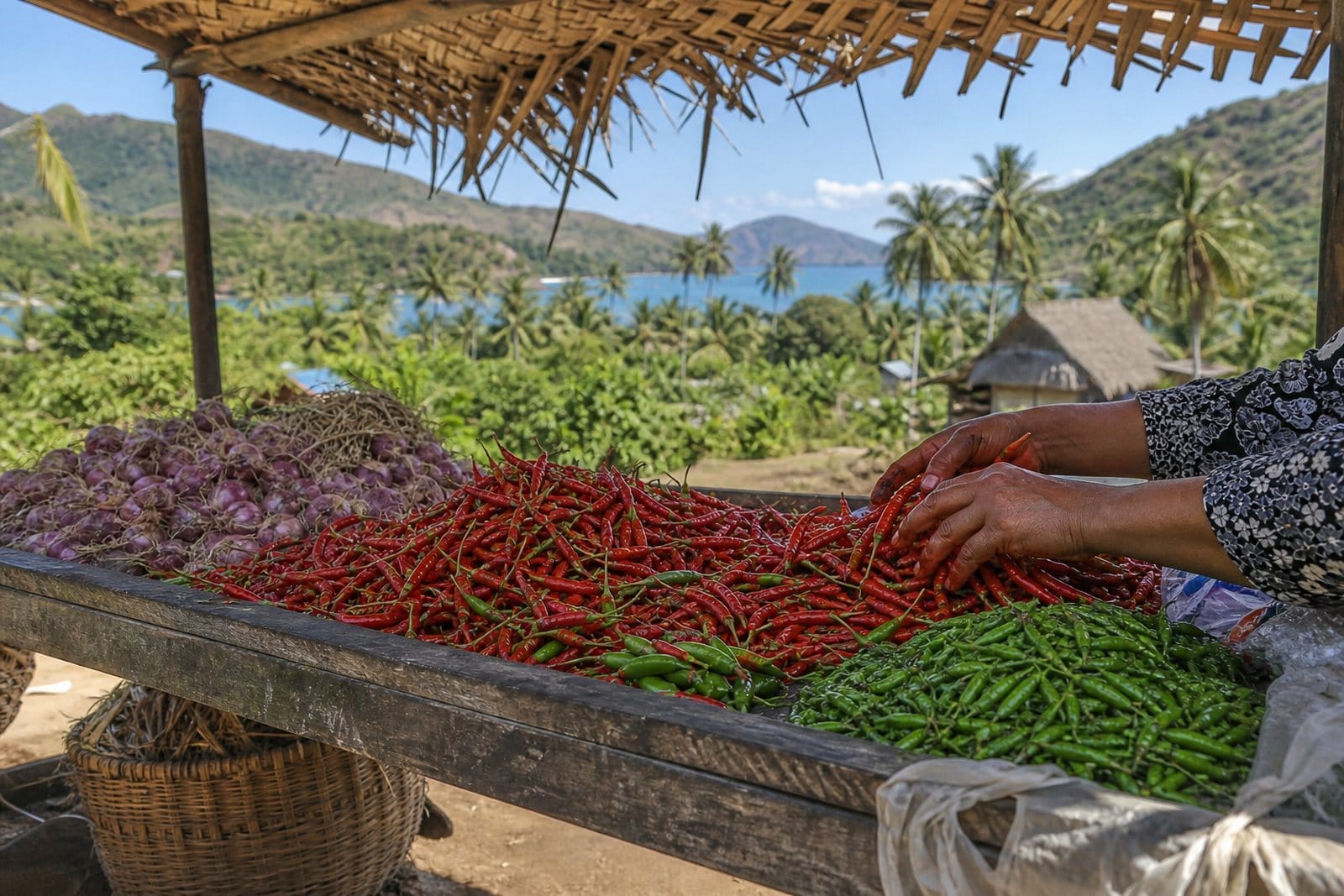 Indonesia Moves to Contain Food Inflation as August Prices Rise · Illustration: HubLombok (AI-generated)
Why the Composition Matters for Lombok Assets
Investment property is exposed to inflation in several ways. Some are direct: consumables, maintenance inputs and wages can become more expensive. Others are indirect: guests may alter discretionary spending, operators may reassess budgets, and local service providers may face changing cost bases.
The implications vary by asset and operating model. A land investor with no near-term development timetable has a different exposure from an owner operating a staffed villa. A rental property that includes breakfast, concierge services or extensive food-and-beverage provision may feel food-cost volatility more immediately than a simpler self-catered unit.
This is where underwriting discipline becomes valuable. Investors should ask managers and developers not merely for a revenue projection, but for the assumptions below it:
- Which expenses are borne by the owner and which by the operator?
- Are food, guest-service and maintenance costs modelled separately?
- How often are budgets reviewed when volatile inputs move?
- Does the projected return distinguish gross revenue from net income after management fees and other costs?
- What contingency exists if costs rise while nightly rates do not move in parallel?
The last question is particularly relevant in an early-cycle destination. South Lombok’s realistic stabilised occupancy is 55-70% in years one to three, compared with 70-85% in Bali. That difference does not make Lombok unattractive; it makes conservative modelling essential. A property can have compelling long-term positioning and still require patient, properly capitalised ownership in its earlier operating years.
HubLombok is the editorial arm of Samudra Villas, an active developer in Are Guling, South Lombok. That proximity makes transparency especially important: readers should treat any project-level yield claim as an operator assumption to be tested against management costs, occupancy and the specific services included.
The broader Lombok investment case remains tied to relative value and the “Bali-overflow” thesis: rising Bali prices and congestion may direct demand towards a cheaper, earlier-cycle market. But relative value is not immunity from operating risk. Food-price volatility is a reminder that local economics matters alongside beach frontage, design quality and tourism narratives.
What This Means for Investors
The immediate investment conclusion is not to abandon Lombok exposure; it is to sharpen the budget. August’s inflation reading does not establish a new long-term price regime, but it does show that food costs are currently the most important source of monthly inflation pressure in Indonesia.
For prospective buyers, the most useful response is practical due diligence. Request operating budgets that separate revenue assumptions from controllable and uncontrollable expenses. Examine whether quoted returns are gross or net. Ask how a manager deals with price changes in cleaning supplies, guest amenities, staffing, repairs and food-related services. If the property is off-plan, establish who carries cost-overrun risk during construction and what is included in the turnkey specification.
Legal diligence remains equally important. Foreigners cannot hold Indonesian freehold, or Hak Milik. Available structures include leasehold, Hak Pakai for eligible residents, and a foreign-owned PT PMA holding Hak Guna Bangunan. Nominee arrangements in which an Indonesian party holds freehold on a foreign buyer’s behalf are illegal and void in court.
TerraNusa Advisory is HubLombok’s independent licensed-notary and legal advisory partner for foreign buyers in Lombok. Its stated scope includes certificate and ownership-history checks, zoning and encumbrance diligence, PT PMA setup, taxes, and title transfer at the land office. Investors should ensure that any purchase has equivalent end-to-end scrutiny, rather than treating the execution of a deed as the entirety of due diligence.
The policy response now being emphasised by BI and government is directed at supply and coordination, not at a single monetary lever. That is the relevant signal for investors: Indonesia’s authorities are identifying food-price pressure as a problem requiring active management. For a Lombok owner, the sensible parallel is active asset management, clear budgets, conservative projections and regular review of cost lines that can move faster than a brochure suggests.
Stay informed, subscribe to the free Lombok Briefing for market intelligence like this, published twice a month.
What drove Indonesia’s inflation in August 2026?
Indonesia recorded monthly inflation of 0.21% in August 2026. Volatile food inflation was the principal driver, rising 0.88% and contributing 0.15% to headline inflation. Broiler chicken was the largest food contributor, followed by cayenne pepper, fresh fish and rice.
How could food inflation affect a Lombok villa investment?
Food-price volatility may affect a Lombok villa through operating budgets, especially where guest services, staffing or food-and-beverage provision are included. Investors should test projected returns against management fees, realistic occupancy and separately identified cost assumptions rather than relying on gross-yield claims.
Is Indonesia’s August inflation data a reason to avoid Lombok property?
The August data alone does not establish a long-term outlook for Lombok property. It shows that food was the main monthly inflation pressure while transportation prices fell. A prudent investor should respond with conservative operating budgets, clear net-yield modelling and full legal due diligence.

The Lombok Buyer's Field Guide
Legal structures ranked by risk, the honest ROI math line by line, all six zones ranked, and the 24-point due-diligence checklist. The whole book, free in your inbox.
See what's inside