Indonesia’s EAEU Trade Pact: The Longer View for Lombok Investors
Indonesia’s new EAEU trade agreement is a national trade framework, not a Lombok property catalyst. Here is the context investors should watch.
Quick answer: Indonesia’s planned free-trade agreement with the Eurasian Economic Union broadens the national trade framework rather than creating an immediate Lombok-specific investment event. For Lombok investors, its relevance is contextual: it may shape the commercial setting around Indonesia, but the agreement is not due to enter into force until early 2027.
There is a temptation to treat every international agreement as a direct signal for property markets. It is usually wiser to separate the announcement from the transmission mechanism. Indonesia’s agreement with the Eurasian Economic Union is significant in scope, but its practical meaning for an investor in Lombok lies in the questions it raises about market access, implementation and the wider Indonesian economy, not in any instant repricing of local assets.
The Context
At the 11th Eastern Economic Forum in Vladivostok, President Prabowo Subianto presented the Indonesia-Eurasian Economic Union Free Trade Agreement as a two-way commercial bridge. Eurasian producers, he said, would gain access to Indonesia’s market of more than 290 million consumers. Indonesian producers, meanwhile, would gain access to the five EAEU member states: Armenia, Belarus, Kazakhstan, Kyrgyzstan and Russia.
The agreement was signed in St Petersburg on 21 December 2025. According to the account carried by Antara Business, it covers the elimination or reduction of duties on 11,882 tariff lines, representing more than 90% of traded goods. Its planned entry into force is in early 2027, subject to the completion of the exchange of notifications and the member states’ internal procedures.
“This agreement is a South-South trade architecture,” President Prabowo said, describing an arrangement intended to open five markets to Indonesian producers while giving Eurasian businesses access to Indonesian consumers.
That language matters. The agreement is framed not merely as a bilateral Indonesia-Russia initiative, but as an arrangement between Indonesia and a five-member economic union. It is also being presented as part of Indonesia’s place within a larger regional commercial system. The President described Indonesia as a natural entry point for Eurasian businesses seeking the ASEAN market, citing Indonesia’s position as the region’s largest market and its role as the hub of the Regional Comprehensive Economic Partnership.
For investors, this is the first useful distinction: an agreement can be strategically important before its commercial effects are visible in a particular location. Lombok is part of Indonesia, but the source does not identify a Lombok-specific programme, trade route, project or property-market consequence arising from the FTA. Treating it as one would go beyond the evidence.
A Framework, Not Yet a Flow of Trade
The scale of tariff coverage gives the agreement its analytical weight. Covering more than 90% of traded goods signals broad intent. Yet tariff coverage is not the same thing as realised trade. The agreement’s value will depend on businesses identifying buyers, arranging logistics, completing payments and moving goods under the new rules.
Antara reports that Indonesian business delegates at the forum were preparing pilot shipments, finding buyers, securing logistics and finalising payment arrangements. Those details are more revealing than the headline alone. They show that the practical work of using an agreement is still underway.
A trade agreement creates a framework. Commercial participants must then decide whether it is worthwhile to use it. In this case, the near-term sequence is clear:
- Internal procedures and notifications must be completed before the agreement can take effect.
- The planned entry point is early 2027.
- Businesses must convert tariff preferences into actual transactions through buyers, logistics and payment arrangements.
- Investors should distinguish this process from claims of an immediate, localised benefit.
President Prabowo has proposed a clear ambition: to double trade between Indonesia and Russia during the FTA’s first review period. He linked that challenge to what he called the complementary nature of the two economies. It is an objective, rather than an achieved result, and should be read accordingly.
| What the source establishes | What investors should not assume | |---|---| | The FTA was signed in 2025 and is planned to begin in early 2027. | That it is already operating. | | Duties will be eliminated or reduced across 11,882 tariff lines. | That every covered line will generate substantial trade. | | Indonesian delegates are preparing pilot shipments and commercial arrangements. | That a settled trade flow has already emerged. | | Indonesia is being positioned as an ASEAN entry point. | That any one Indonesian region will automatically benefit first. |
This is particularly relevant to investment analysis because property narratives often compress several steps into one. A national agreement becomes, too quickly, a tourism story; a tourism story becomes a rental thesis; a rental thesis becomes a valuation forecast. None of those later links is established by the source.
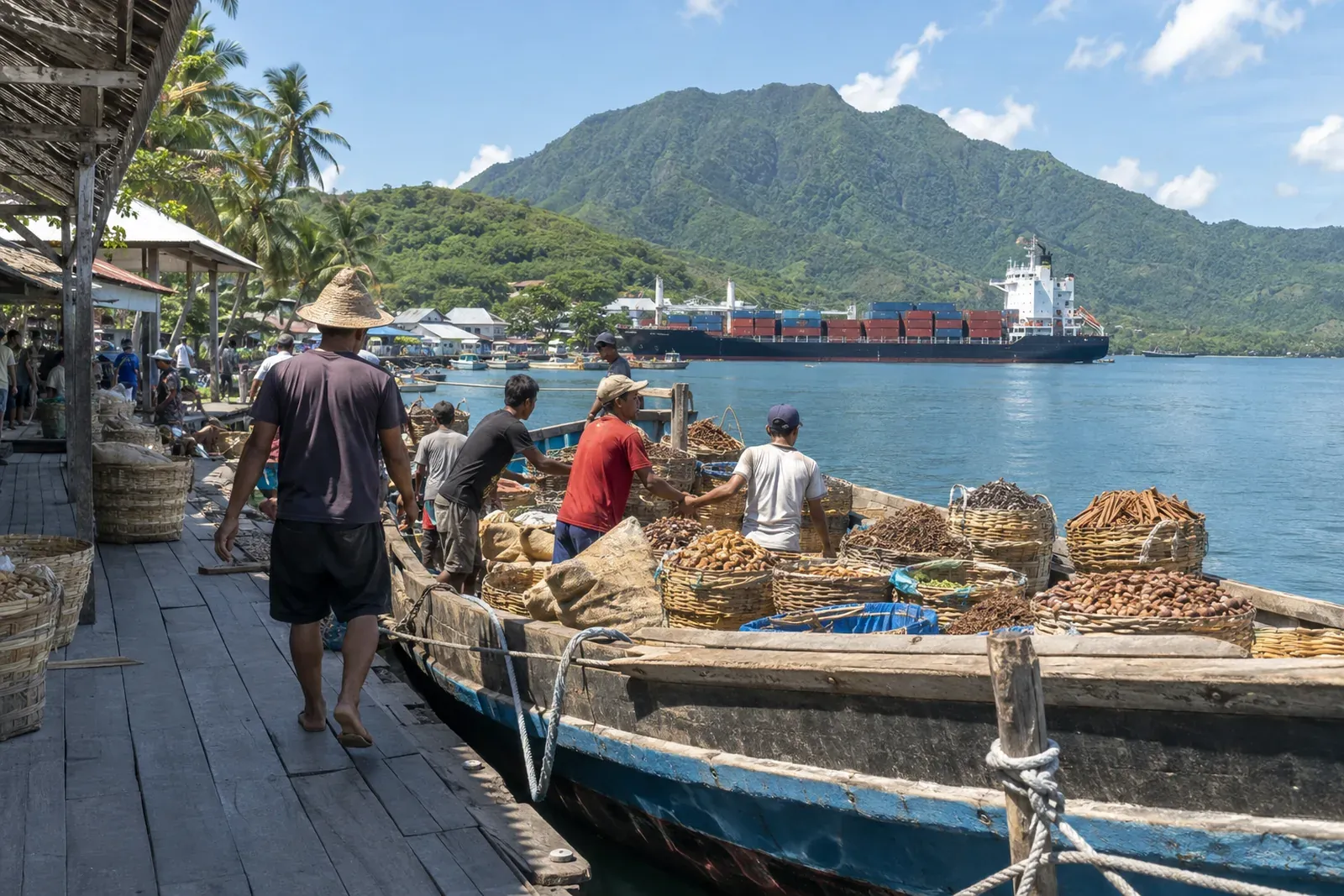
 Indonesia’s EAEU Trade Pact · Illustration: HubLombok (AI-generated)
Why Lombok Investors Should Read Beyond the Headline
The agreement nevertheless belongs on the wider reading list for investors considering Indonesia. Country-level trade architecture influences the setting in which companies, consumers and capital operate. That is a contextual observation, not a forecast of returns or a claim that the FTA will alter Lombok’s market conditions.
The more disciplined approach is to ask what evidence would be needed before assigning local investment significance. Investors would need to see which goods are traded, which Indonesian businesses use the preferences, how logistics and payments develop, and whether any economic activity relevant to Lombok is actually connected to those changes. The Antara report establishes that commercial preparation is occurring; it does not answer those later questions.
For a real-estate investor, this distinction protects against misplaced certainty. A villa or land decision requires its own assessment of location, title, development quality, management, operating costs and demand. An international FTA may be part of the macro backdrop, but it cannot substitute for asset-level due diligence.
The same principle applies to expectations around foreign demand. The source refers to access for Eurasian producers to Indonesia and for Indonesian producers to EAEU markets. It does not say that the agreement will increase visitor arrivals to Lombok, prompt a new buyer segment, change local land values or improve villa occupancy. Those would be separate propositions requiring separate evidence.
There is, however, a useful mental model here. National policy can matter to local investors in layers:
- First layer: formal access. The agreement changes the tariff framework for covered goods once it enters into force.
- Second layer: commercial use. Companies decide whether to use the agreement, with logistics, buyers and payment arrangements determining whether access becomes trade.
- Third layer: local relevance. Only then can investors assess whether an identified trade pattern has any meaningful connection to a particular Indonesian region or asset class.
At present, the source gives substance to the first layer and early indications of activity in the second. It does not provide evidence for a Lombok-specific third layer.
That restraint is not a dismissal of the agreement. On the contrary, it is how a long-horizon investor should read a development of this kind. Broad trade agreements can be consequential precisely because they alter rules across many products and markets. But the pathway from rules to revenues, and from revenues to a local investment outcome, is neither automatic nor uniform.
What This Means for Investors
The immediate investment conclusion is modest but useful. Treat the I-EAEU FTA as a national strategic development to monitor, not as a standalone reason to alter a Lombok allocation. The agreement’s planned early-2027 entry into force provides a clear point at which implementation should begin to be assessed more closely.
A sensible monitoring framework would focus on evidence rather than mood. Watch whether the required procedures are completed, whether pilot shipments become repeat commercial activity, and whether Indonesian businesses identify concrete use cases for the tariff changes. If an investor believes there is a connection to Lombok, that connection should be specified rather than presumed.
The broader message from Vladivostok is that Indonesia is seeking to widen its commercial links while presenting itself as an entry point to ASEAN. For investors with exposure to Indonesia, that is a meaningful piece of macro context. Yet a macro context is not an underwriting model.
This is where patience becomes a competitive advantage. The agreement is already signed, but it is not planned to enter into force until early 2027. The intervening period is not empty: it is where notifications, business preparation, logistics, buyers and payment arrangements will determine whether formal market access becomes a practical trade relationship.
For Lombok, the right posture is attentive rather than declarative. Investors should welcome clearer frameworks and broader commercial connections at the national level, while keeping local investment decisions anchored to evidence that is genuinely local. The FTA may eventually form part of a larger Indonesian economic story. The source does not yet establish that it has become a Lombok property story.
Stay informed, subscribe to the free Lombok Briefing for market intelligence like this, published twice a month.
When is the Indonesia-EAEU free-trade agreement expected to take effect?
The agreement is planned to enter into force in early 2027, once the exchange of notifications is completed and EAEU member states finish their internal procedures. It was signed in St Petersburg on 21 December 2025.
Does the EAEU trade agreement create an immediate Lombok property opportunity?
No Lombok-specific property outcome is established by the source. The agreement is a national trade framework covering tariff reductions or eliminations, with commercial use still dependent on implementation, buyers, logistics and payment arrangements.
What does the agreement cover for Indonesian and Eurasian businesses?
The Indonesia-EAEU FTA covers elimination or reduction of duties on 11,882 tariff lines, representing more than 90% of traded goods. It opens access between Indonesia and the five EAEU member states: Armenia, Belarus, Kazakhstan, Kyrgyzstan and Russia.

The Lombok Buyer's Field Guide
Legal structures ranked by risk, the honest ROI math line by line, all six zones ranked, and the 24-point due-diligence checklist. The whole book, free in your inbox.
See what's inside