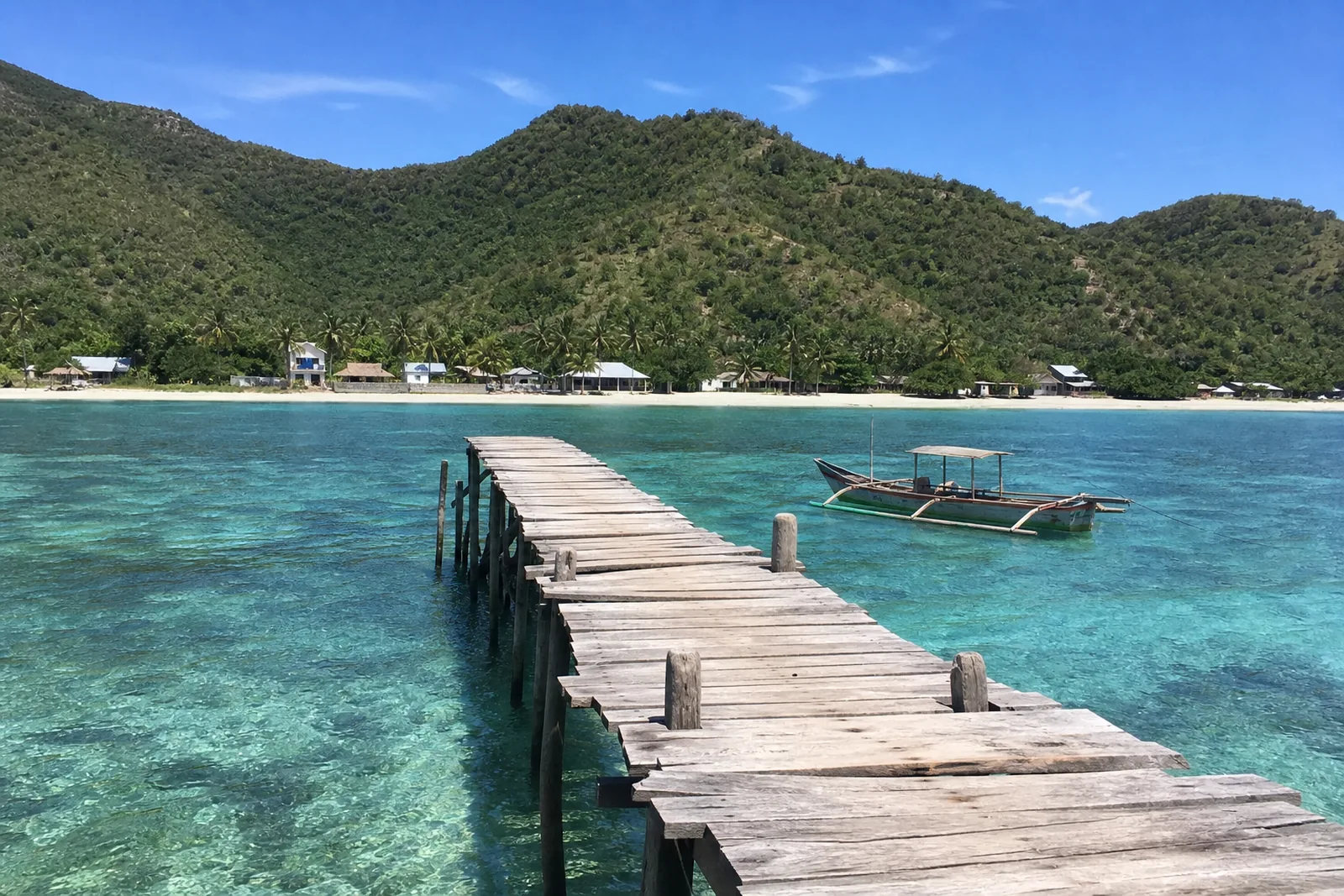
Daily Dispatch: Indonesia Backs Samota’s Global Marine Tourism Ambition
Indonesia’s renewed support for Samota puts marine tourism back on the regional investment watchlist. Here is what Lombok investors should, and should not, read into it.
Quick answer: Indonesia’s Tourism Ministry has reinforced support for developing the Samota Special Economic Zone in Sumbawa as a global marine-tourism destination, according to Antara Business. For Lombok investors, it is a regional policy signal worth monitoring, not evidence that any specific Lombok asset, tourism route or return profile has changed today.
A short report can carry a long shadow when it concerns a Special Economic Zone and national tourism backing. Antara Business reports that the Tourism Ministry has reinforced support for efforts to develop Samota, in Sumbawa, as a global marine-tourism destination. The immediate fact is narrow; the investor question is broader: what does renewed official attention to a nearby island-market tourism proposition mean for the South Lombok thesis?
The Context
The report’s central development is straightforward. Indonesia’s Tourism Ministry has reinforced its support for efforts to develop the Samota Special Economic Zone, or SEZ, as a global marine-tourism destination.
That wording matters. It is a statement of support for development efforts, rather than a disclosed investment timetable, a completed project, a visitor forecast or a property-market result. Antara’s report, as supplied, does not provide details on specific facilities, capital commitments, opening dates, investor incentives or anticipated visitor volumes. Investors should resist filling those gaps with assumptions.
The news is a policy-and-positioning signal: Samota is being framed for global marine tourism, with Tourism Ministry support behind its development efforts.
For South Lombok, the relevant lens is regional tourism positioning. Lombok’s own investment case is already shaped by a recovering visitor market and the MotoGP effect: foreign arrivals are running 40-50% year on year higher, while Kuta/Mandalika villa rates are about 38% year on year higher. Those figures describe South Lombok’s market context; they do not demonstrate that the Samota announcement caused, or will cause, either trend.
The distinction is more than editorial hygiene. A tourism announcement can alter the questions investors ask, but it is not the same thing as rental income, planning approval, an operating hotel, an air route or a completed asset. Today’s dispatch should therefore be read as a live addition to the regional watchlist, not as a reason to rewrite an underwriting model.
Why the Signal Deserves Attention
Marine tourism is an investable theme only when a destination can translate its natural proposition into reliable access, accommodation, operating standards and repeat demand. Antara’s report establishes the first element of the current story: official reinforcement of support for Samota’s development as a marine-tourism destination. It does not establish the others.
That restraint is particularly important for overseas buyers, who can be tempted to treat the words “SEZ” and “global” as a shortcut to certainty. Neither is a substitute for transaction-level diligence. In Lombok, foreign buyers cannot hold freehold, or Hak Milik/SHM; that is reserved for Indonesian citizens. The available routes include leasehold, Hak Pakai and a foreign-owned PT PMA holding Hak Guna Bangunan.
A sensible reading of today’s news therefore separates three layers:
- The confirmed development: the Tourism Ministry has reinforced support for Samota’s marine-tourism ambition.
- The reasonable inference: marine tourism remains a strategically relevant regional theme for investors following eastern Indonesian leisure markets.
- The unconfirmed leap: that any particular Lombok project, land parcel or villa will benefit directly, or that a return can be forecast from this announcement.
In the South Lombok market, the numbers already demand selectivity. Investment-grade turnkey villas begin at EUR 95,000-350,000. Honest net rental yields are typically 7-12% after management fees and realistic occupancy, while top-performing assets can reach around 15% net. Developer-quoted gross yields of 12-22% are not comparable: they exclude costs that a net-yield assessment must carry.
The operating assumptions matter as much as the headline. Stabilised occupancy in the first three years is realistically 55-70%, management fees run 18-22% of gross rental revenue, and OTA or booking commissions are 15-20%. None of those inputs has been changed by the Samota report.
 Daily Dispatch · Illustration: HubLombok (AI-generated)
A Regional Story, Not a Lombok Transaction Signal
The most useful investor response is curiosity with a valuation discipline. The report gives market watchers a reason to follow how Samota’s development story evolves; it does not eliminate the need to assess South Lombok on its own supply, location, tenure, construction and operating merits.
South Lombok itself is not a single market. Prime Kuta land is quoted at Rp 300-400 million per are, approximately $18,200-24,200 per are, while Are Guling is quoted at Rp 120-180 million per are, approximately $7,300-10,900 per are. An are is 100 m². These are local-convention land figures, not a promise of future pricing.
| Investor question | What today’s report answers | What it does not answer | |---|---|---| | Is marine tourism receiving official attention? | Yes: Antara reports reinforced Tourism Ministry support for Samota’s development. | How quickly the effort will translate into operating tourism infrastructure. | | Does it change Lombok property pricing? | No direct evidence is supplied. | Whether any South Lombok zone will see a measurable pricing effect. | | Does it change a villa’s income case? | No. | Occupancy, rates, costs, management quality or net yield for a specific asset. |
This is where the Bali-overflow thesis should be handled carefully. Rising Bali prices and congestion can push demand towards a cheaper, earlier-cycle Lombok market. But a thesis is not a guarantee, and a regional tourism-development headline does not turn a broad proposition into asset-level proof.
For buyers assessing a South Lombok opportunity, the durable questions remain deliberately practical: What tenure is being sold? Is the zoning appropriate? What is the ownership history? Are there encumbrances? Who is operating the villa, and how are gross revenue and costs separated? Nominee arrangements, where an Indonesian citizen holds freehold on a foreigner’s behalf, are illegal and void in court.
TerraNusa Advisory, HubLombok’s independent licensed-notary and legal advisory partner, supports foreign buyers through due diligence on certificates, ownership history, zoning and encumbrances, as well as PT PMA setup, tax, deed and title-transfer processes. That sort of work is not glamorous, but it is where a regional narrative becomes a defensible purchase decision.
What This Means for Investors
First, add Samota to the regional tourism monitor. The reported ministerial support is a fresh indication that marine tourism is part of the policy conversation around Sumbawa. Watch for subsequent, verifiable disclosures before assigning a monetary value to the development story.
Second, keep Lombok underwriting local. Kuta/Mandalika, Selong Belanak, Are Guling, Mawun and Bumbang have different price points and market positions. The overall South Lombok land spread is about Rp 30-400 million per are; treating the island as one homogeneous bet is a category error.
Third, be precise about what is changing today. The announcement may strengthen the strategic interest of the broader region. It does not alter the legal constraints for foreign buyers, validate promotional yields, or provide evidence that a particular villa will achieve a particular occupancy level.
The prudent conclusion is neither indifference nor exuberance. Indonesia’s support for Samota’s global marine-tourism ambition is a noteworthy regional signal at a time when South Lombok is already attracting investor attention. For now, it belongs in the research file, alongside due diligence and realistic income assumptions, not in the spreadsheet as a new guaranteed return.
Stay informed, subscribe to the free Lombok Briefing for market intelligence like this, published twice a month.
What did Indonesia announce about the Samota SEZ?
Antara Business reports that Indonesia’s Tourism Ministry reinforced support for efforts to develop the Samota Special Economic Zone in Sumbawa as a global marine-tourism destination. The supplied report does not disclose a timetable, investment amount, visitor forecast or individual project details.
Does the Samota news change Lombok villa returns today?
No direct evidence in the report shows a change to Lombok villa returns, occupancy or land values. South Lombok buyers should continue to assess each asset using realistic occupancy, management costs, booking commissions, tenure and location-specific demand rather than a regional headline.
What should foreign investors check before buying in South Lombok?
Foreign investors should confirm the permitted tenure, certificate and ownership history, zoning, encumbrances, tax and transfer process. Foreigners cannot hold freehold Hak Milik/SHM. Leasehold, Hak Pakai and a PT PMA holding HGB are the available legal routes described in HubLombok’s verified facts.

The Lombok Buyer's Field Guide
Legal structures ranked by risk, the honest ROI math line by line, all six zones ranked, and the 24-point due-diligence checklist. The whole book, free in your inbox.
See what's inside