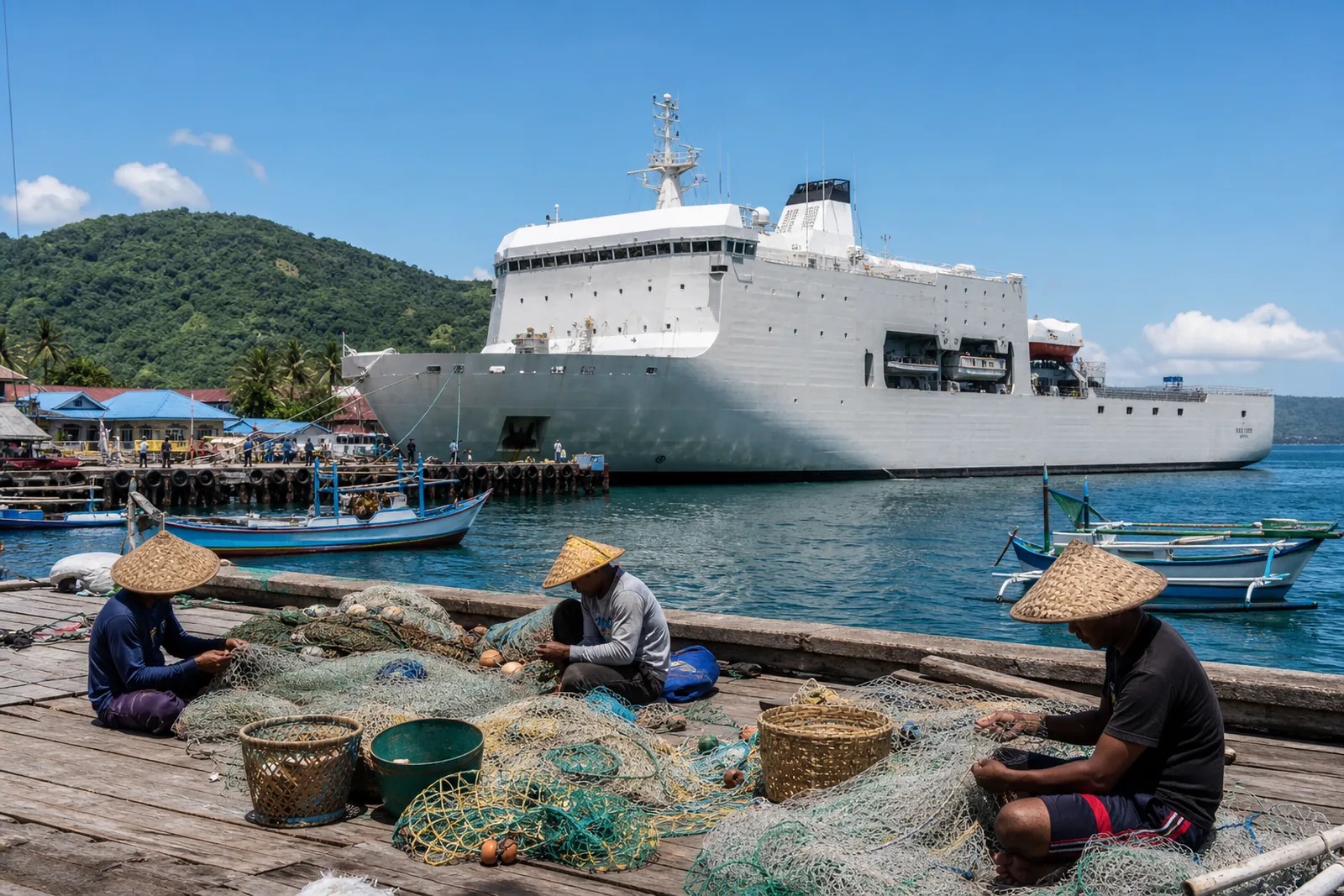
Hospital Ship Reaches Manggarai After East Nusa Tenggara Earthquake
Indonesia has deployed the KRI Dr. Soeharso-990 hospital ship to Manggarai to support medical care after the 7.7-magnitude earthquake.
Indonesia’s Navy has deployed the KRI Dr. Soeharso-990 hospital ship to Manggarai, East Nusa Tenggara, as authorities strengthen medical support following the magnitude 7.7 earthquake.
The vessel has reached Reo Port in Manggarai District, bringing clinical capacity, a joint medical team and facilities intended to help residents obtain treatment as the post-earthquake response continues.
A floating hospital arrives in Manggarai
According to Berton SP Panjaitan, acting head of the National Disaster Mitigation Agency’s (BNPB) Center for Disaster Data, Information, and Communication, the ship sailed from Surabaya before arriving at Reo Port.
Its deployment is designed to supplement healthcare provision in affected areas, where the government is seeking to restore hospital services while responding to immediate injuries and medical needs. The KRI Dr. Soeharso operates as a hospital support ship rather than simply a transport vessel, enabling care to be delivered close to communities affected by the disaster.
As of Saturday, August 22, the ship had treated 21 patients, including people requiring fracture surgery, laceration treatment, outpatient care and three inpatients, Panjaitan said.
For a disaster response, such capacity matters not merely for the treatment already delivered but for the flexibility it provides. A hospital ship can combine clinical care, emergency response and medical evacuation support in a location where demand may change quickly.
Facilities intended for urgent and continuing care
The KRI Dr. Soeharso is equipped with an emergency room, intensive care unit, operating theatre, clinic, pharmacy, laboratory and treatment rooms, according to BNPB. These are the core functions needed to assess injuries, deliver emergency treatment and conduct procedures for patients whose needs cannot be handled through basic first aid alone.
The ship is also preparing two treatment rooms, each with 20 beds, with separate facilities for male and female patients. That arrangement adds a practical layer of inpatient capacity while authorities work to ensure that local hospitals can resume basic services.
Its listed capabilities include:
- an emergency room and intensive care unit;
- an operating theatre and treatment rooms;
- a clinic, pharmacy and laboratory;
- two treatment rooms with 20 beds each;
- a helicopter landing deck for medical evacuations from remote areas.
The helicopter deck is especially relevant to the stated aim of facilitating evacuations from remote locations. In disaster conditions, geography can become a clinical constraint: care may be available, but the ability to bring a patient to it can determine whether treatment is timely.
Care is provided according to medical need
A joint medical team from the Indonesian Navy and the Ministry of Health is serving aboard the vessel. Available services include general health checks, wound care, surgery and emergency treatment.
All services are provided free of charge and are prioritised according to medical need. This is an important operational principle in the immediate aftermath of an earthquake, when healthcare teams must allocate finite clinical capacity according to urgency rather than order of arrival.
The government has said it hopes the hospital ship will allow residents in affected areas to receive prompt and appropriate medical treatment. The combination of operating facilities, inpatient space and a medical team gives the response an additional platform while wider healthcare systems are being stabilised.
The update does not present the ship as a replacement for land-based hospitals. Instead, it forms part of a broader response intended to keep medical care available while damaged or disrupted local services are brought back into operation.
Health authorities focus on restoring hospitals
The Ministry of Health has activated nine Health Emergency Operation Centers (HEOCs) to strengthen coordination, monitor conditions and ensure that post-earthquake healthcare needs in East Nusa Tenggara are addressed promptly.
Health Minister Budi Gunadi Sadikin said on August 18 that the immediate priority was restoring all hospitals in affected districts and cities to full operational capacity, particularly in anticipation of a potential increase in patients in the following days.
The government is targeting the resumption of basic services within a week at earthquake-affected Regional General Hospitals, or RSUD, in East Nusa Tenggara. The stated focus is on trauma surgery, maternal and child healthcare, and hemodialysis.
That priority list reflects the breadth of healthcare that must continue during a disaster response. Earthquake injuries require trauma capacity, but affected communities also need uninterrupted care for childbirth, children and patients dependent on regular treatment. The hospital ship’s services sit alongside this effort to restore basic hospital operations.
What this means for investors
This is first and foremost a humanitarian and public-health development, not an investment story. For investors with interests in Indonesia, it is a reminder that disaster events can place pressure on essential services and that official response capacity depends on coordination among national agencies, the armed forces and health authorities.
The facts currently reported point to several areas worth following:
- the progress of hospital restoration in affected districts and cities;
- the continuing medical demand in areas served by the ship;
- the operation of the nine HEOCs coordinating the health response;
- the availability of trauma surgery, maternal and child healthcare, and hemodialysis at affected RSUD facilities.
Investors should avoid drawing commercial conclusions from an early emergency update. The report establishes that medical support has been deployed and that authorities have set a target for basic hospital services to resume; it does not provide a basis for assessing wider economic, property or infrastructure effects.
What it does show is the value of deployable healthcare capacity in a difficult setting. The KRI Dr. Soeharso’s arrival at Reo Port gives the response an equipped clinical facility, evacuation support and a joint medical team as the government works to restore land-based services.
Stay informed, subscribe to the free Lombok Briefing for analysis like this, published twice a month.
What medical support has the KRI Dr. Soeharso brought to Manggarai?
The KRI Dr. Soeharso-990 is a hospital support ship with an emergency room, intensive care unit, operating theatre, clinic, pharmacy, laboratory and treatment rooms. A joint Indonesian Navy and Ministry of Health medical team provides health checks, wound care, surgery and emergency treatment free of charge.
How many patients had the hospital ship treated in Manggarai?
As of Saturday, August 22, BNPB said the KRI Dr. Soeharso had treated 21 patients. The cases included people requiring fracture surgery, laceration treatment and outpatient care, while three patients were receiving inpatient care.
What is the government doing to restore healthcare after the earthquake?
The Ministry of Health activated nine Health Emergency Operation Centers to coordinate and monitor the response. The government is targeting the resumption of basic services within a week at affected Regional General Hospitals, focusing on trauma surgery, maternal and child healthcare, and hemodialysis.

The Lombok Buyer's Field Guide
Legal structures ranked by risk, the honest ROI math line by line, all six zones ranked, and the 24-point due-diligence checklist. The whole book, free in your inbox.
See what's inside