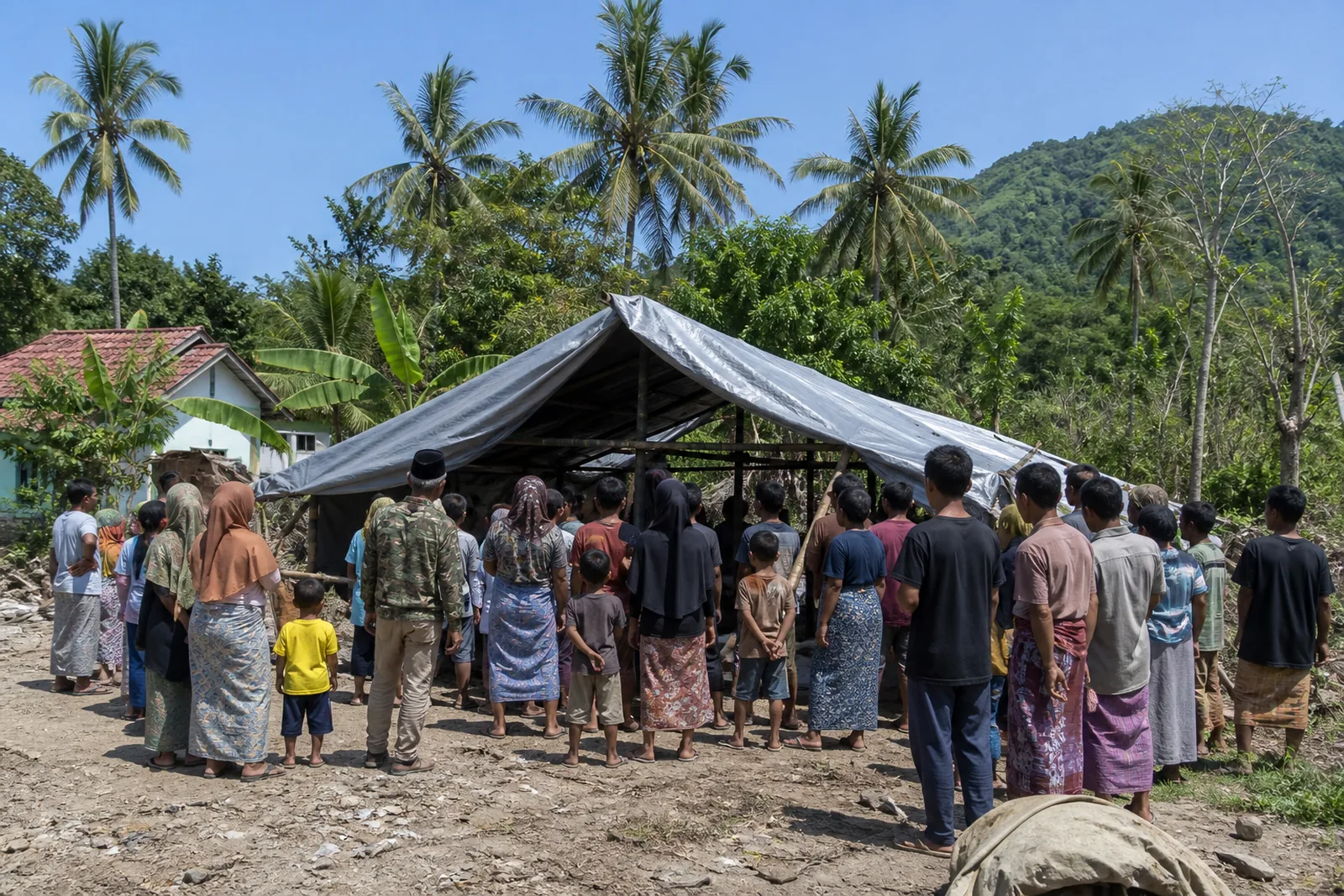
Daily Dispatch: Gibran Pledges Support for NTT Earthquake Survivors
Indonesia’s Vice President has pledged a safety-first emergency response for communities affected by the NTT earthquake.
Quick answer: Vice President Gibran Rakabuming Raka has pledged that Indonesia’s emergency response for East Nusa Tenggara earthquake survivors will prioritise safety and urgent needs. For Lombok investors, the immediate message is not a market forecast but a reminder to distinguish confirmed operational facts from wider regional assumptions: the source identifies no direct impact on Lombok.
This is a live humanitarian and administrative test for eastern Indonesia. During a visit to an evacuation post in Sikka District, Gibran placed public safety, access to basic assistance and support for vulnerable residents at the centre of the government’s response.
The Context
The immediate priority, according to Gibran, is the safety of people affected by the earthquake in East Nusa Tenggara (NTT). Speaking at the evacuation post at Gelora Samador Stadium in Sikka District, he expressed empathy for residents and condolences for those who had lost family members.
The vice president said emergency measures must focus on safety and on meeting urgent needs. He also acknowledged that there may still be shortcomings on the ground, an important admission in any rapidly developing disaster response, where the delivery of assistance matters as much as its announcement.
“Public safety is important. Therefore, all emergency response measures must prioritize safety and the fulfillment of people's urgent needs,” Gibran said.
His visit was framed as a practical listening exercise as well as a public commitment. He spoke directly with residents to understand their conditions and the assistance they require. That emphasis matters because the needs of affected communities are rarely uniform, particularly where access is difficult and where evacuation, health and household concerns overlap.
The source identifies a broad list of priorities for assistance:
- Food and clean water.
- Toilets and medicine.
- Healthcare services and other urgent support.
- Delivery of aid to hard-to-access communities, including mountainous settlements.
- Specific attention for pregnant and breastfeeding women, older people, people with disabilities and children.
Gibran said these groups should be registered, monitored and assisted according to their needs. For observers of Indonesia’s regional operating environment, the statement sets a clear standard against which the response can be judged: whether support reaches affected communities safely, including those beyond the most accessible locations.
A Safety-First Response, With Recovery in View
The vice president instructed central and regional governments to ensure aid reaches all affected communities. He described this as the responsibility of the state and said the government would remain alongside residents throughout the disaster response.
The instruction is significant for two reasons. First, it makes coordination between levels of government central to the response. Secondly, it places immediate welfare needs alongside the practical problem of reaching communities in more difficult terrain. The source does not provide a timetable, scale of damage or an assessment of delivery progress; it does, however, set out the government’s stated priorities in unambiguous terms.
Residents were also advised not to return to damaged homes for the time being because of the potential for aftershocks. That is the clearest near-term safety instruction in the report. It reinforces that the event remains an active emergency rather than a completed response story.
Gibran further said that affected homes, schools and public facilities would be repaired immediately. President Prabowo Subianto’s directives, he said, require emergency response and post-disaster recovery to be carried out swiftly, effectively and sustainably.
For investors and operators assessing developments from afar, the appropriate distinction is between a government commitment and a completed outcome. The report documents the former: commitments on aid, safety, monitoring, repair and recovery. It does not establish the condition of individual assets, transport links, utilities, tourism operations or property markets in Lombok or elsewhere. Those questions require separate, local verification.
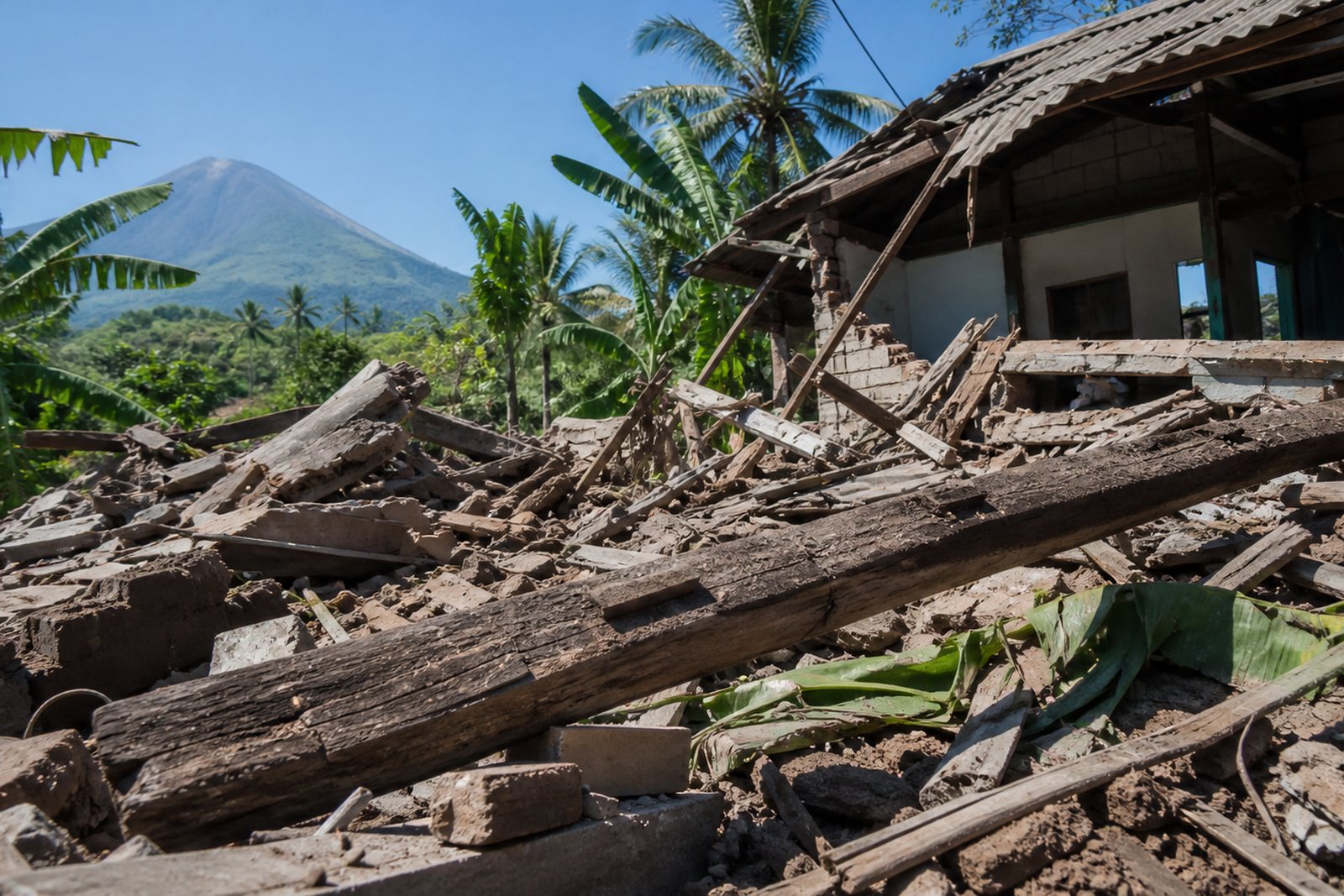 Daily Dispatch · Illustration: HubLombok (AI-generated)
What the Statement Does, and Does Not, Establish
The strongest confirmed takeaway is governmental intent. Gibran has publicly committed the central and regional authorities to a response centred on safety, basic services and vulnerable residents. He has also urged people not to re-enter damaged homes while aftershock risk remains.
That matters beyond the immediate evacuation post because confidence in a disaster response is built through visible priorities: who is being reached, what services are being provided and how long officials remain engaged after the first visit. In this case, the declared agenda spans emergency assistance and subsequent recovery.
Yet a disciplined reading of the report is equally important. It does not state:
- The earthquake’s magnitude or a figure for casualties, injuries or damage.
- A date for completion of repairs.
- The operational status of airports, ports, roads, hotels or utilities.
- Any effect on Lombok’s tourism, real-estate market or construction activity.
- Any forecast for regional investment conditions.
This is not a technicality. In moments of fast-moving news, imprecise regional narratives can travel farther than verified information. NTT and Lombok may be considered within the same broad Indonesian investment conversation, but the supplied report is specifically about communities affected in NTT and the official response there. It should not be used to imply damage, disruption or opportunity elsewhere.
For a portal serving international investors, that boundary is useful. A credible investment decision is not improved by treating a humanitarian emergency as market colour. The near-term task is to follow official safety guidance, monitor verified local information where one has exposure, and avoid claims that have not been substantiated.
What This Means for Investors
For investors with assets, staff, contractors or travel plans connected directly to affected parts of NTT, the immediate consideration is duty of care. The vice president’s guidance is explicit: people should not return to damaged homes for the moment because aftershocks remain a concern. Safety and access to essential support come first.
For Lombok-focused investors, the source supports a more restrained conclusion. There is no confirmed direct market implication in the report. It would therefore be premature to draw conclusions about demand, construction schedules, rental performance, land values or visitor flows in Lombok.
The sensible investor response is practical rather than speculative:
- Confirm the location and wellbeing of any directly affected people or operations through local channels.
- Treat official instructions on damaged buildings and evacuation as controlling until updated.
- Keep communications with guests, tenants, teams and counterparties factual and measured.
- Separate verified conditions in NTT from assumptions about other Indonesian destinations.
- Reassess operational exposure only as confirmed information becomes available.
There is also a broader governance lesson. In a crisis, the quality of information management is part of risk management. Owners and operators should be able to identify what has been confirmed, what remains unknown and who is responsible for making safety decisions. Gibran’s comments point to the same hierarchy: immediate protection, basic needs, attention to vulnerable people, then repair and recovery.
The human priority in NTT is clear. The investment relevance lies in disciplined observation, not extrapolation: watch the official response, respect safety guidance and resist the temptation to turn incomplete information into a regional market narrative.
Stay informed, subscribe to the free Lombok Briefing for market intelligence like this, published twice a month.
What did Gibran say about the NTT earthquake response?
Vice President Gibran Rakabuming Raka said Indonesia’s emergency response should prioritise public safety and urgent needs. He instructed central and regional governments to ensure aid reaches affected communities, including hard-to-access settlements, while giving particular attention to vulnerable residents.
Should residents return to damaged homes in NTT?
No. Gibran advised evacuees not to return to damaged homes for the time being because of the potential for aftershocks. The report also says the government will continue emergency response and post-disaster recovery efforts, including repairs to affected homes, schools and public facilities.
Does this report confirm an impact on Lombok property or tourism?
No. The supplied report concerns the earthquake response in East Nusa Tenggara and does not state a direct effect on Lombok property, tourism, infrastructure, utilities or investment conditions. Lombok investors should avoid drawing market conclusions without separate, verified local information.

The Lombok Buyer's Field Guide
Legal structures ranked by risk, the honest ROI math line by line, all six zones ranked, and the 24-point due-diligence checklist. The whole book, free in your inbox.
See what's inside