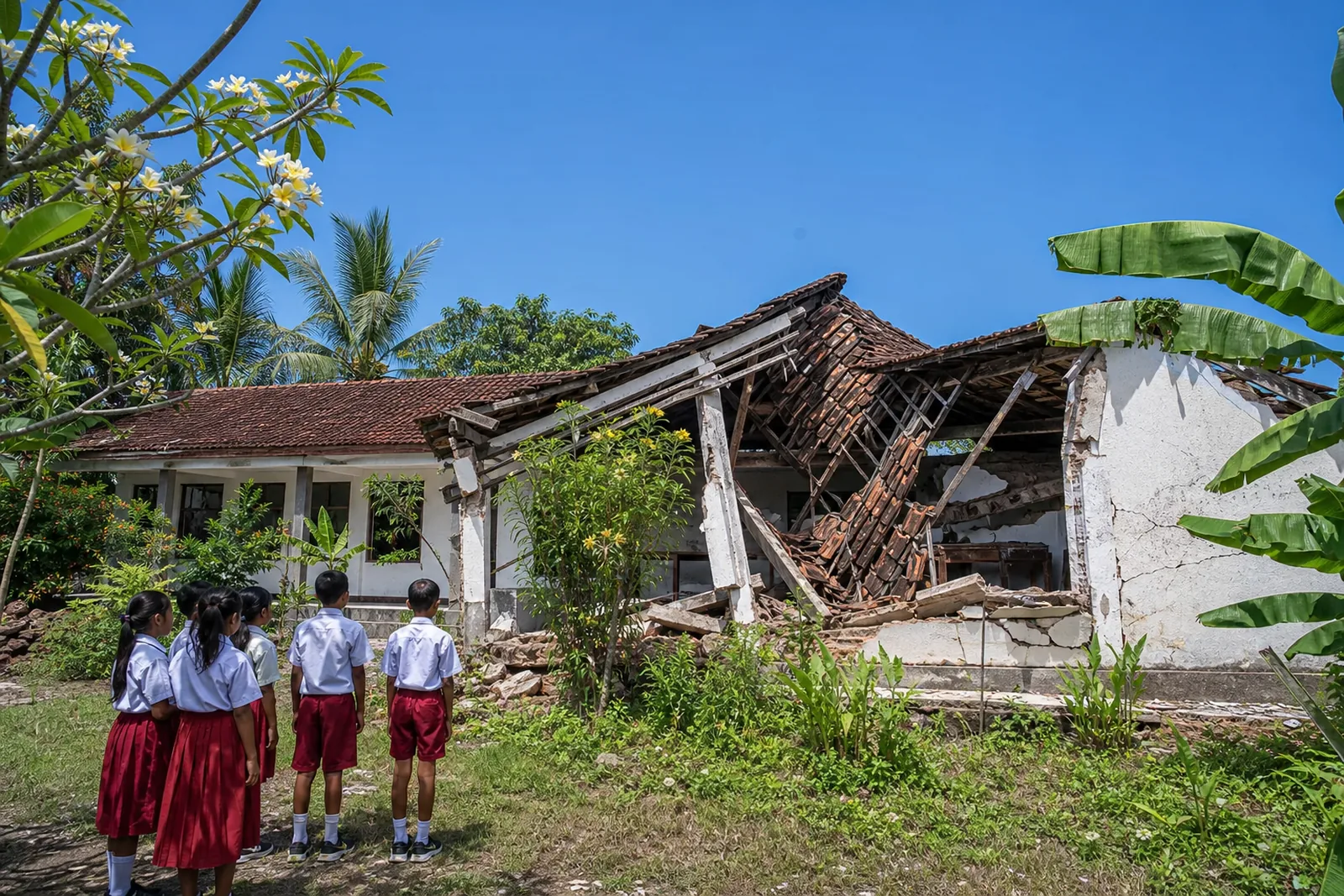
Flores quake damages 1,378 schools, BNPB says
Indonesia’s disaster agency says the Flores earthquake damaged 1,378 schools, disrupting education for more than 177,000 students.
Indonesia’s National Disaster Mitigation Agency (BNPB) says the magnitude 7.7 earthquake that struck the region on August 15 damaged 1,378 schools on Flores Island in East Nusa Tenggara. The reported impact reaches far beyond damaged buildings: BNPB said 177,678 students and 21,166 teachers and education staff are affected by the disruption.
The figures underline the practical challenge of post-earthquake recovery. While assessments continue, the government is preparing emergency arrangements intended to keep education operating while damaged school infrastructure is reviewed and recovery measures are assembled.
The scale of the education disruption
BNPB Acting Data, Information and Disaster Communications Chief Berton SP Panjaitan said field teams had completed 92% of their assessment of the damaged schools.
BNPB’s reported assessment: 1,378 damaged schools; 5,521 damaged classrooms; and 502 school-facility buildings classified as severely damaged.
The agency’s figures point to a disruption that is both widespread and operationally complex. A school can face constraints even where only part of its campus has been damaged: classrooms may be unavailable, facilities may require inspection, and administrators must decide whether pupils can be accommodated safely.
BNPB did not specify which education levels were represented in the affected-school total. That leaves an important detail unresolved, but the reported number of students and staff shows the breadth of the educational system now reliant on temporary solutions, safety checks and further assessments.
The authorities have not yet received official assessments for the remaining 219 schools, according to Panjaitan. BNPB, relevant ministries and agencies, and local governments are to accelerate the final assessment process and prepare education-recovery measures.
Temporary closures and emergency learning
The immediate picture is uneven. BNPB reported that 923 schools had temporarily closed for safety reasons, while 35 schools were conducting classes in emergency facilities. A further 171 schools had moved to remote learning, and only 30 schools were still operating normally.
The agency’s figures show that temporary closure is the predominant immediate response, with emergency facilities and remote learning serving as interim routes for a smaller number of schools.
These categories are not merely administrative labels. They describe different practical conditions for families, teachers and local authorities. Emergency facilities can allow teaching to continue where a conventional school site cannot yet be used. Remote learning offers another continuity measure, although BNPB’s statement did not set out how it is being delivered or what resources are available to pupils and teachers.
The priority, as stated by BNPB, is to ensure students can continue their studies and education staff can continue their work. The agency’s planned recovery effort therefore has two tracks: completing the physical assessment of the schools and arranging the education response while that work proceeds.
Recovery will depend on final assessments
The 92% assessment-completion rate gives officials a substantial working picture, but it is not a final accounting. The outstanding 219 schools have yet to receive official assessments, while recovery measures must account for the condition of classrooms and other facilities already identified as damaged.
The distinction matters. BNPB has reported 5,521 damaged classrooms, alongside 502 school facility buildings categorised as severely damaged. The source does not provide a reconstruction timetable, a cost estimate or a date for reopening schools. Those are therefore questions for the next stage of the official response rather than facts that can responsibly be assumed today.
For now, the government’s stated intention is to prepare emergency facilities and accelerate the assessment process with ministries, agencies and local governments. In a disaster response, that coordination determines whether temporary education arrangements can be sustained while more permanent decisions are made.
The response also has a regional dimension. Antara reported related support from neighbouring provinces, including thanks from the NTT governor to NTB and Bali for post-quake assistance, as well as aid supplies received by BNPB and Indonesian Navy personnel sent to support the response. The supplied report does not specify how those efforts are allocated between education, housing or other recovery needs.
What this means for investors
For investors watching Indonesia’s eastern islands, the report is a reminder that resilience is not an abstract consideration. It is a question of public infrastructure, local institutions and the ability of authorities to keep essential services functioning after a major disruption.
The immediate story is humanitarian and educational, not a property-market report. BNPB’s figures should not be read as a measure of economic loss, tourism impact or real-estate risk, because the source does not provide those assessments. Nor does it provide information on damage in Lombok, Bali or other locations beyond Flores Island in East Nusa Tenggara.
A disciplined investor response is therefore to separate verified facts from speculation:
- Verified: BNPB reports widespread damage to school infrastructure on Flores Island, with assessment work still incomplete.
- Verified: Temporary closures, emergency facilities and remote learning are being used to maintain educational continuity.
- Not established by this report: the cost of recovery, the duration of disruption, or any effect on property values, visitor demand or business activity.
That distinction is particularly important in archipelago markets, where a headline from one island should not automatically be treated as a direct indicator for another. Investors assessing any Indonesian project should continue to focus on site-specific due diligence, legal structure, insurance, construction standards and the relevant local risk profile.
TerraNusa Advisory, HubLombok’s legal and notary advisory partner for foreign buyers in Lombok, advises on due diligence including land certificates, ownership history, zoning and encumbrances, as well as title-transfer processes at the land office. Those checks do not eliminate physical risks, but they help ensure that an investment decision is grounded in documented local conditions rather than broad assumptions.
The next meaningful update will be BNPB’s completed assessment and the recovery measures that follow. Until then, the clearest fact is the urgency of restoring safe, workable education for the students and staff affected across Flores.
Stay informed, subscribe to the free Lombok Briefing for analysis like this, published twice a month.
How many schools were damaged in the Flores earthquake?
Indonesia’s National Disaster Mitigation Agency, BNPB, reported that 1,378 schools on Flores Island in East Nusa Tenggara were damaged after the magnitude 7.7 earthquake that struck the region on August 15. Field teams had completed 92% of the school-damage assessment.
How many students are affected by the damaged schools on Flores?
BNPB said the school disruption affects 177,678 students and 21,166 teachers and education staff. The agency said the government was preparing emergency facilities so students could continue studying and education personnel could continue working.
Are schools on Flores still operating after the earthquake?
BNPB reported that 923 schools had temporarily closed for safety reasons. Another 35 were holding classes in emergency facilities, 171 had switched to remote learning, and 30 were still operating normally. Official assessments were still outstanding for 219 schools.

The Lombok Buyer's Field Guide
Legal structures ranked by risk, the honest ROI math line by line, all six zones ranked, and the 24-point due-diligence checklist. The whole book, free in your inbox.
See what's inside