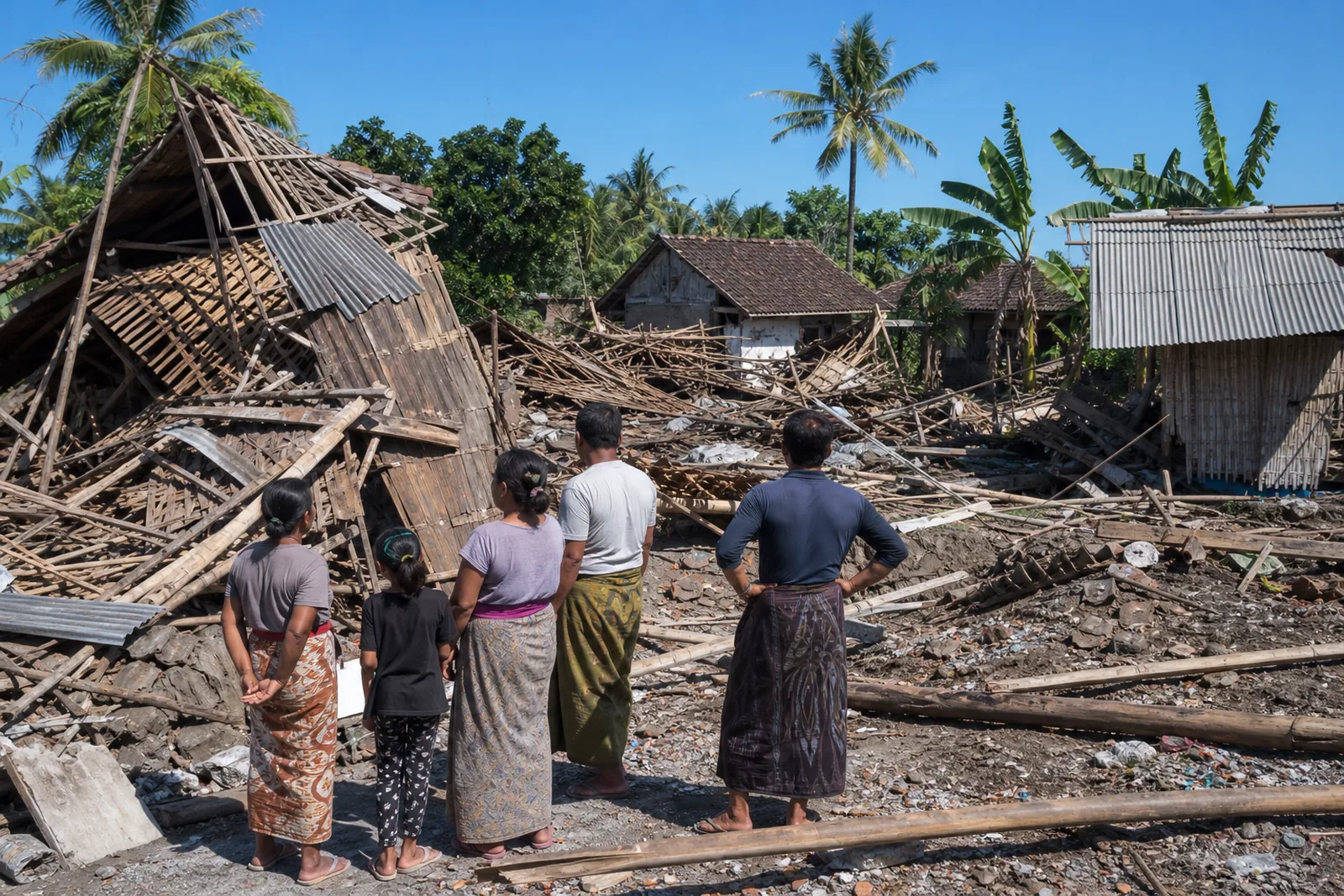
East Nusa Tenggara Earthquake Death Toll Rises to 100
Indonesia’s disaster agency reports 100 deaths, 1,603 injuries and more than 180,000 displaced after the NTT earthquake.
Indonesia’s National Disaster Mitigation Agency, BNPB, has confirmed that the death toll from the magnitude 7.7 earthquake in East Nusa Tenggara (NTT) province has risen to 100. The agency says the increase reflects survivors later dying from severe injuries, while relief teams work to reach displaced communities.
A sharply rising human toll
The earthquake struck NTT on Aug. 15, according to ANTARA. Suhartoyo, head of BNPB, said fatalities stood at 48 during the first two days after the tremor before reaching the latest confirmed total of 100.
The agency attributed much of the sharp rise to the severity of injuries suffered during the initial earthquake. As of Monday, BNPB reported 1,603 people injured and 180,327 residents displaced across emergency shelters.
Key reported figures: 100 deaths, 1,603 injuries and 180,327 displaced residents.
These figures underline the scale of the emergency response now required across the affected province. BNPB said it was extending assistance to people in centralised shelters as well as those who had established camps independently or remained in more remote locations.
Suhartoyo said authorities were seeking to ensure that displaced survivors receive food, supplies and other essential aid, including those outside the main relief facilities. The operational challenge is not merely one of supplying formal evacuation centres, but of identifying and supporting households that have moved beyond the immediate reach of relief teams.
False tsunami warnings complicate relief efforts
Alongside the physical destruction and injuries caused by the earthquake, BNPB has raised concern about false tsunami warnings circulating in local communities. The agency said the rumours triggered widespread panic and led some survivors to set up makeshift camps in remote areas.
That movement can complicate the delivery of assistance. People leaving established shelters may be harder for relief teams to locate, while unofficial information can heighten fear at a time when clear instructions are especially important.
BNPB dismissed the tsunami reports as false and urged the public to rely on official updates. Suhartoyo pointed specifically to BMKG, Indonesia’s Meteorology, Climatology and Geophysics Agency, which provides daily reporting on seismic developments.
The distinction matters. In a disaster, accurate information is itself a form of resilience: it helps households make decisions based on official warnings rather than unverified messages, and helps emergency teams focus resources where they are most needed.
Aftershocks remain an active concern
BMKG recorded 6,409 aftershocks during the eight days following the main earthquake. Their magnitudes ranged from 1.1 to 6.2, illustrating that seismic activity has continued well after the initial magnitude 7.7 event.
Of the 139 aftershocks felt by NTT residents, 33 exceeded magnitude 5.0, according to BMKG. The agency projected that seismic activity could persist for up to four weeks while tectonic plates stabilise.
Seismic update: BMKG recorded 6,409 aftershocks in eight days; 33 of 139 felt tremors were above magnitude 5.0.
For affected families, this continuing activity adds uncertainty to an already difficult recovery period. It also reinforces BNPB’s message that official channels should remain the reference point for information on earthquake conditions and any associated public-safety guidance.
The agencies’ statements do not remove the hardship faced by injured people, bereaved families and displaced residents. They do, however, set out a clearer picture of the immediate priorities: supporting survivors, extending relief to isolated camps and countering misinformation that could place people further from assistance.
What this means for investors
For investors following Indonesia, the immediate significance of this story is humanitarian rather than financial. The confirmed numbers describe a severe emergency in NTT, where the focus is on casualty care, shelter, accurate public information and access to essential supplies.
It is important not to draw unsupported conclusions about other Indonesian destinations or property markets from this report. The source concerns East Nusa Tenggara and does not provide evidence about conditions, disruption or investment implications elsewhere.
A prudent response for investors with interests in Indonesia is to monitor official agency communications and distinguish verified reporting from social-media speculation. BNPB has explicitly warned that false tsunami messages contributed to panic and to the establishment of remote camps beyond the immediate reach of relief teams.
For those assessing projects, travel plans or wider exposure, the useful discipline is straightforward:
- rely on BNPB and BMKG updates for official disaster information;
- avoid treating unverified warnings as established fact;
- keep the humanitarian situation at the centre of any assessment;
- recognise that this report does not establish conditions in locations outside NTT.
The next meaningful developments will be the official updates on relief access, the condition of displaced communities and the ongoing aftershock sequence. For now, the confirmed toll is a sobering reminder that reliable information and effective logistics are central to disaster response.
Stay informed, subscribe to the free Lombok Briefing for analysis like this, published twice a month.
How many people have died in the East Nusa Tenggara earthquake?
Indonesia’s National Disaster Mitigation Agency, BNPB, confirmed that the death toll from the magnitude 7.7 earthquake in East Nusa Tenggara had risen to 100. BNPB said fatalities were 48 during the first two days, with later deaths linked largely to severe injuries.
How many people were injured or displaced after the NTT earthquake?
As of Monday, BNPB reported 1,603 people injured and 180,327 residents displaced across emergency shelters after the East Nusa Tenggara earthquake. The agency said relief operations were being extended to survivors in isolated and self-established camps as well as centralised shelters.
What did BMKG report about aftershocks in East Nusa Tenggara?
BMKG recorded 6,409 aftershocks in the eight days after the main earthquake, ranging from magnitude 1.1 to 6.2. Of 139 aftershocks felt by residents, 33 exceeded magnitude 5.0. BMKG projected seismic activity could persist for up to four weeks.

The Lombok Buyer's Field Guide
Legal structures ranked by risk, the honest ROI math line by line, all six zones ranked, and the 24-point due-diligence checklist. The whole book, free in your inbox.
See what's inside