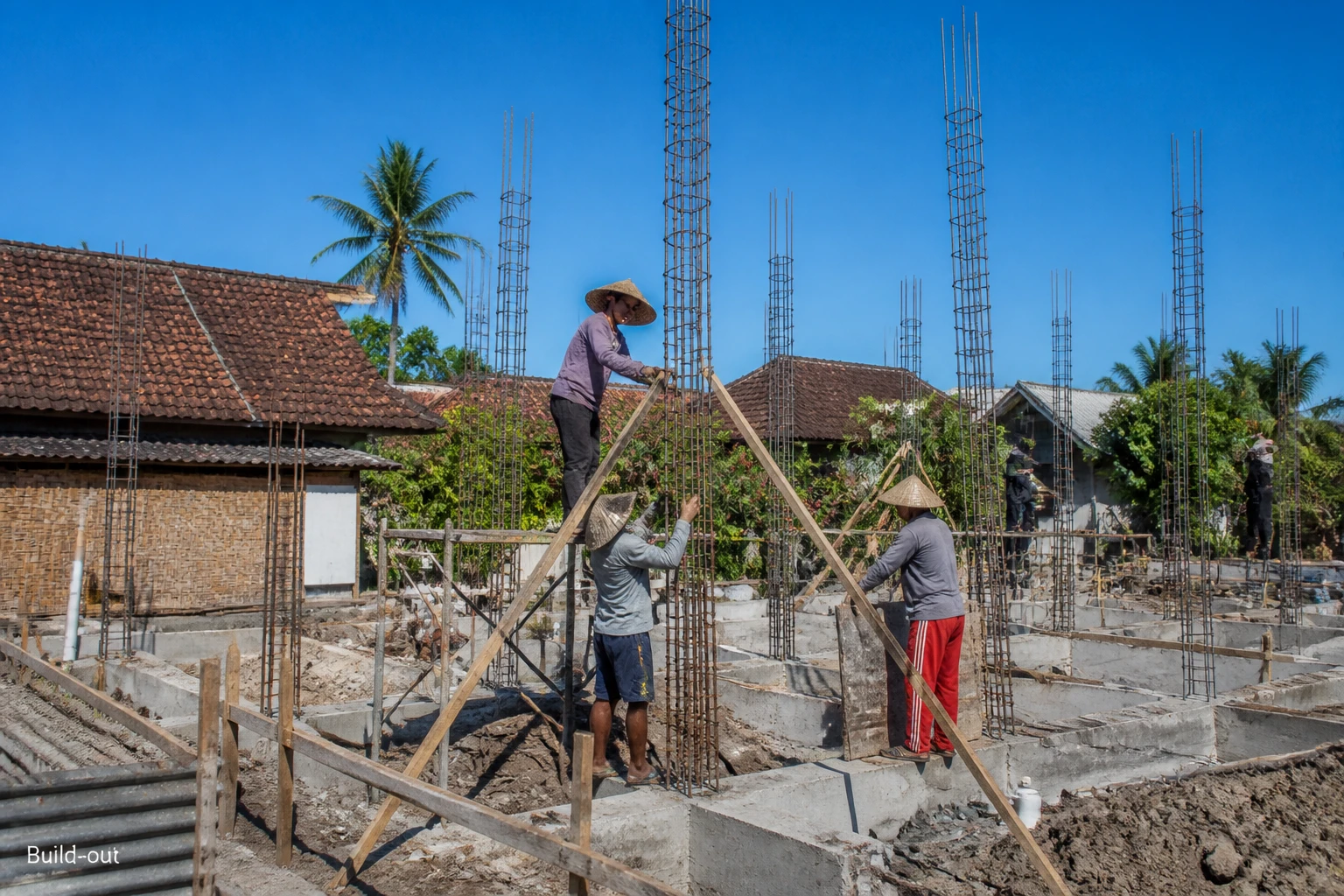
Earthquake Risk and Safe Building Standards in Lombok
South Lombok carries genuine seismic risk. The 2018 earthquake sequence, which peaked at magnitude 6.9 and killed more than 550 people, exposed the vulnerability of unreinforced masonry. Modern reinforced-concrete construction to SNI standards substantially reduces structural risk, and savvy buyers
Quick answer: South Lombok carries genuine seismic risk. The 2018 earthquake sequence, which peaked at magnitude 6.9 and killed more than 550 people, exposed the vulnerability of unreinforced masonry. Modern reinforced-concrete construction to SNI standards substantially reduces structural risk, and savvy buyers can verify compliance before purchase.
What happened in 2018, and why it matters
In July and August 2018, Lombok was struck by a series of powerful earthquakes. The largest, on 5 August, measured magnitude 6.9 and caused widespread destruction across the north and centre of the island. More than 550 people died, over 400,000 were displaced, and tens of thousands of structures were damaged or destroyed.
The destruction followed a clear pattern: unreinforced brick and stone buildings collapsed, while reinforced-concrete frames with proper tie beams and column-to-slab connections generally held. That distinction is the single most important lesson for foreign buyers evaluating villa projects today.
Lombok lies close to the Flores Back Arc Thrust, a fault system capable of generating major earthquakes. Indonesia's national seismic-hazard maps, maintained by the National Standardisation Agency (BSN), classify most of Lombok as a high-hazard zone. This is not a reason to avoid the market. It is a reason to ask the right questions before committing capital.
SNI building standards: what the code requires
Indonesia's national building code, Standar Nasional Indonesia (SNI), requires earthquake-resistant design for all new construction in high-hazard zones. The two key references are SNI 1726 (seismic design of structures) and SNI 2847 (structural concrete). Together they mandate:
- Reinforced-concrete frames with continuous column reinforcement down to pad foundations
- Tie beams connecting all columns at ground level
- Ring beams at every floor and at roof level to distribute lateral loads
- Adequate stirrup spacing in columns and beams to prevent brittle failure
- A minimum concrete grade (typically K-250 or C-20) for all structural elements
In practice, compliance varies widely. High-end developer projects and licensed contractors typically follow these standards closely. Informal construction, or projects cutting costs with under-qualified labour, often does not. The gap between a compliant and a non-compliant build is not always visible to the untrained eye, which makes paperwork checks essential.
What to ask your builder
Before signing any construction or off-plan purchase contract, request documentation on the following:
Structural drawings and engineering sign-off. Legitimate developers produce stamped structural drawings prepared by a licensed civil engineer. Ask to see them, and confirm the engineer holds a current licence.
Building permit (PBG). The Building Construction Approval (PBG, which replaced the older IMB in 2021) requires a seismic compliance review for new structures. A building without a valid permit is both legally precarious and structurally unverified.
Concrete grade and rebar specification. Ask the builder to confirm the concrete grade and reinforcement diameter for columns, beams and slabs. A reputable contractor will state this in the bill of quantities.
Site soil assessment. Soft or waterlogged soils amplify ground motion significantly. A basic geotechnical report should be standard on any responsible project and available on request.
Post-pour inspection. On larger projects, an independent structural inspector can verify that reinforcement was placed correctly before concrete is poured. This is common in the premium segment and worth the relatively modest cost.
For a full checklist of due-diligence questions to put to developers, see the complete due-diligence guide for Lombok buyers. The seven mistakes foreign buyers make also covers contract and permitting traps that frequently catch purchasers off guard.
Insurance: what the market offers (and its limits)
Property insurance in Indonesia is available through local and international insurers, and most standard policies cover earthquake damage. Buyers should read the small print carefully, however. Common limitations include:
- Sub-limits on earthquake claims, meaning a separate and lower sum insured than the main fire cover
- Requirements that the structure hold a valid building permit, since a missing permit can void the policy
- Exclusions for construction defects where damage is deemed to result from non-compliance with the building code
Premium rates for earthquake cover in Lombok typically run at 0.1 to 0.5 per cent of the insured value per year, though insurers will assess each risk individually. An unlicensed or informally built structure may be uninsurable, or insured only at a punishing rate.
For buyers purchasing through established developers, such as projects in Are Guling where Samudra Villas operates, all-risks construction insurance is standard during the build phase, with the buyer's own policy taking over on handover.
Effect on resale and long-term value
Earthquake risk does not suppress demand in well-built markets. Demonstrated structural quality can actually become a resale advantage. Buyers in the premium segment increasingly request engineering documentation as a condition of purchase, mirroring behaviour already common in Japan and parts of California.
What does suppress value is ambiguity. A villa with no PBG, no engineer-stamped drawings and an informal construction history will face a narrower buyer pool and potential difficulties if Indonesia's mortgage market develops further in the years ahead.
The practical implication is that investing in proper documentation and construction quality at the outset costs relatively little as a proportion of total project cost. It protects both the asset and its future marketability. For buyers considering building rather than purchasing off-plan, the guide to building a villa in Lombok covers contractor selection and permitting in detail.
Practical guidance for buyers
- Only buy from developers who can provide SNI-compliant structural drawings and a valid PBG.
- Visit the site during construction if possible, or commission an independent inspector to do so.
- Budget for earthquake insurance from day one and treat it as a fixed operating cost, not an afterthought.
- Avoid any project described as having a permit that can be "sorted later". In practice, retrospective legalisation is slow, expensive and not guaranteed.
- Ask your legal adviser (independent from the seller) to verify zoning compliance and confirm there are no outstanding encumbrances before funds are transferred.
Lombok's seismic environment is real and deserves to be taken seriously. The good news is that the 2018 earthquakes triggered meaningful improvements in construction oversight across the island's premium development segment. Buyers who do their homework can acquire well-built, well-insured assets in an early-cycle market, with confidence in the structural fundamentals beneath their investment.
Is Lombok safe to buy property in after the 2018 earthquakes?
Yes, provided construction meets SNI earthquake-resistant standards. The 2018 quakes demonstrated clearly that properly built reinforced-concrete structures fared well, while unreinforced masonry did not. The key is to verify building permits, engineer-stamped structural drawings and concrete specifications before purchasing.
What building documents should I request before buying a villa in Lombok?
Ask for the PBG building permit (or IMB if the building predates 2021), engineer-stamped structural drawings, the concrete grade and rebar specification, and any available soil assessment report. Legitimate developers will provide all of these without hesitation.
Does property insurance in Lombok cover earthquake damage?
Most Indonesian property policies include earthquake cover, but often with sub-limits and exclusions for buildings without valid permits or for damage attributed to construction defects. Premium rates typically run at 0.1 to 0.5 per cent of insured value per year. Always read the policy carefully before assuming full coverage.

The Lombok Buyer's Field Guide
Legal structures ranked by risk, the honest ROI math line by line, all six zones ranked, and the 24-point due-diligence checklist. The whole book, free in your inbox.
See what's inside