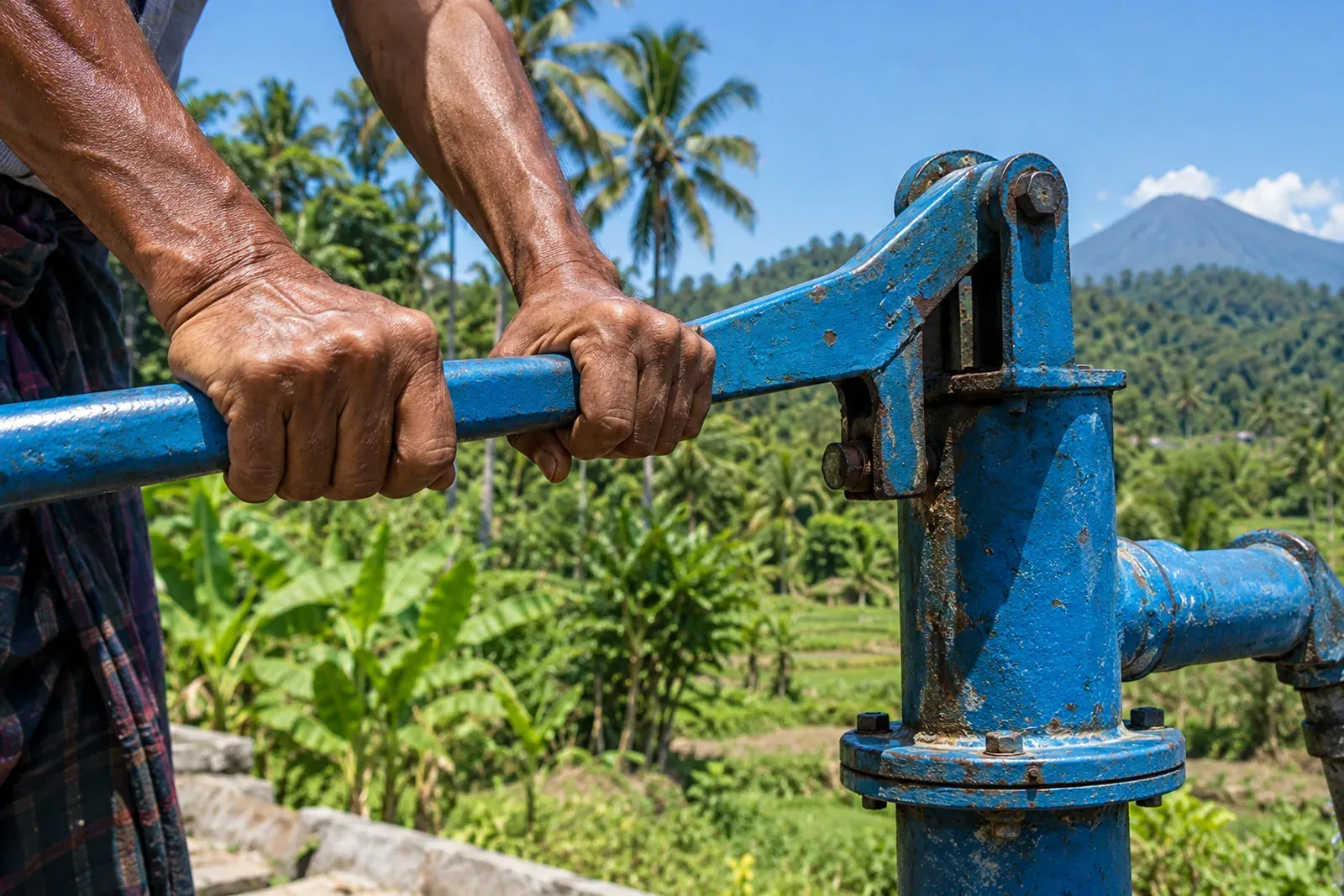
BRI Peduli Deploys 270 Water Pumps to West Kalimantan for Karhutla Response
BRI Peduli has distributed 270 water pumps to West Kalimantan to support the government's forest and land fire response. We read the announcement for what it says, and what it leaves out.
On Monday 12 October 2026, PT Bank Rakyat Indonesia (Persero) Tbk, working through its BRI Peduli programme, distributed 270 motorised water pumps for use in West Kalimantan. The equipment is intended to support the government's handling of forest and land fires, known in Indonesia as karhutla, and the distribution was carried out in coordination with the Karhutla Task Force.
That is a short factual sentence for a programme of this kind, and it is worth reading slowly. Corporate environmental announcements tend to arrive with the adjectives attached and the arithmetic missing. This one, as reported by Radar Lombok, is unusually plain, and the plainness is the most useful thing in it.
What the report actually establishes
Stripping the story back to its verifiable parts leaves a short list:
- 270 units of water pumps, described in the report as alkon or water pump equipment.
- West Kalimantan as the receiving province.
- Monday 12 October 2026 as the date of distribution.
- BRI Peduli, the bank's Tanggung Jawab Sosial dan Lingkungan (TJSL) programme, as the channel.
- Coordination with the Karhutla Task Force and government as the delivery mechanism.
Everything beyond that list is framing. The report does not state the procurement value, the cost per unit, the districts or regencies receiving the pumps, the tender route followed, or any measured change in fire incidence that the equipment might be expected to produce. Those gaps are not a criticism of the bank. They are simply the normal shape of a corporate social announcement, and a reader who wants to reason about it needs to know precisely where the record stops.
Why water pumps are a more interesting signal than they look
An alkon is a motorised water pump, and the term distinguishes a powered unit from equipment that depends on manual labour or gravity feed. In practical terms, 270 of them are 270 identifiable objects that a task force can assign, log and account for. That is a different category of commitment from a campaign, a workshop or a slogan.
Physical equipment is auditable. It can be counted on delivery, tracked to a location, and checked again later. It also outlives the news cycle that announced it, which is more than can be said for most communications spend. For anyone who spends their working life assessing claims about Indonesian assets, that distinction between a countable input and a warm sentence is the whole game.
What the report does not do is connect the input to an outcome. There is no statement of hectares protected, response times improved, or fires extinguished. A careful reader should hold that space open rather than fill it.
The corporate frame: TJSL, ESG and the audit trail
TJSL, Tanggung Jawab Sosial dan Lingkungan, is the heading under which Indonesian companies present community and environmental spending. For investors who screen Indonesian equities, or who lend to Indonesian groups, that heading is where non-financial risk first becomes visible in a company's own language.
Three questions are worth asking of any TJSL announcement, including this one:
- Is the input countable? Here, yes: 270 pumps.
- Is the outcome measurable? The report does not say so.
- Is the delivery partner named? The Karhutla Task Force and government are named, though specific agencies are not detailed in the report.
That third point matters more than it first appears. A named partner is a point of accountability. An unnamed one leaves the reader to assume one exists.
What this means for investors
Let us be blunt. Nothing in this report moves a South Lombok land price, a villa entry price or a rental yield. HubLombok's published ranges for South Lombok stand exactly as they did before this announcement, and we are not going to manufacture a link between a pump delivery in West Kalimantan and a leasehold negotiation in Are Guling.
What the story does offer is a small, concrete example of how environmental risk in Indonesia is administered: through named task forces, through corporates with formal social programmes, and through provincial coordination. For a foreign buyer sizing up any Indonesian asset, including property, the relevant question is not whether a company publishes this kind of announcement. The question is whether the same institutional machinery exists around the asset you are buying. Who is responsible when something goes wrong? Which authority signs? What paperwork survives the event?
On that measure, the practical diligence is unglamorous and familiar. Confirm zoning. Confirm the certificate. Confirm the ownership history and any encumbrances. Confirm which structure you are actually acquiring, remembering that foreigners cannot hold Hak Milik, and that the available routes are leasehold (Hak Sewa), Hak Pakai, or a PT PMA holding HGB. Those are legal facts, not market forecasts, and they are the ones that decide outcomes.
TerraNusa Advisory, HubLombok's independent legal and notary partner, runs exactly this chain: certificate and ownership history checks, zoning and encumbrance review, PT PMA company setup, BPHTB and tax handling, and deed and title transfer at BPN. Most notaries handle the deed and nothing else. TerraNusa's stated differentiator is that it handles the whole sequence.
A note on where this story sits
HubLombok covers South Lombok property and the capital that follows it. This report comes from West Kalimantan and concerns neither. We are running it because our readers invest in Indonesia, not merely in a postcode, and because the way Indonesian institutions handle environmental events forms part of the backdrop against which any Indonesian asset is priced.
The pumps themselves are a modest thing: 270 units, one province, one week in October. Modest things, properly counted, are how risk management actually looks.
HubLombok is the editorial arm of Samudra Villas, an active developer in South Lombok. That relationship is disclosed here because it shapes what we cover, not what we conclude.
What to watch next is the follow-through: whether the bank or the task force publishes the districts served, the programme value, and any assessment of what the equipment achieved in the field. Until that arrives, 270 pumps is a fact, and the rest is context waiting to be filled.
Stay informed: subscribe to our free Lombok Briefing, published twice a month (the 1st and 15th), for analysis like this.
What did BRI Peduli distribute in West Kalimantan?
BRI Peduli distributed 270 motorised water pumps, described in the report as alkon units, to support the government's handling of forest and land fires in West Kalimantan. The distribution took place on Monday 12 October 2026, coordinated with the Karhutla Task Force.
Does this announcement affect South Lombok property prices?
No. The report concerns fire-response equipment in West Kalimantan and contains no property data. HubLombok's published South Lombok land and villa ranges are unchanged, and we draw no causal link between a social programme delivery outside Lombok and local land or rental values.
Why would an investor in Indonesia care about TJSL programmes?
TJSL is the heading under which Indonesian companies report community and environmental spending, so it is where non-financial risk first appears in corporate language. The useful test is whether inputs are countable, outcomes measurable and delivery partners named, rather than whether an announcement was made.

The Lombok Buyer's Field Guide
Legal structures ranked by risk, the honest ROI math line by line, all six zones ranked, and the 24-point due-diligence checklist. The whole book, free in your inbox.
See what's inside