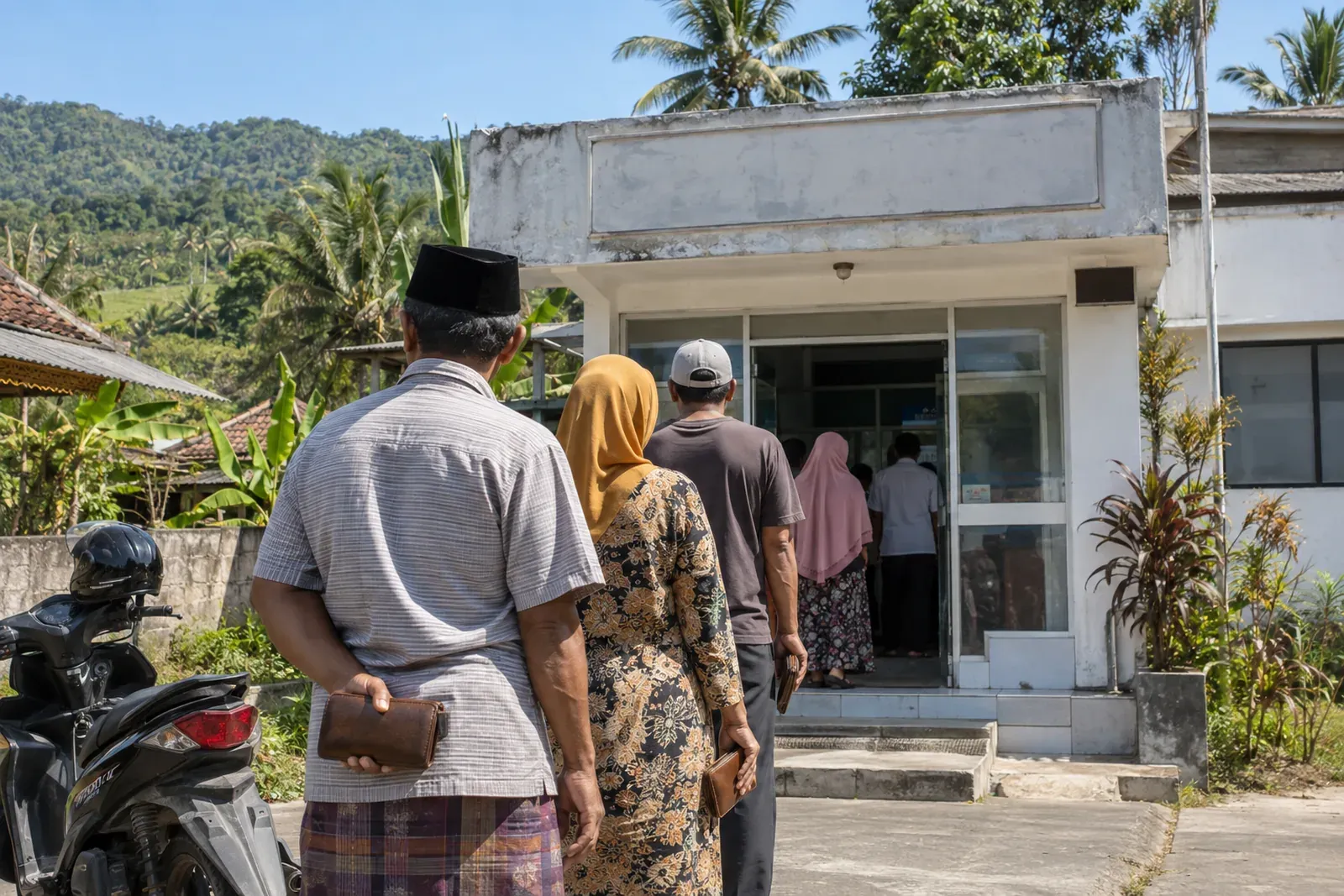
BRI Backs Prabowo’s Push for Wider Bank Account Ownership
BRI says it is ready to support President Prabowo Subianto’s call to widen bank account ownership and financial access across Indonesia.
President Prabowo Subianto has called for more Indonesians to hold bank accounts, placing financial inclusion and literacy at the centre of a broader effort to connect communities with the formal financial system. PT Bank Rakyat Indonesia (Persero) Tbk, known as BRI, has said it is ready to support that direction.
For investors watching Indonesia, the significance lies less in a single banking announcement than in the policy priority it signals: wider participation in formal finance is being treated as an important national objective. The source does not set out implementation targets, timelines or specific measures, but it frames bank-account ownership as a route towards deeper access to the financial ecosystem.
A policy emphasis on formal financial participation
According to Radar Lombok, the President delivered the instruction during a limited meeting. The stated aim was to expand ownership of banking accounts among the public, while strengthening both financial inclusion and financial literacy.
Those two ideas are related but distinct. Financial inclusion concerns whether people can access formal financial services. Financial literacy concerns whether they understand and can use those services effectively. The source presents both as part of the same policy direction, with the intended result that more people become connected to Indonesia’s formal financial ecosystem.
Key policy signal: President Prabowo has asked for wider public ownership of bank accounts, while BRI has stated its readiness to support expanded financial access.
This matters because a bank account is often the practical point of entry into formal finance. Yet the article does not claim that an account alone resolves every barrier to participation, nor does it specify which products, distribution channels or customer groups will form the focus of BRI’s support. Those questions will matter as the policy moves from broad direction to execution.
BRI’s stated role
BRI’s statement is a commitment to support the President’s instruction. The bank is described by the source as ready to help widen financial access, in line with the objective of bringing more people into the formal financial system.
The announcement should therefore be read as an institutional response to a presidential priority, rather than as a detailed product launch. No figures on account growth, investment, branch expansion, digital adoption or geographic coverage are supplied in the source. Investors should resist filling those gaps with assumptions.
What can be said is straightforward: BRI has publicly aligned itself with the policy goal. That alignment gives the story relevance beyond banking alone. Formal financial access can influence how households and small businesses engage with payments, savings and other financial activity, even though the source does not make claims about any particular economic outcome.
For Lombok-focused readers, the development is best understood within the national setting. It is not a property-market announcement, a tourism announcement or a direct statement about investment structures. Rather, it concerns the infrastructure of participation in the formal economy: the ability of citizens to be connected to banking channels.
Inclusion and literacy travel together
The source expressly links wider account ownership with both financial inclusion and financial literacy. That wording is important. Access without understanding can limit the value of financial services; education without accessible services can leave people unable to act on what they learn.
A credible programme must ultimately address both sides of that equation. However, Radar Lombok’s report does not describe the form that support will take, and it would be premature to infer specific educational campaigns, incentives or account features.
The prudent reading is that policymakers are identifying a combined objective:
- wider ownership of banking accounts;
- stronger financial inclusion;
- stronger financial literacy; and
- broader connection to the formal financial ecosystem.
For international investors, this is a reminder that Indonesia’s investment environment includes not only projects, assets and regulations, but also the continuing development of financial participation. The current report offers a policy signal, not a forecast. It does not establish a timetable for change or quantify the commercial implications for BRI or the banking sector.
What this means for investors
The immediate takeaway is one of policy direction. President Prabowo’s instruction places bank-account ownership and financial access on the public agenda, while BRI’s response indicates its readiness to participate.
Investors should distinguish that signal from investable conclusions. The source provides no basis to estimate revenue effects, customer growth, profitability, market share or the pace at which access may widen. It also provides no detail on whether other institutions will take part, how programmes may be funded, or which regions may be prioritised.
Still, the report is relevant for those assessing Indonesia over a longer horizon. Formal financial participation is a foundational issue: it shapes the channels through which individuals and businesses can interact with banking services. The direction of travel is clear from the announcement, even if the route remains unspecified.
The most useful investor questions now are practical rather than speculative:
- What concrete measures will follow the presidential instruction?
- How will BRI describe its role as implementation details emerge?
- Will future announcements provide measurable objectives or milestones?
- How will financial literacy be addressed alongside access?
Until those details are published, the appropriate conclusion is measured. BRI has expressed readiness to support a national push for broader bank-account ownership, and the government has identified formal financial inclusion and literacy as connected priorities.
Stay informed, subscribe to the free Lombok Briefing for analysis like this, published twice a month.
What did President Prabowo ask for in this banking announcement?
President Prabowo Subianto called for more members of the public to have banking accounts. Radar Lombok reports that the direction is intended to strengthen financial inclusion and financial literacy, while connecting more people to Indonesia’s formal financial ecosystem.
What has BRI said it will do?
PT Bank Rakyat Indonesia (Persero) Tbk, or BRI, said it is ready to support President Prabowo Subianto’s instruction to expand public ownership of banking accounts and widen financial access. The source does not provide specific implementation measures or targets.
Does the report provide financial targets or a rollout timetable?
No. The source reports a policy instruction and BRI’s stated readiness to support it, but does not provide account-growth targets, financial projections, geographic priorities, product details or an implementation timetable.

The Lombok Buyer's Field Guide
Legal structures ranked by risk, the honest ROI math line by line, all six zones ranked, and the 24-point due-diligence checklist. The whole book, free in your inbox.
See what's inside