BI Calls for Stronger Policy Coordination: A Lombok Investor Dispatch
Bank Indonesia’s call for stronger fiscal-monetary coordination puts policy coherence back on the agenda for Lombok investors.
Quick answer: Bank Indonesia has called for stronger fiscal and monetary coordination to safeguard the national economy. For Lombok investors, the immediate significance is not a newly announced property rule, but a reminder that investment decisions should be tested against national policy conditions as well as local demand, pricing and legal due diligence.
Bank Indonesia’s intervention is concise but consequential. When the country’s central bank calls for closer alignment between fiscal and monetary policy, investors should listen less for drama than for direction: the national policy environment remains an essential part of the investment case for Indonesian real assets.
The Context
Antara Business reports that Bank Indonesia, widely known as BI, has called for stronger coordination between fiscal and monetary policies to safeguard the national economy. The message arrives at a moment when international buyers are increasingly assessing Lombok not as an isolated resort proposition, but as part of a larger Indonesian investment framework.
That distinction matters. A villa, a plot of land or a leasehold interest in South Lombok may be chosen for its beach access, design quality or rental potential, yet its investment environment is also shaped by national institutions, policy settings and the confidence with which investors can assess them.
The supplied report does not present a new Lombok-specific measure. Its relevance instead lies in what the call signals: BI considers coordination between the state’s fiscal stance and monetary policy important to national safeguarding. For a foreign buyer, that is a useful prompt to separate local opportunity from national context, and to give both their proper weight.
Lombok’s appeal still rests on its own market characteristics. Investment-grade turnkey villas have an entry range of EUR 95,000-350,000, while prime tourist-zone land is commonly discussed in the local convention of per are. In Kuta, authoritative land ranges sit at Rp 300-400 million per are; in Are Guling, they are Rp 120-180 million per are.
Those figures describe a market opportunity. BI’s call concerns the policy backdrop in which that opportunity is assessed.
Why Coordination Matters Beyond Jakarta
Fiscal and monetary policy are often discussed as national abstractions. For an overseas investor, however, they are part of the practical framework behind confidence, timing and risk assessment. The point is not that a policy call determines the value of a particular Lombok asset. It does not. Rather, it reinforces the need to examine a property purchase through more than one lens.
A disciplined buyer should distinguish between three layers:
- National policy context: the broader environment in which Indonesian investment is evaluated.
- Local market context: demand, land pricing, supply quality and the character of a particular South Lombok zone.
- Transaction context: title, structure, zoning, contract terms and the quality of due diligence.
The first layer is the subject of BI’s call. The second is where Lombok’s differentiated proposition sits. The third is where an investor’s protection is either built carefully or left exposed.
There is particular value in resisting the temptation to turn a national policy headline into an immediate property forecast. The Antara Business report says BI seeks stronger coordination to safeguard the national economy; it does not, on the information supplied, announce a Lombok property-price target, a new foreign-buyer route or a return forecast. Investors should treat it as a live macro-policy signal, not as a substitute for asset-level underwriting.
The important read-through is one of discipline: national policy coherence belongs in the investment memo, alongside the local evidence for the asset itself.
This is especially relevant in a market where price differences between locations are material. Kuta is the demand and liquidity leader, with land at Rp 300-400 million per are. Selong Belanak sits at Rp 150-250 million per are, while Mandalika is listed at Rp 100-150 million per are. Lower entry points do not automatically mean lower risk, nor does a premium zone remove the need for rigorous review.
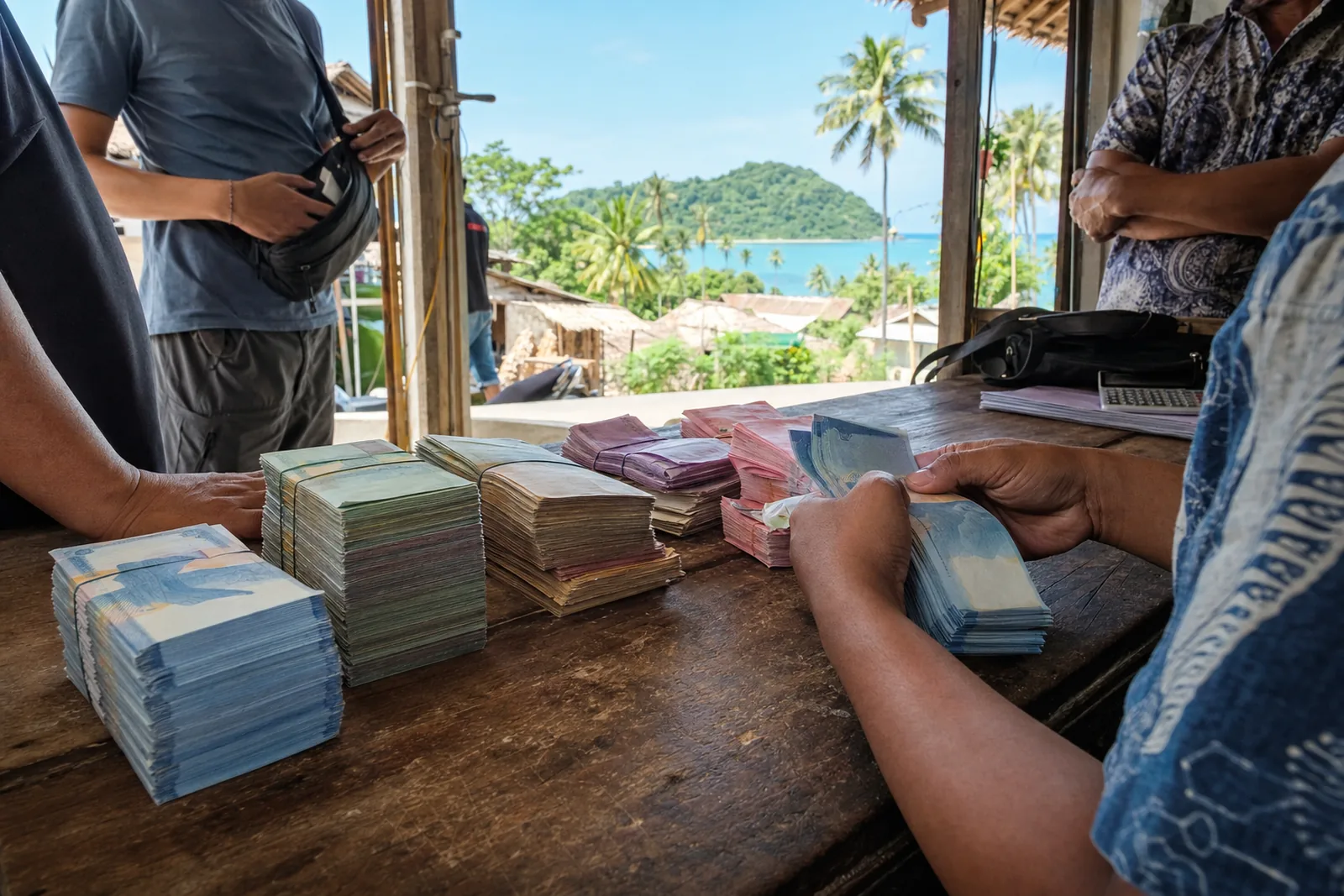
 BI Calls for Stronger Policy Coordination · Illustration: HubLombok (AI-generated)
Lombok’s Opportunity Still Requires Asset-Level Judgement
South Lombok is frequently examined through the “Bali-overflow” thesis: higher Bali prices and congestion may push demand towards a cheaper, earlier-cycle Lombok market. The thesis can be useful, but it is not an investment conclusion in itself.
The verified market picture contains both attraction and caution. Honest net rental yields are described in a range of 7-12% after management fees and realistic occupancy, while top-performing assets can reach around 15% net. Developer-quoted gross yields, by contrast, range from 12-22% and exclude costs that investors must account for. The distinction is not semantic; it is central to sound underwriting.
Likewise, realistic stabilised occupancy in the first years is 55-70%, compared with 70-85% in Bali. Management fees range from 18-22% of gross rental revenue, and OTA or booking commissions from 15-20%. These are the practical inputs that deserve attention when a national policy headline encourages renewed interest in Indonesia.
A short comparison helps keep the local assessment grounded:
| Investor question | Evidence to review | |---|---| | Is the location priced for its position? | Land range per are and the zone’s market role | | Is the income case realistic? | Net rather than gross yield, occupancy and operating costs | | Is the legal route appropriate? | Leasehold, Hak Pakai or PT PMA structure | | Is the title position understood? | Certificate, ownership history, zoning and encumbrances |
Foreigners cannot hold freehold, or Hak Milik/SHM; it is reserved for Indonesian citizens. Available routes include leasehold, typically 25-30 years with extensions, Hak Pakai for qualifying residents, and a foreign-owned PT PMA holding Hak Guna Bangunan, initially 30 years and extendable. Nominee arrangements, in which an Indonesian party holds freehold on a foreigner’s behalf, are illegal and void in court.
That legal reality is independent of the BI headline, but it is precisely why policy confidence should never replace transaction diligence. TerraNusa Advisory, HubLombok’s independent legal and notary advisory partner, supports foreign buyers with certificate, ownership-history, zoning and encumbrance checks, as well as PT PMA setup, taxes, deeds and transfer at BPN.
What This Means for Investors
The practical conclusion from BI’s call is measured rather than dramatic. Investors considering Lombok should add the national policy environment to their regular watchlist, without allowing one short-term dispatch to overwhelm the fundamentals of a specific acquisition.
A sensible response is to ask better questions before committing capital:
- Does the proposed return clearly distinguish gross marketing language from net operating reality?
- Is the land price quoted per are, and does it fit the authoritative range for that zone?
- Does the chosen foreign ownership structure match the buyer’s circumstances and intended use?
- Has a licensed PPAT notary and appropriate legal adviser reviewed the title, zoning and transfer process?
- Is the purchase case resilient if local demand develops more gradually than a promotional narrative suggests?
For investors already watching Lombok, BI’s statement is a reminder that the strongest investment case combines a local thesis with a national one. Local demand, beachside scarcity and relative entry pricing may create interest; transparent legal structure, realistic operating assumptions and a credible policy setting determine whether that interest becomes investable.
HubLombok is the editorial arm of Samudra Villas, an active developer in Are Guling, South Lombok. That position informs our attention to the market, while this dispatch treats BI’s reported call as a national-policy development rather than a promotional property signal.
The live question now is not whether a single statement changes Lombok overnight. It is whether investors use it to sharpen their process: monitor national policy, interrogate local assumptions and insist on a transaction structure that remains clear under scrutiny.
Stay informed, subscribe to the free Lombok Briefing for market intelligence like this, published twice a month.
What did Bank Indonesia call for in this dispatch?
Antara Business reports that Bank Indonesia called for stronger coordination between fiscal and monetary policies to safeguard the national economy. The report is a national-policy signal; it does not, in the supplied information, announce a Lombok-specific property measure.
Does BI’s call change foreign ownership rules in Lombok?
No new foreign-ownership rule is stated in the supplied report. Foreigners cannot hold freehold Hak Milik/SHM. Available routes include leasehold, Hak Pakai for qualifying residents, and a PT PMA holding Hak Guna Bangunan; nominee structures are illegal and void in court.
How should Lombok property investors respond to this news?
Treat the development as a prompt to review national policy context alongside asset-level fundamentals. Compare net and gross yield assumptions, assess occupancy and operating costs, confirm land prices per are, and obtain proper title, zoning and legal due diligence before committing capital.

The Lombok Buyer's Field Guide
Legal structures ranked by risk, the honest ROI math line by line, all six zones ranked, and the 24-point due-diligence checklist. The whole book, free in your inbox.
See what's inside