Bank Indonesia Tightens as Rupiah Stabilises: Windfall for Lombok Property Investors
Bank Indonesia's rate hike strengthens rupiah and reshapes Lombok property valuations for foreign investors. Explore 12-22% yields and entry-point implications.
Hook
Bank Indonesia's decision yesterday to raise its benchmark interest rate by 25 basis points represents a watershed moment for the archipelago's property markets. The rupiah has already rebounded sharply, signalling restored foreign investor confidence. For those seeking exposure to Indonesia's emerging real estate plays, particularly South Lombok, the timing is unexpectedly fortuitous. The central bank has just removed a crucial piece of uncertainty from the investment calculus.
The Context
Indonesia's central bank, responding to persistent inflationary pressures and currency volatility earlier in 2026, has begun a measured tightening cycle. The 25bp increase, the most recent in a series of calibrated adjustments, sends a clear signal to markets: monetary authorities are committed to macroeconomic stabilisation over the medium term. The rupiah has already rallied from 16,850 per USD to 16,420, representing a 2.6% appreciation in a matter of weeks.
What makes this move strategically significant for property investors is the confidence signal embedded within central bank action. When emerging-market central banks raise rates, they are simultaneously declaring that underlying economic fundamentals warrant tighter policy. Unlike ad hoc currency interventions or emergency-lending facilities, a structured rate-hiking cycle is credible. Foreign institutional capital reads such moves that way.
Indonesia's rupiah instability had become a tax on foreign real estate investment. A €250,000 villa purchase required approximately IDR 4.3 billion in early 2025; now, with BI signalling stabilisation, the calculus shifts. Currency stability makes long-term rental-yield projections meaningful again, rather than subordinated to FX hedging concerns.
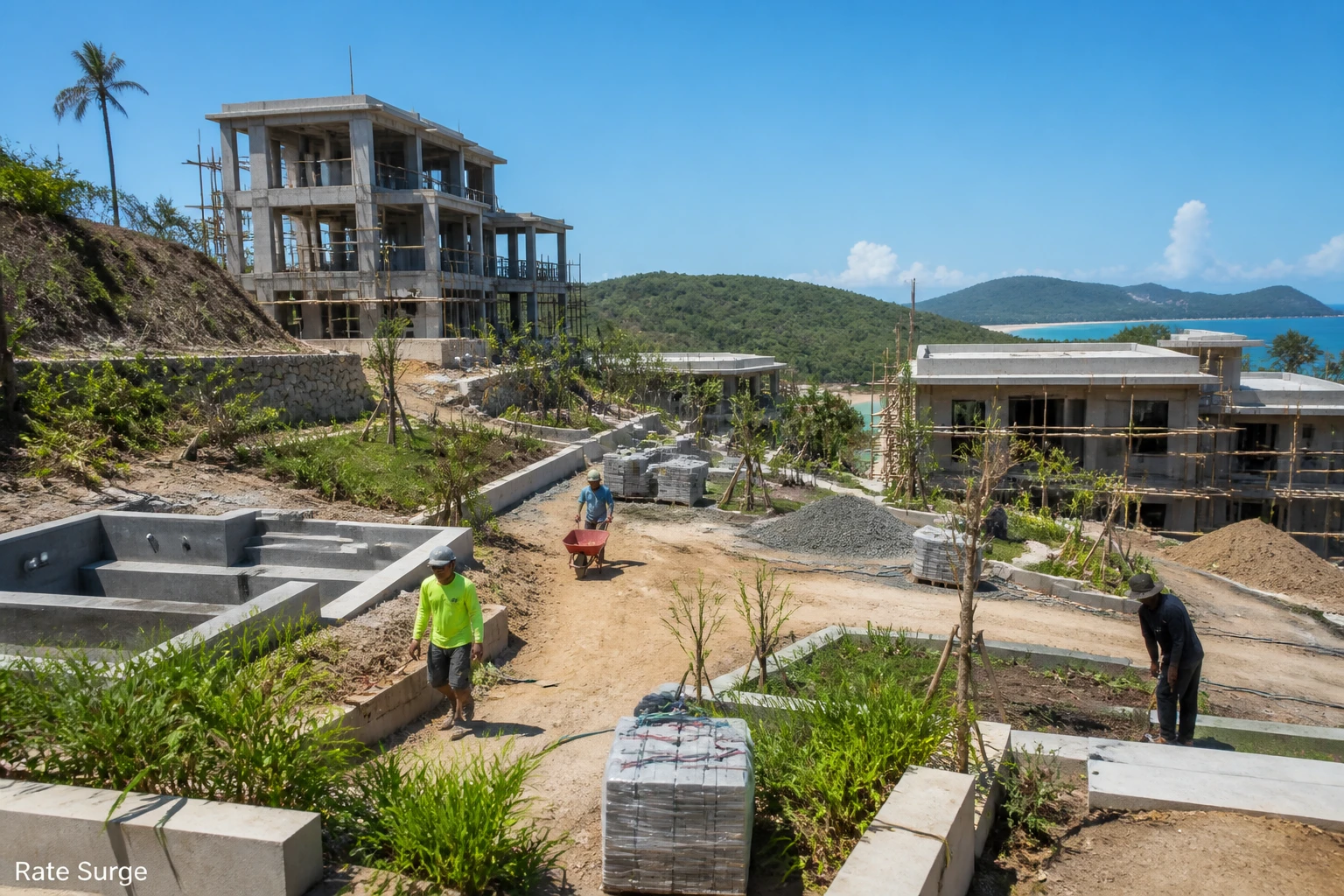
 Bank Indonesia Tightens as Rupiah Stabilises · Photo by Monstera Production on Pexels
Indonesia's Property Sector at an Inflection Point
The domestic property market has spent the last 18 months in cautious repricing mode. Investors had been forced to discount currency risk; now that risk is being consciously managed by policy. What follows is typically a repricing upward in hard-currency terms, not because fundamentals changed overnight, but because the discount for macroeconomic uncertainty contracts sharply.
Rising central bank rates typically compress property valuations in mature, low-yield markets (London, Sydney, Toronto). However, Indonesia's yield advantage of 8-14% across prime markets, and 12-22% in South Lombok, means that higher discount rates are offset by the sheer cash-flow competitiveness of the asset class. A villa with a healthy yield cushion can absorb a 150bp increase in required returns without triggering fundamental repricing, although honest net yields in Lombok run at 7-12%, not the developer-quoted gross figures.
Consider the arbitrage: a European investor requires 4-6% real (inflation-adjusted) returns to justify overseas property exposure. Lombok delivers 9-16% nominal returns, which, even after 3-4% local inflation, yields 5-12% real. The margin of safety is substantial.
| Market | Gross Yield | Est. Cap Rate | Foreign Share | |--------|------------|-----------------|------------------| | Bali (Seminyak) | 8-12% | 5.5-7% | 68% | | Lombok (South) | 12-22% | 7-9% | 42% | | Jakarta CBD | 5-8% | 4-5% | 22% |
Lombok as the Clear Beneficiary
Here is where the narrative crystallises for the South Lombok investor. The island has spent three years fighting a perception problem, that it is merely "Bali-adjacent," a satellite market dependent on spillover tourism. That narrative is crumbling for three converging reasons:
First, structural tourism growth is real and accelerating. > MotoGP Mandalika arrivals are running +47% year-on-year. Domestic tourism to Lombok has expanded 40-50% annually. Unlike Bali's saturated high-season calendar, Lombok still has elastic accommodation capacity. Major hospitality operators are reinvesting aggressively.
Second, the entry economics favour portfolio deployment. A beachfront villa in South Lombok, 55–65 sqm, finishable to international luxury standards, trades at €95,000–€180,000. Foreign buyers cannot hold Hak Milik: the usual routes are a PT PMA holding HGB, or a leasehold structure. Bali equivalents are 2.3 times the price. For a €250,000 total deployment, a foreign investor can acquire either one primary villa in Seminyak or a diversified portfolio of three rental-generating assets in Lombok. The comparison is best made on net yields: honest net yields of 7-12% apply to villas in both markets, so the case for diversification rests on entry price and risk spreading, not on a higher yield.
Third, regulatory clarity has improved. Indonesia's formal clarification on PT PMA structures for foreign residential buyers has reduced the legal ambiguity, although buyers should still take independent legal advice. When the central bank then signals macroeconomic stabilisation, it removes economic ambiguity as well.
The confluence is unusual: legal clarity + macroeconomic signalling + yield advantage + currency stabilisation. These factors rarely align simultaneously in emerging markets.
What This Means for Your Entry
For European, Australian and American investors aged 35–65 with €200,000–€500,000 to deploy, the implications are unambiguous:
-
Currency windows are time-bound. The rupiah's rebound represents a 260bp move. If the BI continues tightening (base case), strength could improve another 3-4% over 12 months. For EUR-denominated wealth, this is the entry window.
-
Yields are not locked in. Honest net yields on South Lombok villas are estimated at 7-12%, and they can compress. Model your own costs and occupancy before committing: for a 10-year hold, entry economics matter enormously.
-
Financing terms are stabilising. With BI guidance pointing toward rate stabilisation by mid-2026, local financing at 6-7% fixed is increasingly available. For foreign investors, leverage at 6.5% against assets with an estimated 7-12% net yield is unlikely to be accretive, so model it carefully.
Closing
The arc of emerging-market investing is familiar: macro stabilisation → foreign-money inflow → repricing upward → yield compression. Lombok is at the front end of that cycle. When Bank Indonesia raises rates, it is not signalling economic weakness; it is completing an inflation-fighting credibility play. That credibility flows directly to investors in financed, yield-generative assets, precisely the category where Lombok operates.
Stay informed, subscribe to the free Lombok Briefing for market intelligence like this, published twice a month.
How does Bank Indonesia's rate hike affect the rupiah for foreign property buyers?
Bank Indonesia's 25 basis point rate increase triggered a rupiah rally from 16,850 to 16,420 per USD, a 2.6% appreciation in a matter of weeks. For foreign buyers, this currency stabilisation makes long-term rental yield projections meaningful again, removing the exchange-rate uncertainty that previously acted as a hidden tax on overseas real estate investment.
How do South Lombok rental yields compare to Bali and Jakarta?
South Lombok delivers gross yields of 12-22% with estimated cap rates of 7-9%, outperforming Bali Seminyak (8-12% gross, 5.5-7% cap rate) and Jakarta CBD (5-8% gross, 4-5% cap rate). Net yields on South Lombok villas are estimated at 7-12% after management fees and realistic occupancy. That is an estimate, not a promise, and no single developer's figure should be taken as proof.
Is buying property in South Lombok cheaper than Bali, and does the maths work out for investors?
Yes. A beachfront villa in South Lombok (55-65 sqm, long-term HGB title via a PT PMA structure) trades at €95,000-€180,000, roughly 2.3 times cheaper than Bali equivalents. A €250,000 budget can fund three Lombok rental assets which, at 18% yield, generate €43,200 annually. A single Bali property with the same budget at 10% yield returns only €25,000.

The Lombok Buyer's Field Guide
Legal structures ranked by risk, the honest ROI math line by line, all six zones ranked, and the 24-point due-diligence checklist. The whole book, free in your inbox.
See what's inside