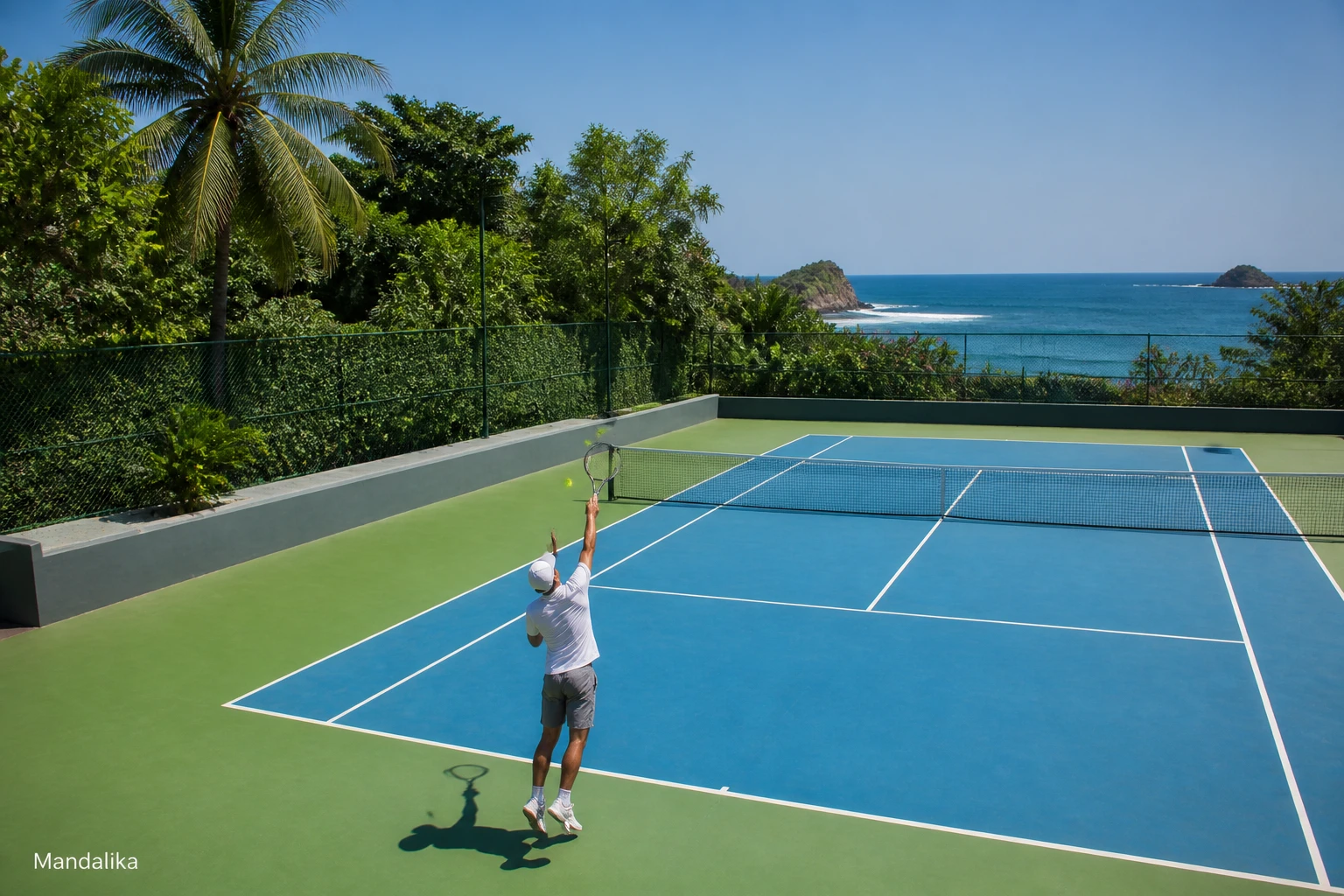
Bali’s sports boom is strengthening Lombok’s overflow case
Racket sports are drawing capital deeper into Bali’s tourism core. For Lombok, the implication is clear: premium demand keeps spreading east, and earlier-cycle markets may benefit.
Quick answer: Bali’s surge in racket-sports clubs matters for Lombok investors because it reinforces the broader tourism premium cycle that is pushing capital, visitors and lifestyle demand beyond the island’s most expensive enclaves. For South Lombok, the investor takeaway is straightforward: the Bali-overflow thesis remains intact, with 7-12% honest net yields, 55-70% stabilised occupancy and materially lower entry prices still available in select zones.
Bali is not just a beach market any more; it is becoming a broader leisure economy where wellness, fitness and community now sit beside surf and hospitality. That matters because each new layer of premium infrastructure tends to deepen the island’s appeal, lift congestion and support spillover demand for nearby alternatives.
The Context
The latest report that racket-sports clubs are booming across Bali’s top tourism destinations fits a pattern investors should already recognise: tourism markets rarely expand in a straight line. They compound through amenity upgrades, and the winners are often the places that offer the same lifestyle logic at a lower entry cost.
For Lombok, that means the story is not simply about competition with Bali. It is about proximity to Bali’s demand engine, while remaining earlier in the cycle and meaningfully cheaper to access.
Bali’s premium leisure layer is widening. For investors, that usually means adjacent markets become more visible, not less.
The most useful comparison remains structural:
| Market | Typical villa entry | Prime land | Honest net yield | Occupancy | |---|---:|---:|---:|---:| | South Lombok | EUR 95,000-350,000 | Rp 150–400 million per are | 7-12% | 55-70% | | Bali | USD 400,000-800,000 | USD 200–500/m² | n/a in this brief | 70-85% |
The gap matters. In practice, it means Lombok can offer a lower-cost route into the same broad thesis: lifestyle-led tourism, premium short-stay demand and asset-backed exposure to a region still catching up.
What Changed in Bali’s Demand Mix
The source report points to a market where sports and wellness are now part of the draw, not an accessory. That widens the guest profile. A destination that can support surf, fitness, social clubs and higher-spend leisure becomes more resilient than one dependent on a single holiday script.
For South Lombok, this is not an abstract trend. The island is already benefiting from the same regional dynamics that have lifted nearby destinations:
- Foreign arrivals: +40-50% YoY
- Kuta/Mandalika villa rates: about +38% YoY
- Are Guling momentum: about +47% YoY
Those figures do not prove a straight-line forecast, but they do show where investor attention is concentrating. The strongest momentum is still coming from places that remain relatively underbuilt, not from mature enclaves where pricing is already rich.
A second point matters for underwriting. Too many marketing decks lead with gross returns. In this market, that is a mistake. Developer-quoted gross yields of 12-22% are not the same thing as investable returns. Once management fees of 18-22% of gross revenue and OTA commissions of 15-20% are included, the more honest lens is the net figure: 7-12%, with top-performing assets reaching about 15% net.
That distinction becomes more important as markets mature. A busy amenity environment can support demand, but it can also compress margin if operating assumptions are too optimistic.
Why Lombok Still Screens Well
Lombok remains compelling because it combines a lower buy-in with real tourism upside and an emerging premium corridor. In investor terms, it offers three advantages that are hard to ignore when Bali’s pricing continues to climb.
First, capital efficiency. A turnkey investment-grade villa in South Lombok can still be acquired at EUR 95,000-350,000, versus USD 400,000-800,000 for comparable spec in Bali. That is not a cosmetic difference; it changes portfolio construction, leverage tolerance and diversification options.
Second, the market is still early enough to reward selectivity. The zones with the strongest positioning are not all the same:
- Kuta Mandalika: demand and liquidity leader, with 14-22% gross yield range, Rp 300–400 million per are land and +38% momentum.
- Are Guling: early-cycle frontier, with 17-25% gross yield range, Rp 120–180 million per are land and +47% momentum.
- Tanjung Aan: trophy beachfront positioning, with 15-21% gross yield range and +29% momentum.
Third, the broader tourism backdrop still favours a spillover market. Bali’s own premium leisure expansion tends to pull more visitors, operators and capital into the region. When a destination becomes crowded and expensive, the adjacent market that can offer a similar lifestyle proposition at a lower price often benefits first.
 Bali’s sports boom is strengthening Lombok’s overflow case · Illustration: HubLombok (AI-generated)
There is, however, a discipline test here. Investors should not confuse tourism buzz with bankable yield. The realistic stabilised occupancy range for years 1-3 is 55-70%, not the effortless figures often implied in brochures. The operating stack also matters: management, distribution and acquisition costs can absorb a significant share of revenue.
For that reason, the strongest Lombok case is not “Bali, but cheaper” in a generic sense. It is a more specific proposition: early-cycle coastal zones where land is still relatively affordable, tourism is gaining traction and asset pricing has not yet fully caught up with the demand story.
What This Means for Investors
The immediate implication of Bali’s racket-sports boom is not a tradeable catalyst in isolation. It is a signal that the region’s premium leisure market is still broadening. That supports the long-running argument that South Lombok can capture overflow demand from a pricier, more congested neighbour.
For investors, the practical read-through is:
- Prioritise markets where entry pricing remains disciplined.
- Underwrite on net, not gross, yield.
- Assume realistic occupancy, not brochure occupancy.
- Focus on zones where momentum is supported by both tourism growth and relative scarcity.
That is why South Lombok continues to stand out. It offers a rare combination of lower entry prices, credible tourism momentum and enough room for capital appreciation to matter. In a region where lifestyle demand is expanding, the better question is no longer whether Lombok benefits from Bali’s success. It is which parts of Lombok benefit first.
Stay informed, subscribe to the free Lombok Briefing for market intelligence like this, published twice a month.
Why does Bali’s sports boom matter to Lombok investors?
It signals a wider premium leisure cycle in the region. As Bali adds more amenities and becomes more congested and expensive, nearby markets like South Lombok can capture spillover demand at lower entry prices and with attractive honest net yields.
What yield should investors use when underwriting South Lombok?
Use honest net yield, not developer gross yield. The verified range is **7-12%** net after management fees and realistic occupancy, with top-performing assets able to reach about **15%** net in the best cases.
Is South Lombok still cheaper than Bali for villa investment?
Yes. Verified South Lombok entry pricing is **EUR 95,000-350,000** for turnkey investment-grade villas, compared with **USD 400,000-800,000** for comparable spec in Bali. That gap is central to the overflow thesis.

The Lombok Buyer's Field Guide
Legal structures ranked by risk, the honest ROI math line by line, all six zones ranked, and the 24-point due-diligence checklist. The whole book, free in your inbox.
See what's inside