Bali, NTB, and NTT Launch Five Action Plans to Unify Island Economies
A landmark tripartite pact between Bali, West Nusa Tenggara, and East Nusa Tenggara targets cross-provincial banking, seaplane routes, and a unified energy grid.
A landmark regional cooperation agreement between the provincial administrations of Bali, West Nusa Tenggara (NTB), and East Nusa Tenggara (NTT) marks a decisive shift in how eastern Indonesia coordinates economic growth. By aligning transport links, clean energy development, and financial systems across three island provinces, the initiative establishes an integrated regional corridor designed to accelerate cross-border investment.
The pact, formally designated as the Regional Cooperation of Bali, NTB, and NTT (KRBNN), was ratified in Bali with five concrete action plans. Leaders from all three jurisdictions underscored that the surrounding sea should no longer be viewed as an economic boundary, but rather as an active highway connecting island communities, commerce, and private capital.
Unifying Banking and Financial Infrastructure
A central operational pillar of the KRBNN framework is the direct integration of provincial banking networks. Regional development lenders Bank NTB Syariah, Bank NTT, and BPD Bali are collaborating to introduce cross-regional payment solutions, unified ATM access, and shared transaction processing across the three provinces.
Alongside commercial banking connectivity, regional credit guarantee agencies PT Jamkrida Bali Mandara, PT Jamkrida NTB Syariah, and PT Jamkrida Nusa Tenggara Timur signed mutual agreements to broaden credit guarantees for micro, small, and medium enterprises (MSMEs). For regional businesses, this unified framework reduces payment friction, deepens domestic trade corridors, and lowers systemic risk for enterprises expanding beyond single-island operations.
Seaplanes and Multi-Island Tourism Connectivity
For international hospitality operators and real estate investors, transport infrastructure remains the primary catalyst for long-term value. Regional authorities are now evaluating commercial seaplane routes engineered to connect high-potential travel destinations across Bali, Lombok, and the eastern archipelago.
This initiative directly supports the ongoing structural shift known as the Bali-overflow effect. As established resort hubs in southern Bali face rising land valuations and physical saturation, high-spending leisure travelers are expanding eastward. Lombok, positioned within NTB directly east of Bali, has recorded strong tourism expansion, with foreign arrivals trending up between 40% and 50% year-on-year on the back of broader tourism normalization and international sporting events at the Mandalika circuit.
Establishing direct point-to-point aviation links bypasses congested transit bottlenecks, linking high-volume entry hubs with emerging coastlines. The broader cooperation agreement prioritizes sustained development planning and private sector participation to construct commercial models that support quality tourism rather than unmanaged volume.
Regional Energy Integration: The Super Grid
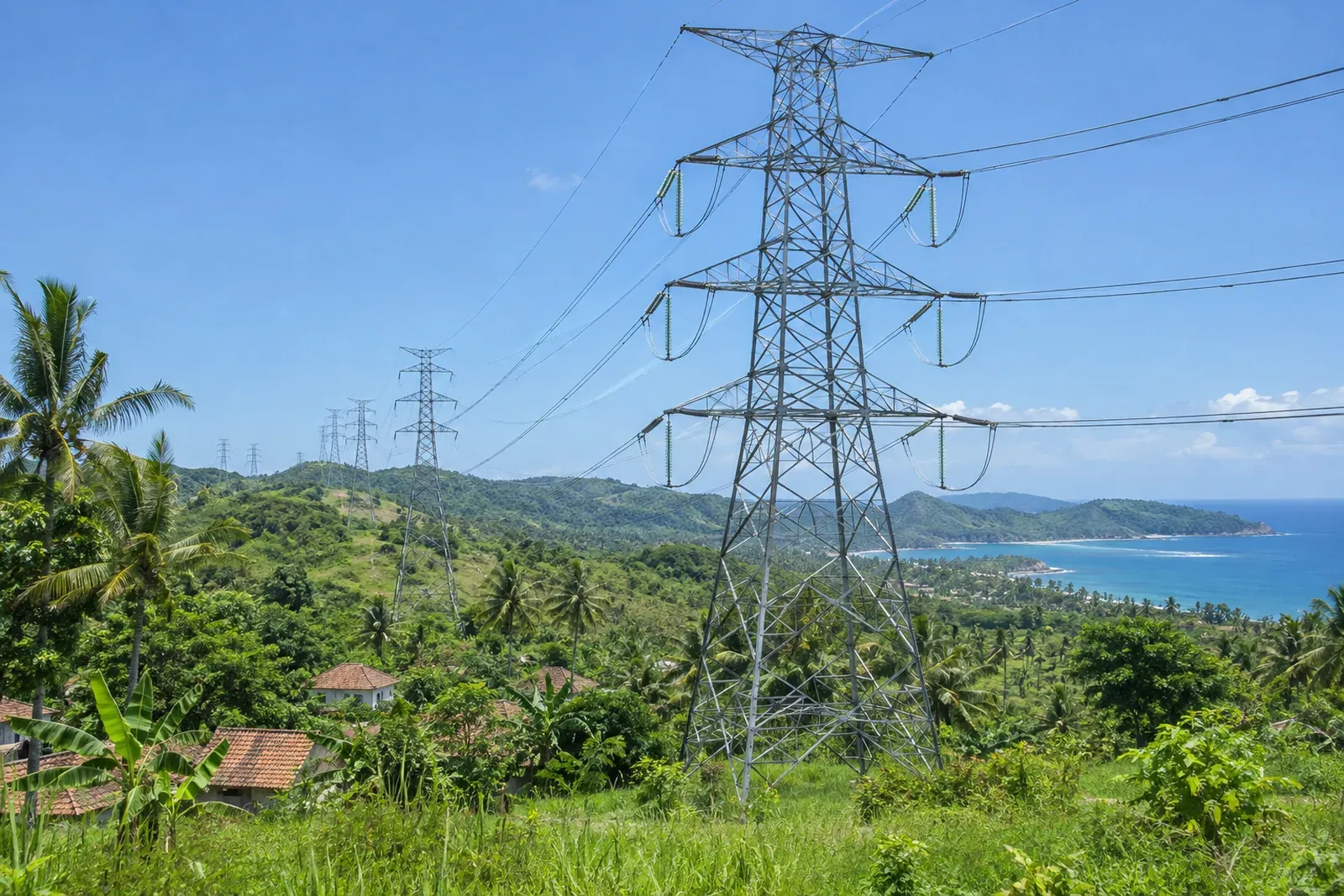
Energy security has historically presented an infrastructure challenge for archipelagic development. Under the new five-point framework, the three provinces are progressing an inter-island super grid project.
The initiative is currently finalizing its technical feasibility study before moving toward commercial stages with private infrastructure partners. By interconnecting provincial energy supplies, the tri-provincial grid aims to stabilize power delivery, integrate renewable energy potential across the Lesser Sunda Islands, and establish a resilient utility base capable of supporting modern hospitality and residential projects.
Regional leaders emphasized that government bodies must establish policy direction while allowing the private sector to drive implementation. Inter-provincial solidarity had previously been proven during emergency disaster coordination following an earthquake in Flores, NTT, when relief from Bali and NTB arrived within days. KRBNN formalizes that cross-border alignment into a permanent, structured platform.
What This Means for Investors
The formal integration of Bali, NTB, and NTT offers concrete advantages for foreign capital evaluating property and infrastructure assets in the Lesser Sunda region.
First, coordinated transport planning significantly improves accessibility for secondary markets. In South Lombok, prime tourist-zone land trades at approximately Rp 150-400 million per are (one are equals 100 square metres, or roughly USD 90-240 per square metre at approximately Rp 16,500 per USD). In contrast, equivalent land in Bali commands approximately USD 200-500 per square metre. The total land spread across South Lombok ranges from Rp 30 million to Rp 400 million per are, with prime Kuta commanding Rp 300-400 million per are (~$18,200-24,200 per are), Selong Belanak at Rp 150-250 million per are (~$9,100-15,200 per are), and Are Guling at Rp 120-180 million per are (~$7,300-10,900 per are).
Second, integrated regional logistics and shared utility planning directly address operational costs. When evaluating hospitality and residential rental returns, net performance depends heavily on operating margins. While developer-quoted gross yields in South Lombok often range between 12% and 22%, realistic net yields after deducting management fees (typically 18-22% of gross revenue), booking platform commissions (15-20%), and local taxes sit honestly between 7% and 12% under stabilised occupancy rates of 55% to 70%. Top-performing assets can reach approximately 15% net as exceptional outliers, but disciplined underwriting must account for realistic logistics and infrastructure costs.
Finally, the regulatory and institutional collaboration between regional governments signals greater policy stability. Foreign investors structuring property acquisitions through legal frameworks, such as a foreign investment company (PT PMA) holding a right-to-build title (Hak Guna Bangunan or HGB) or long-term leaseholds (Hak Sewa), benefit from standardized regional governance. Foreigners cannot hold freehold title (Hak Milik), which is strictly reserved for Indonesian citizens under national law.
As provincial authorities begin executing the five action plans across banking, transport, energy, trade, and regional planning, the Lesser Sunda Islands are moving toward a cohesive economic zone capable of attracting institutional scale investment.
Stay informed: subscribe to our free Lombok Briefing, published twice a month (the 1st and 15th), for analysis like this.
What is the KRBNN agreement between Bali, NTB, and NTT?
KRBNN is a tripartite regional cooperation pact between Bali, West Nusa Tenggara, and East Nusa Tenggara. It establishes five action plans covering integrated provincial banking, credit guarantee expansion for small enterprises, joint tourism transport including seaplanes, a cross-provincial energy super grid, and coordinated regional planning.
How does regional connectivity impact Lombok property yields?
Improved transport links drive visitor numbers, supporting realistic stabilised occupancy of 55% to 70%. While developers cite gross yields of 12% to 22%, honest net yields in South Lombok range from 7% to 12% after accounting for 18% to 22% management fees and booking commissions.
Can foreign investors own freehold land under this regional framework?
No. Indonesian land law strictly reserves freehold ownership (Hak Milik) for Indonesian citizens only. Foreign investors participate through compliant alternatives such as a PT PMA holding Hak Guna Bangunan (HGB), personal Hak Pakai with residency, or long-term leasehold agreements (Hak Sewa).

The Lombok Buyer's Field Guide
Legal structures ranked by risk, the honest ROI math line by line, all six zones ranked, and the 24-point due-diligence checklist. The whole book, free in your inbox.
See what's inside