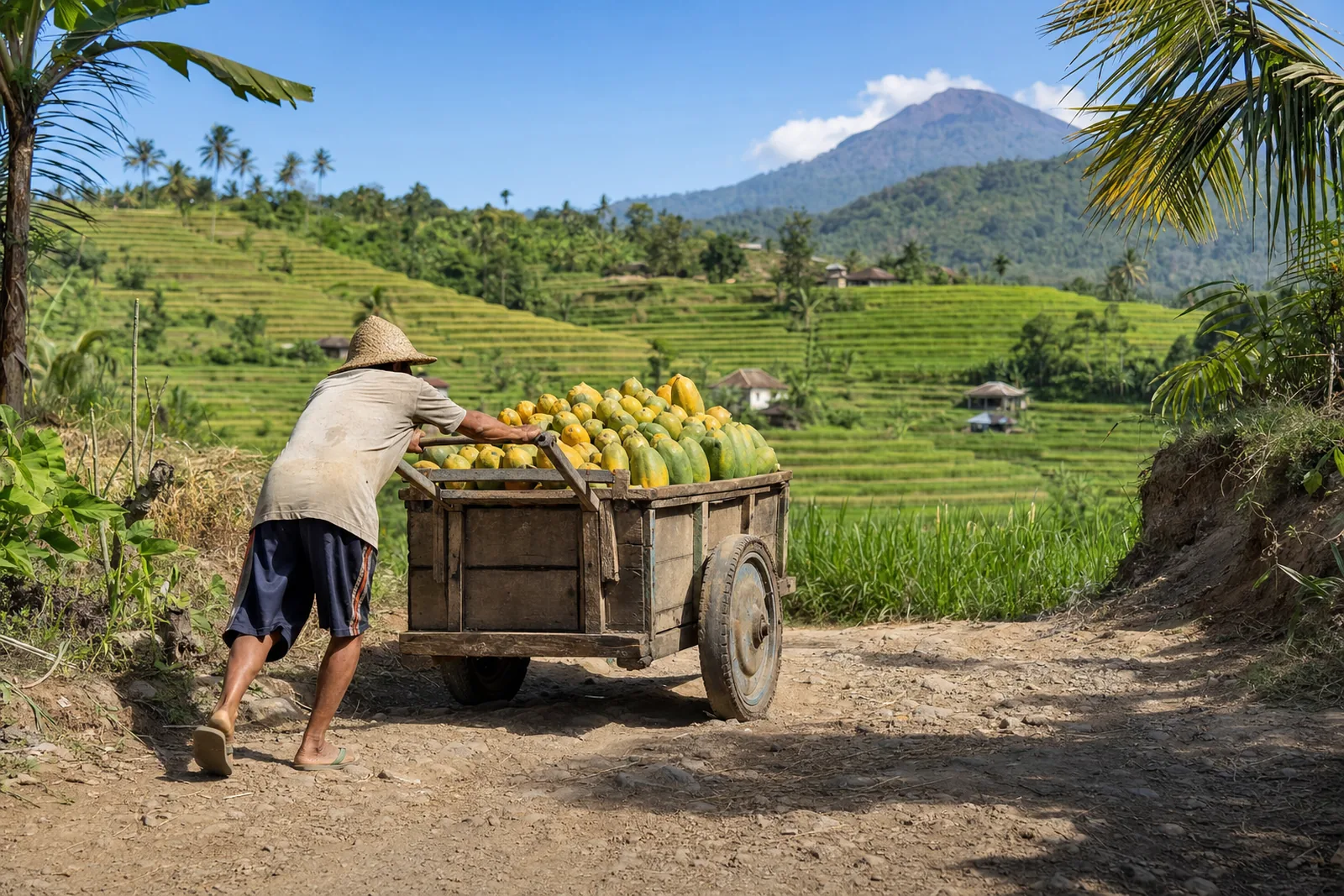
Daily Dispatch: Bali, NTB and NTT move to strengthen food supply links
A new Bali–NTB–NTT food-supply collaboration puts logistics, price visibility and agricultural land protection in focus for Lombok investors.
Quick answer: Bali, West Nusa Tenggara (NTB) and East Nusa Tenggara (NTT) are strengthening cross-provincial food-supply collaboration to help control inflation. For Lombok investors, the immediate significance is operational rather than transactional: food logistics, supply resilience and land-use policy have moved closer to the centre of the regional investment conversation.
The announcement from Tabanan is not a property-market intervention, nor does it change the legal route for buying in Lombok. It is nevertheless a useful live signal. In a tourism-led regional economy, the journey from farm to kitchen is part of the operating environment that owners, hospitality operators and developers must watch.
The Context
Deputy Home Affairs Minister Bima Arya said the priority is stronger coordination in food-supply distribution across Bali, NTB and NTT. Speaking at the Inflation Control and Food Prosperity Movement in Jatiluwih Tourism Village, he framed the collaboration around a straightforward regional proposition: production and distribution should be secure and well managed.
The three provinces are neighbours, but proximity alone does not guarantee a smooth supply chain. Arya identified connectivity as a shared constraint, with implications for logistics costs and production. That matters because the regional economies are shaped by tourism, food and micro, small and medium enterprises. The same strengths that make these places commercially attractive can also expose them to volatility when demand shifts or distribution becomes difficult.
“Both production and distribution remain challenging,” Arya said, noting the region’s reliance on tourism.
The policy logic is mutual support. A province with a surplus of a commodity can supply another experiencing a shortage; the direction of trade can reverse when circumstances change. Bali Regional Secretary Dewa Indra illustrated the potential complementarity: NTB is a major production centre for shallots and garlic, while Bali produces rice, including red and organic rice in the Jatiluwih area. He also said Bali distributes eggs and other food commodities to NTB and NTT.
This is a modest but important distinction for investors. The news is about the plumbing of a regional economy, not a promise of lower prices, higher margins or a new infrastructure project. No timetable, budget, price target or investment programme was announced in the Antara report. The dispatch should therefore be read as evidence of policy attention to an existing vulnerability, not as a basis for forecasting an outcome.
For owners and prospective operators in South Lombok, that framing is valuable. A villa can be well designed, well located and legally sound, yet still depend on a wider ecosystem of suppliers, staff, transport and local demand. The regional food system is one part of that ecosystem.
From Commodity Flows to Investor Due Diligence
Arya’s comments point to three practical areas: coordination between regions, better use of information technology to map price movements from upstream production through distribution, and protection of Sustainable Food Agricultural Land, known as LP2B, from conversion.
The first is the most immediate. Interregional cooperation recognises that food availability and food prices are not contained neatly within provincial borders. It suggests a more deliberate approach to matching supply with shortfalls across the Bali–NTB–NTT corridor. For an investor, the relevant question is not whether the announcement alone will transform supply conditions. It is whether an operator has a clear, locally grounded approach to sourcing and procurement.
The second area is visibility. Arya called for price fluctuations to be mapped from the upstream level through production and then integrated with relevant policymakers. The language is revealing. Supply problems are often discussed as if they begin at the point of sale; this approach places equal weight on what happens earlier in the chain. Yet Arya also acknowledged a coordination challenge: data is only useful when stakeholders can use it together.
The third area deserves particular care from property investors. Long-term protection for sustainable agricultural land is an explicit part of the discussion. That is not an instruction to avoid development, and the report does not identify specific sites or alter zoning. It is, however, a reminder that land is not simply a blank financial canvas. Its designation, permitted use, access and surrounding economic role require scrutiny before any commitment.
A disciplined buyer should distinguish between a regional policy announcement and the parcel-level checks that determine whether a transaction is viable. In Lombok, foreigners cannot hold freehold Hak Milik, or SHM; it is reserved for Indonesian citizens. Available routes include leasehold, Hak Pakai for qualifying residents, and a foreign-owned PT PMA holding Hak Guna Bangunan, or HGB. Nominee arrangements in which an Indonesian holds freehold on a foreigner’s behalf are illegal and void in court.
That legal discipline is especially relevant where agriculture, tourism and development meet. Buyers should have land certificates, ownership history, zoning and encumbrances independently examined. TerraNusa Advisory, HubLombok’s independent licensed-notary and legal advisory partner, supports foreign buyers through that chain, including due diligence, PT PMA setup, taxes, deed work and title transfer at BPN. Deeds are executed by a licensed PPAT notary; the deed of sale is known as an AJB.
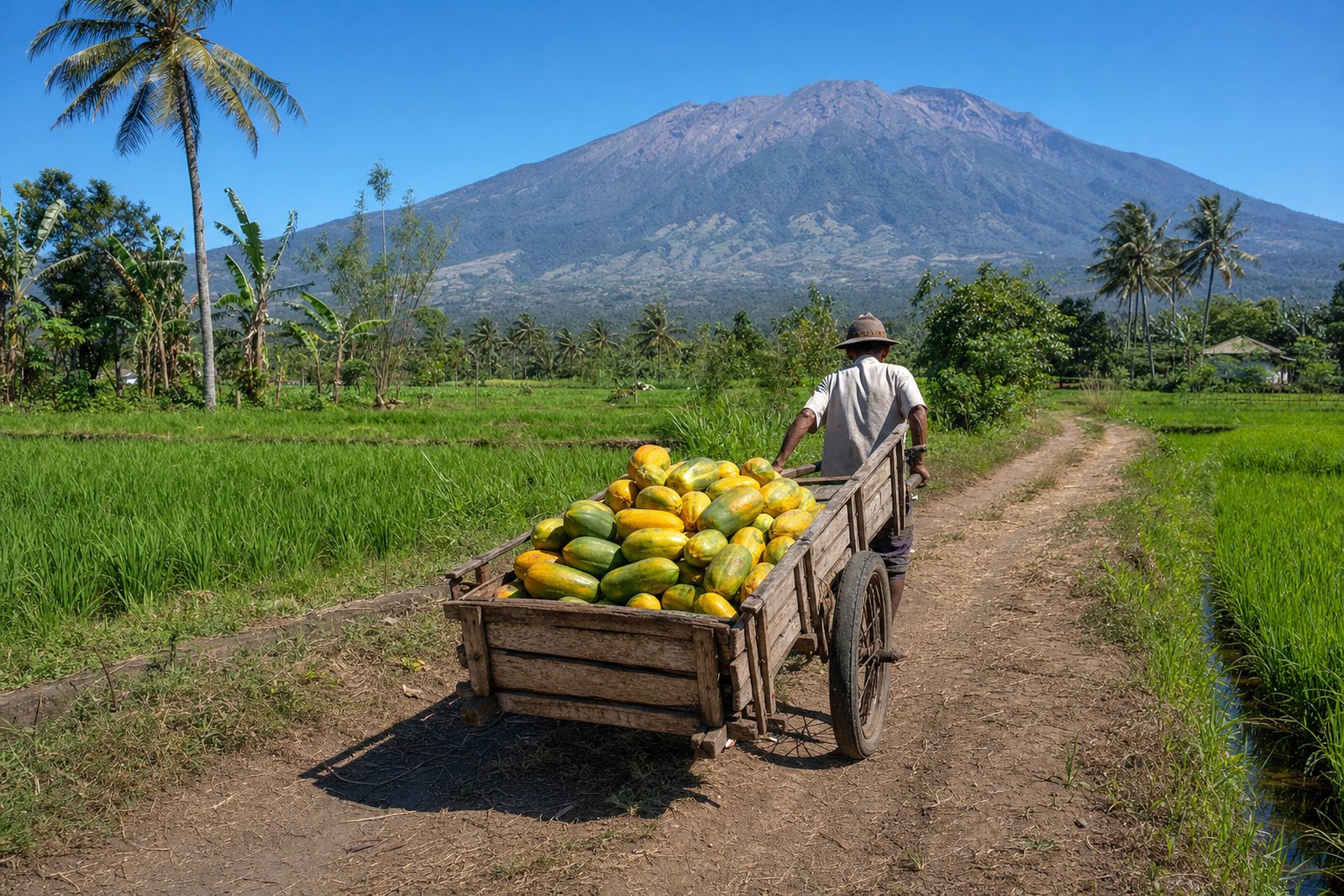 Daily Dispatch · Illustration: HubLombok (AI-generated)
A Regional Signal, Not a Market Forecast
It would be easy to turn a collaboration announcement into an oversized investment thesis. That would be a mistake. The Antara report does not say that inflation has fallen, that food costs will decline, or that the provinces have solved their connectivity challenge. It reports an effort to strengthen collaboration precisely because production, distribution and tourism-linked volatility remain active concerns.
The more useful reading is narrower. Public authorities are treating food distribution as a regional economic issue rather than a purely local one. That has relevance for places such as Lombok, where tourism and local enterprise coexist with agricultural production and where investor returns depend on the quality of day-to-day operations as much as on headline demand.
For hospitality investors, this is a prompt to ask better questions of a prospective manager or developer:
- Which food and consumable inputs are sourced locally, and which depend on deliveries from elsewhere?
- How are suppliers diversified when availability changes?
- Who monitors procurement costs and availability?
- Is there a clear plan for communicating operational pressures without disguising them as guaranteed returns?
- Have zoning and agricultural-land considerations been checked independently for the specific site?
These questions do not require a prediction about inflation. They are basic operating diligence. A strong answer will be specific to the asset, its location and its intended use, not a generic assurance that a region is “growing”.
The same restraint applies to rental analysis. South Lombok’s honest net rental-yield range is 7–12% after management fees and realistic occupancy, while developer-quoted gross yields of 12–22% exclude costs. Management fees are typically 18–22% of gross rental revenue, and OTA or booking commissions are 15–20%. These are market-context ranges, not a claim that the food-supply initiative will change them.
The point is instead that operating assumptions should be genuinely operational. Food supply, transport, staffing, maintenance, utilities, booking commissions and management all belong in the same underwriting conversation. Investors who treat a gross-yield headline as a complete answer are overlooking the texture of ownership.
What This Means for Investors
The immediate takeaway is attentiveness, not alarm. The Bali–NTB–NTT initiative acknowledges that supply distribution and connectivity matter to inflation control in a tourism-oriented regional economy. For investors considering Lombok exposure, it reinforces the value of local due diligence and transparent operating models.
There are several constructive elements in the report. The provinces have complementary agricultural capacities. Officials are discussing surplus-to-shortage flows rather than isolation. They are also identifying the need for information that follows price movements through the chain, and for the protection of sustainable agricultural land over the long term. Those are serious policy themes, even if the present announcement does not yet quantify delivery.
The risks should be kept equally clear. Regional collaboration does not remove logistics frictions by declaration. Technology does not automatically create coordination. And an investor cannot infer site-specific land rights, zoning permissions or future costs from a provincial-level statement. Each requires separate verification.
For buyers evaluating a Lombok property now, the practical sequence remains familiar:
- establish the appropriate legal structure before committing;
- obtain independent certificate, ownership-history, zoning and encumbrance checks;
- model net rather than gross income, including management and booking costs;
- ask operators how supply and procurement are managed in practice; and
- separate what officials have announced from what a contract, permit or operating plan actually provides.
HubLombok is the editorial arm of Samudra Villas, an active developer in Are Guling, South Lombok. That relationship does not alter the core conclusion of this dispatch: this is a regional economic-policy development, not an instruction to buy, sell or alter a particular investment.
The clearest value of today’s news lies in its reminder that investable places are systems. Lombok’s appeal may be shaped by a coastline, a villa or a tourism itinerary, but the durability of an investment also rests on less visible networks: food production, distribution, land governance and the institutions that connect them. The new Bali–NTB–NTT collaboration has placed those networks firmly on the day’s agenda.
Stay informed, subscribe to the free Lombok Briefing for market intelligence like this, published twice a month.
What did Bali, NTB and NTT announce on food supply?
Officials said Bali, West Nusa Tenggara and East Nusa Tenggara are strengthening collaboration on food-supply distribution to help control inflation. The approach includes interregional support when one area has a commodity surplus and another faces a shortage, alongside closer attention to price information and agricultural land.
Does this collaboration change how foreigners buy Lombok property?
No. The announcement concerns food-supply coordination and does not change foreign property rules. Foreigners cannot hold freehold Hak Milik or SHM. Buyers should use an appropriate legal structure, avoid illegal nominee arrangements and independently verify certificates, ownership history, zoning and encumbrances.
How should a Lombok hospitality investor respond to this news?
Treat it as an operational due-diligence signal, not a return forecast. Ask prospective managers how they source food and consumables, handle supply disruptions and monitor costs. Underwrite net income rather than promotional gross yield, including management fees and OTA or booking commissions.

The Lombok Buyer's Field Guide
Legal structures ranked by risk, the honest ROI math line by line, all six zones ranked, and the 24-point due-diligence checklist. The whole book, free in your inbox.
See what's inside