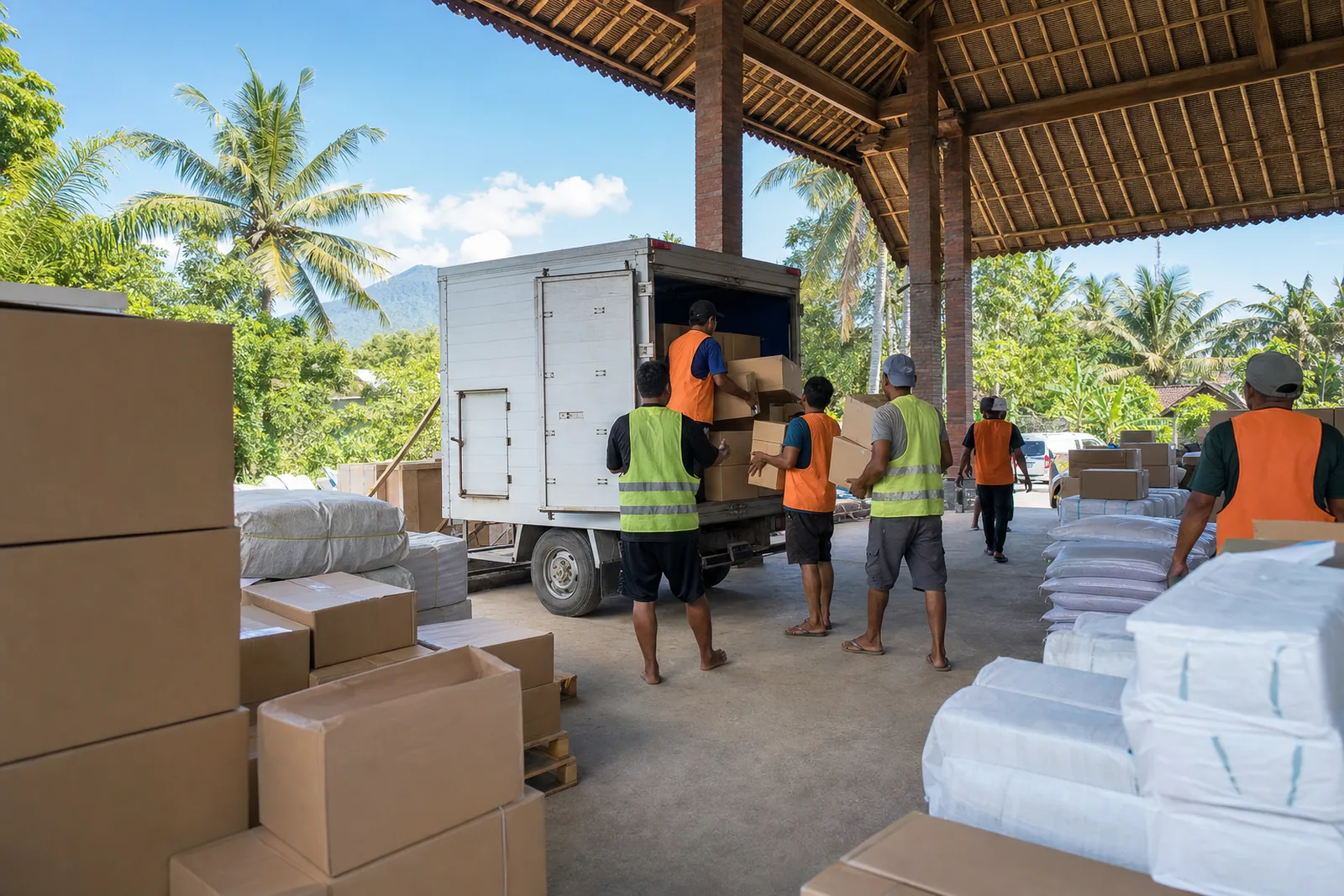
Bali Mobilises Relief Mission After Flores Earthquake
Bali has sent funding, relief personnel and medical support to earthquake-hit Flores, underscoring the operational reach of regional disaster response.
Quick answer: Bali’s provincial government has mobilised initial relief funding, five disaster-response personnel and medical support for communities affected by the magnitude 7.7 earthquake on Flores Island in East Nusa Tenggara. For Lombok investors, the immediate relevance is regional: monitor official updates, distinguish confirmed facts from assumptions, and ensure local operating plans can respond to disruption.
This is a live regional emergency rather than a Lombok market event. Yet the response matters to anyone with assets, guests, staff or supply relationships across Indonesia’s eastern islands: Bali’s disaster agency is already on Flores, buying supplies locally, supporting evacuation centres and assessing what affected communities need next.
The Context
Bali’s provincial government has activated a practical, on-the-ground relief operation following Saturday’s earthquake on Flores Island, in East Nusa Tenggara (NTT). According to Antara Current, Governor Wayan Koster instructed Bali’s Regional Disaster Mitigation Agency, known as BPBD, to deploy an advance team after the earthquake.
The reported magnitude was 7.7. That figure establishes the seriousness of the event; it does not, by itself, describe conditions in every affected locality. For investors and operators, that distinction is important. In the first hours of a disaster, the useful discipline is to follow official deployment and relief information, rather than to extrapolate operational consequences beyond what has been confirmed.
Bali BPBD Executive Chief I Gede Agung Teja Bhusana Yadnya said the agency had allocated Rp150 million, described by Antara as more than US$8,300, as initial funding to procure and deliver relief supplies. The team was in Ende District, procuring goods from local businesses while the procurement process continued.
The deployment is geographically focused on Flores, not South Lombok. The source does not report damage, transport disruption or tourism effects in Lombok, and none should be inferred from Bali’s relief mission. The relevance for the wider investment community lies instead in the regional operating environment: disaster response depends on reliable local coordination, practical procurement and the capacity to move people and essential items where they are needed.
“The procurement process is still underway,” Yadnya said, according to Antara.
That brief update carries a larger message. Relief work is not a single delivery but a sequence: establish a team on site, assess needs, obtain appropriate supplies, consolidate them and distribute them through the local response system. It is the unglamorous part of emergency management, but it is also the part that determines whether aid reaches households in usable form.
For owners of hospitality or real-estate assets in the region, the sensible immediate question is not whether an unreported market consequence exists. It is whether their own operating arrangements are clear enough to handle a fast-moving regional incident: who communicates with guests, who verifies information, who checks staff welfare, and which local partners can provide dependable updates.
From Advance Team to Relief Supplies
The Bali BPBD advance team has arrived on Flores and has begun delivering initial assistance while assessing community needs. Antara reports that the team arrived first in Maumere and was subsequently in Ende to procure and distribute supplies.
The items being procured and consolidated are a concise picture of the needs relief agencies expect to meet in evacuation settings:
- ready-to-eat meals;
- cooking oil;
- bottled water;
- diapers;
- hygiene kits;
- mattresses;
- tarpaulins; and
- blankets.
Distribution is planned through a command post. This is significant because it places delivery within a coordinated relief structure, rather than presenting assistance as an isolated donation exercise. A command-post route can help match supplies to verified local needs as assessments develop.
The initial allocation should also be read accurately. It is funding for procurement and delivery of relief supplies, not a complete statement of the total resources that may eventually be used in the response. Antara describes it expressly as initial funding. In a developing emergency, investors should avoid treating an early allocation as either a final measure of need or a forecast of the wider economic impact.
| Confirmed response element | What Antara reports | |---|---| | Initial funding | Rp150 million for procuring and delivering relief supplies | | Personnel deployment | Five BPBD personnel instructed to deploy | | Field locations named | Maumere, Ende, Sikka District and Nagekeo District | | Relief route | Distribution through a command post |
The operational choice to purchase supplies from local businesses in Ende is also a specific fact worth noting. It shows the response moving through local procurement while the agency evaluates actual needs. It should not be over-read as a broader economic conclusion; the source does not make one. But it is a reminder that, in a crisis, local knowledge and available supply channels become central to the response.
For property investors, this is the point at which governance becomes tangible. A professionally managed asset is not merely a building with an occupancy plan. It is an operation with defined contacts, a communications chain and a credible local team that can respond to an event without relying on rumours or distant decision-making.
 Bali Mobilises Relief Mission After Flores Earthquake · Illustration: HubLombok (AI-generated)
Medical Support and the Wider Flores Operation
Bali has also deployed medical personnel. Antara reports that a medical team had already joined relief operations in Sikka District, while additional emergency medical teams were planned to address healthcare needs in Nagekeo District, where the epicentre was located.
The response extends beyond supplies and medical care. Disaster-response personnel from Bali have also been involved in search-and-rescue activity and in distributing relief supplies to evacuation centres across seven districts on Flores Island.
That breadth is worth separating into its component parts. Search and rescue serves an immediate life-safety function. Medical support addresses healthcare needs. Relief distribution helps sustain displaced communities. Assessment informs subsequent decisions. These are related but distinct tasks, and the source indicates that Bali personnel are participating across them.
Yadnya emphasised that disaster victims should receive equal assistance and treatment regardless of origin. In a region with strong inter-island connections, that principle is more than a statement of goodwill. It frames the response as directed at affected people and verified needs, rather than at a narrow local constituency.
For investors accustomed to analysing developments through prices, yields and demand trends, a disaster dispatch calls for a different standard of attention. The important information is operational and human: where teams are deployed, what they are delivering, where medical support is being directed and how official agencies describe the next stage of work.
It is equally important to recognise the limits of the current record. Antara reports the Bali government’s actions and the locations named by its BPBD chief. It does not provide a verified assessment of consequences for Lombok property, visitor flows, asset values or construction activity. An authoritative investor response should preserve that boundary.
This is particularly relevant in a market where regional narratives can travel quickly. A responsible briefing does not turn a humanitarian emergency into an unsupported market thesis. It identifies the confirmed facts, explains why operational preparedness matters and leaves forecasts until evidence exists.
What This Means for Investors
The immediate priority remains relief for communities affected on Flores. For Lombok-based investors, developers and accommodation operators, the practical implication is preparedness rather than speculation.
First, keep communications factual. If guests, staff or partners ask about the event, refer to confirmed official reporting and do not claim effects in locations that have not been reported. Clear communication protects both people and reputation during a fast-moving event.
Second, review local operational readiness. This does not require a dramatic overhaul. It means knowing who has responsibility for staff welfare, guest communication, supplier contact and local updates if conditions change. A plan is useful only if the people expected to use it can locate it and act on it.
Third, distinguish regional resilience from a market prediction. Bali’s mobilisation demonstrates that provincial disaster-response personnel, medical teams and relief procurement can be deployed to Flores. It does not establish a conclusion about investment performance in Lombok. Investors should resist the temptation to convert a current emergency into a pricing narrative.
Fourth, watch for verified developments. The facts currently reported are specific: initial funding, personnel deployment, local procurement, medical support, search-and-rescue involvement and relief distribution across seven districts. Future assessments may add to that picture, but they should be evaluated when they are reported, not anticipated as fact.
The most useful investor posture is therefore calm, attentive and proportionate. Support credible relief information; check the welfare and readiness of any teams within your own operating network; and keep investment decisions anchored to evidence. The live story is Bali’s assistance to Flores, where response work is still being organised and delivered.
For HubLombok readers, that is the essential dispatch: a serious earthquake has prompted a cross-island emergency response, and Bali’s BPBD is already procuring and distributing essential supplies while medical and disaster-response personnel support affected districts. The human response comes first. Sound investor practice follows from the same principle: act on what is confirmed, prepare for what is within your control, and avoid turning uncertainty into assertion.
Stay informed, subscribe to the free Lombok Briefing for market intelligence like this, published twice a month.
What aid has Bali sent after the Flores earthquake?
Bali’s BPBD allocated initial funding of Rp150 million to procure and deliver relief supplies, deployed five personnel, and sent medical support. Reported supplies include ready-to-eat meals, bottled water, hygiene kits, mattresses, tarpaulins and blankets for distribution through a command post.
Does this report confirm an impact on Lombok property or tourism?
No. The report concerns Bali’s response to communities affected on Flores Island in East Nusa Tenggara. It does not provide verified information about effects on Lombok property values, visitor flows, construction activity or tourism operations, so those conclusions should not be assumed.
Which Flores areas are included in Bali’s reported response?
Antara reports Bali BPBD personnel in Maumere and Ende, medical support in Sikka District, planned additional medical teams for Nagekeo District, and relief distribution to evacuation centres across seven districts on Flores Island.

The Lombok Buyer's Field Guide
Legal structures ranked by risk, the honest ROI math line by line, all six zones ranked, and the 24-point due-diligence checklist. The whole book, free in your inbox.
See what's inside